
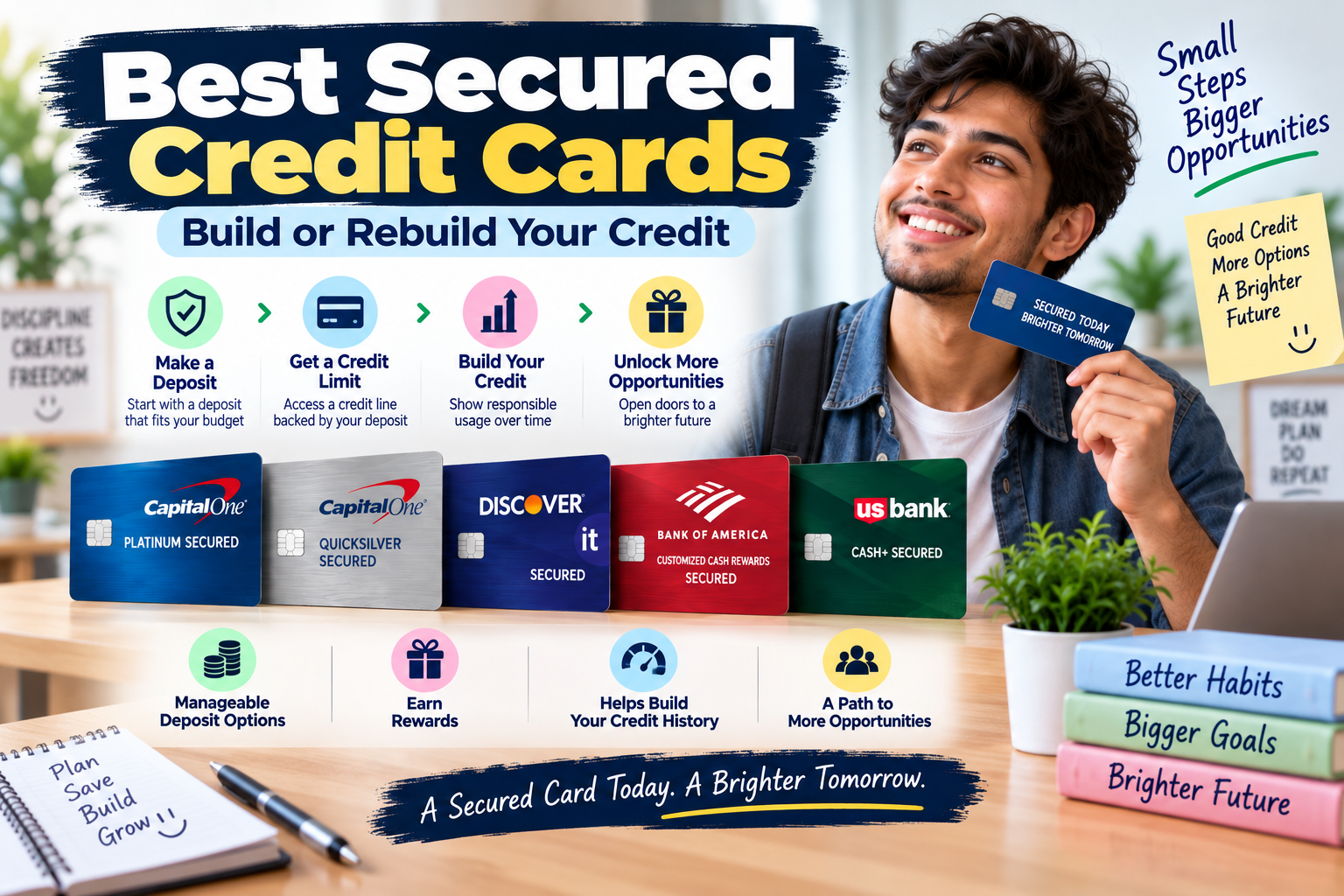
Finding the best secured credit cards can be helpful if you have limited credit history, poor credit, or difficulty qualifying for a traditional unsecured credit card. Secured cards generally require a refundable security deposit, which helps the issuer manage lending risk while giving you access to a credit line.

Unlike prepaid debit cards, secured credit cards involve borrowing money. When the issuer reports your account activity to the credit bureaus, responsible use—including on-time payments and manageable balances—can help you establish or rebuild credit.
The right secured card should have reasonable fees, transparent deposit requirements, credit-bureau reporting, and a practical path toward stronger credit.
Quick Answer: What Are the Best Secured Credit Cards?
The most useful secured credit cards to compare in 2026 include options from Capital One, Discover, Bank of America, and other issuers. The right choice depends on your deposit budget, rewards preferences, annual fees, and credit-building goals.
| Secured Credit Card | Best For | Annual Fee | Key Feature |
|---|---|---|---|
| Capital One Platinum Secured | Flexible deposit options | $0 | Potentially lower deposit for eligible applicants |
| Capital One Quicksilver Secured Cash Rewards | Simple cash back | $0 | 1.5% cash back on purchases |
| Discover it® Secured Cash Back | Rewards and credit building | $0 | Cash back and refundable deposit |
| Bank of America® Customized Cash Rewards Secured | Category rewards | $0 | Cash back in selected categories |
| Bank of America® Unlimited Cash Rewards Secured | Flat-rate rewards | $0 | Unlimited cash back |
| U.S. Bank Cash+® Secured Visa | Category flexibility | Varies | Select spending categories |
| Credit One Bank Secured Card | Credit-building alternative | Varies | Cash back on eligible purchases |
| OpenSky® Secured Visa | Applicants seeking another option | Varies | Secured credit-building product |
Important: Card availability, annual fees, deposits, APRs, rewards, and approval criteria can change. Confirm the current terms directly with the issuer before applying.
1. Capital One Platinum Secured — Best for Deposit Flexibility
The Capital One Platinum Secured Credit Card is worth considering if you want a secured card but may not be able to provide a large deposit immediately.
Capital One has offered deposit requirements of $49, $99, or $200 for eligible applicants, depending on creditworthiness. The initial credit line is at least $200, and the card has a $0 annual fee according to current comparison information.
Why consider it?
- $0 annual fee
- Deposit flexibility for eligible applicants
- Designed for building or rebuilding credit
- Potential credit-line increases
- Possible transition to an unsecured card
Best for:
Applicants who want to explore a secured card with potentially lower initial deposit requirements.
2. Capital One Quicksilver Secured Cash Rewards — Best for Simple Cash Back
The Capital One Quicksilver Secured Cash Rewards card combines secured credit-building features with cash-back rewards.
Current comparisons list a $0 annual fee and 1.5% cash back on everyday purchases, with a higher reward rate for eligible bookings through Capital One Travel.
Why consider it?
- $0 annual fee
- 1.5% cash back on purchases
- Deposit-backed credit line
- Rewards while building credit
- Potential upgrade opportunities
Best for:
People who want cash-back rewards without tracking multiple spending categories.
3. Discover it® Secured Cash Back — Best for Rewards and Credit Building
The Discover it Secured Cash Back card combines a refundable security deposit with cash-back rewards.
Discover currently advertises a refundable deposit as low as $49, depending on creditworthiness, and a $0 annual fee. The card offers up to 5% cash back in rotating categories when activated, plus 1% on other purchases.
Discover also advertises an unlimited dollar-for-dollar Cashback Match for the first year under its current offer.
Why consider it?
- $0 annual fee
- Refundable deposit
- Cash-back rewards
- No credit score required to apply, according to Discover
- Potential upgrade to an unsecured Discover card
Important availability note:
Some third-party sources report changes in the card’s application availability. Check Discover’s official application page before publishing or recommending this card as currently available.
Best for:
People looking for a secured card with rewards and a potential upgrade path.
4. Bank of America® Customized Cash Rewards Secured — Best for Category Rewards
The Bank of America Customized Cash Rewards Secured Credit Card is designed for people who want a secured credit card with category-based rewards.
Forbes Advisor currently lists this card among secured-card options with no annual fee and the ability to earn rewards in selected categories.
Why consider it?
- Secured credit-building structure
- No annual fee according to current comparison information
- Category-based rewards
- Potential option for applicants who want rewards while building credit
Best for:
Applicants who want to compare secured cards with category-based cash back.
Always verify the current deposit, rewards, and approval terms directly with Bank of America.
5. Bank of America® Unlimited Cash Rewards Secured — Best for Flat-Rate Cash Back
A flat-rate rewards card may be easier to manage than a card requiring you to track bonus categories.
The Bank of America Unlimited Cash Rewards Secured card appears in current secured-card comparisons as an option for consumers seeking cash-back rewards.
Why consider it?
- Secured credit-building structure
- Flat-rate rewards
- May be suitable for everyday spending
- Can be compared with other no-annual-fee secured cards
Best for:
People who prefer simple rewards rather than rotating or selected categories.
Check the issuer’s current terms for the precise reward rate, deposit, and eligibility requirements.
6. U.S. Bank Cash+® Secured Visa® Card — Best for Category Flexibility
The U.S. Bank Cash+ Secured Visa is another secured-card option listed in current market comparisons.
Forbes Advisor identifies it as a secured card offering category-selection features.
Why consider it?
- Secured credit-building option
- Category-based rewards structure
- May suit applicants who want greater control over reward categories
Best for:
Consumers who want to explore flexible cash-back categories while building credit.
Review the current annual fee, deposit, rewards limits, and approval criteria before applying.
7. Credit One Bank Secured Card — Best for Comparing Alternative Options
Credit One Bank offers secured-card products that may be worth comparing with other issuers.
Experian’s current secured-card marketplace lists a Credit One Bank secured card with cash-back rewards on eligible categories.
Why consider it?
- Secured credit-building structure
- Rewards on eligible purchases
- Another issuer to compare if other applications are unsuccessful
Pay attention to:
- Annual fee
- APR
- Foreign transaction fees
- Deposit requirements
- Other account charges
- Credit-reporting practices
Best for:
Applicants who want to compare additional secured-card options rather than applying to only one issuer.
8. OpenSky® Secured Visa — Best for Exploring More Secured Options
OpenSky is another name that appears in secured-card comparisons.
Some OpenSky products are designed for consumers who want to establish or rebuild credit through a deposit-backed credit line.
Why consider it?
- Secured credit-building structure
- Alternative issuer to research
- May be useful for applicants comparing different approval requirements
Best for:
People who want to explore additional secured-card products, particularly when comparing fees and application requirements.
Review the specific product’s current terms before applying.
Best Secured Credit Cards by Situation
| Your Situation | Option to Research |
|---|---|
| Want a potentially lower deposit | Capital One Platinum Secured |
| Want simple cash back | Capital One Quicksilver Secured |
| Want rewards and an upgrade path | Discover it Secured |
| Want category-based rewards | Bank of America Customized Cash Rewards Secured |
| Prefer flat-rate cash back | Bank of America Unlimited Cash Rewards Secured |
| Want category flexibility | U.S. Bank Cash+ Secured |
| Want to compare alternative issuers | Credit One Bank Secured |
| Need additional secured-card options | OpenSky Secured Visa |
This table is a comparison framework, not a guarantee of approval or a ranking of issuers.
What Is a Secured Credit Card?
A secured credit card is a credit card that generally requires a refundable cash security deposit.
The deposit helps protect the issuer if the account holder fails to repay the balance. Your credit limit may be equal to or related to the deposit, depending on the card’s terms.
Example
Suppose you open a secured credit card with:
- Security deposit: $200
- Credit limit: $200
- Monthly spending: $50
- Statement balance: $50
If you pay the full $50 statement balance by the due date, you can use the card responsibly without carrying a balance into the next billing cycle.
Your deposit is not the same as a payment toward your monthly bill. You still need to make your required credit-card payments.
How Does a Secured Credit Card Help Build Credit?
A secured credit card can help establish or rebuild credit when the issuer reports account activity to credit bureaus and you manage the account responsibly.
Important habits include:
- Paying on time every month.
- Keeping balances manageable.
- Avoiding unnecessary late fees.
- Monitoring credit reports for errors.
- Avoiding spending beyond your repayment ability.
The CFPB explains that responsible credit activity and positive payment history can support the development of a stronger credit history.
Secured vs. Unsecured Credit Cards
| Feature | Secured Card | Unsecured Card |
|---|---|---|
| Security deposit | Usually required | Usually not required |
| Credit limit | Often connected to deposit | Based on issuer’s assessment |
| Credit building | Possible with responsible use | Possible with responsible use |
| Rewards | Some cards offer rewards | Many cards offer rewards |
| Upgrade potential | Some offer possible upgrades | Not applicable in the same way |
| Approval | May be accessible to some applicants with limited credit | Depends on credit profile and issuer |
A secured card isn’t automatically better or worse than an unsecured card. Your eligibility, financial situation, fees, and long-term goals matter.
How Much Security Deposit Do You Need?
The required deposit depends on the issuer and your application.
Some cards require a minimum deposit of $200, while others may offer lower deposit amounts to eligible applicants. Discover and Capital One have advertised deposit flexibility on selected secured products.
Before applying, check:
- Minimum deposit
- Maximum deposit
- Whether the deposit is refundable
- Credit limit associated with the deposit
- Whether you can increase your credit limit
- How and when your deposit can be returned
Never assume that every secured card has the same deposit policy.
How to Choose the Best Secured Credit Card
1. Annual Fee
A $0 annual fee can help reduce the cost of building credit.
If a card charges an annual fee, compare it with the available features and alternatives.
2. APR
Secured cards can have high interest rates.
If possible, pay the statement balance in full to avoid unnecessary interest charges on purchases.
3. Credit-Bureau Reporting
Look for an issuer that reports account activity to the major credit bureaus.
Reporting practices can differ, so confirm the issuer’s policy before applying.
4. Deposit Requirements
A $200 deposit may be manageable for one applicant but unaffordable for another.
Choose a deposit that doesn’t interfere with essential expenses or emergency savings.
5. Upgrade Opportunities
Some secured cards may allow you to transition to an unsecured product after responsible account management.
However, an upgrade is not guaranteed and the review process differs by issuer.
6. Rewards
Rewards are useful only when the card’s costs and terms make sense for your situation.
Don’t choose a card solely because it advertises a high reward rate.
Can You Get a Secured Credit Card With Bad Credit?
Yes, some secured cards are designed for consumers who are building or rebuilding credit.
However, secured cards are not guaranteed-approval products. Issuers may still review your credit history, income, identity, existing obligations, and other information.
A security deposit reduces some of the issuer’s risk, but it doesn’t eliminate all eligibility requirements.
Can You Get a Secured Credit Card Without Credit History?
Some secured cards may accept applicants with no established credit history.
For example, Discover currently states that no credit score is required to apply for its secured card, although the issuer may use a credit score if one is available.
Approval depends on the issuer’s current application criteria.
How Long Does It Take to Build Credit With a Secured Card?
There is no guaranteed timeline.
Your credit profile can change as the issuer reports payment history, account balances, and other information. The result depends on your complete credit profile and the scoring model used.
To support healthy credit habits:
- Make payments on time.
- Keep balances low relative to your limit.
- Avoid repeated applications.
- Monitor your credit reports.
- Maintain responsible financial habits over time.
Common Mistakes to Avoid
Choosing a card only because approval seems easy
Review the complete terms before applying.
Ignoring annual and monthly fees
Fees can reduce the value of a secured card, particularly when your credit limit is small.
Using the entire credit limit
A high balance relative to your limit can negatively affect credit utilization.
Carrying a balance to build credit
You generally don’t need to pay interest to build credit.
Assuming an upgrade is guaranteed
Some issuers offer upgrade opportunities, but the timing and eligibility requirements vary.
Using emergency savings for the deposit
Only commit money you can reasonably leave tied up in the card account.
Frequently Asked Questions
What are the best secured credit cards?
The best secured credit card depends on your deposit budget, fees, rewards preferences, and credit-building goals. Options to research include Capital One Platinum Secured, Capital One Quicksilver Secured, Discover it Secured, and selected Bank of America secured cards.
Are secured credit cards good for rebuilding credit?
They can be useful because they provide a credit account that may report activity to credit bureaus. Responsible use, including on-time payments and manageable balances, is important for building a positive credit history.
How much money do I need for a secured credit card?
The amount depends on the issuer and your eligibility. Some cards require deposits around $200, while certain products may offer lower deposit amounts for eligible applicants.
Do you get your secured credit-card deposit back?
A deposit is generally refundable when you close the account in good standing or qualify for an issuer-approved upgrade, subject to the card’s terms. Your deposit may be used to cover unpaid obligations if you default.
Can a secured credit card improve my credit score?
Responsible use may help improve or establish your credit profile when account activity is reported to the credit bureaus. Results depend on your overall credit history, payment behavior, balances, and other factors.
Is a secured credit card better than a regular credit card?
Not necessarily. A secured card may be useful when you have limited approval options, while an unsecured card may avoid the need for a security deposit. Compare fees, APR, rewards, and eligibility.
Can I get a secured credit card with a 500 credit score?
Possibly. Some secured cards are designed for people with poor credit, but approval is not guaranteed. Issuers may consider factors beyond your credit score.
Does a secured credit card have an annual fee?
Some secured credit cards have a $0 annual fee, while others charge annual or monthly fees. Always check the specific card’s current pricing and terms.
How quickly can I graduate from a secured credit card?
There is no universal timeline. Some issuers periodically review accounts, while others may provide upgrade opportunities under specific conditions. An upgrade is not guaranteed.
Can I use a secured credit card internationally?
It depends on the card network, issuer, and foreign transaction fees. Check whether the card is accepted in your destination and whether international purchases incur additional charges.
Final Takeaway
The best secured credit cards are those that offer manageable fees, reasonable deposit requirements, credit-bureau reporting, and features aligned with your financial goals.
Capital One Platinum Secured may be worth researching for deposit flexibility, while Capital One Quicksilver Secured can appeal to people who want cash-back rewards. Discover and Bank of America also offer secured-card products or options that should be checked against current issuer terms.
Before applying, compare the deposit, annual fee, APR, rewards, reporting practices, and upgrade policy.
A secured credit card is not a shortcut to excellent credit. But when used responsibly, it can become a useful foundation for building a stronger credit history.
Why Maintain Market Is Different
At Maintain Market, we explain secured credit cards through practical comparisons rather than focusing only on promotional rewards.
We highlight deposit requirements, fees, credit-building features, approval considerations, and long-term account management so readers can evaluate their options more carefully.
Credit-card terms can change, so always verify the current details directly with the issuer before applying.
References
- CFPB – Secured Credit Cards
- Capital One Platinum Secured Card
- Capital One Quicksilver Secured Card
- Discover it Secured Credit Card
- Bank of America Secured Credit Card
- U.S. Bank Secured Visa Card
Editorial Review
Reviewed for: U.S. secured credit-card information, deposit requirements, credit-building guidance, fees, rewards, approval considerations, and responsible credit use.
This article is educational and does not constitute financial advice. Credit-card approval, APRs, fees, rewards, and eligibility vary by issuer and applicant.