
Understanding the credit score needed to buy a car can help you prepare for auto financing and avoid expensive borrowing costs. There is no universal minimum credit score required to purchase a vehicle, but your credit score can influence your approval chances, interest rate, down payment requirements, and loan terms.
Whether you are purchasing a new car, buying a used vehicle, or applying with bad credit, this guide explains what lenders consider and how to prepare before visiting a dealership.
Quick Answer: You may qualify for a car loan with a low credit score, but a credit score around 661 or higher may improve your chances of receiving more competitive terms. A FICO Score of 670 or higher is generally considered good. Lenders also evaluate income, debt, down payment, vehicle type, and repayment history.
What Credit Score Do You Need to Buy a Car?
There is no single credit score that guarantees auto loan approval.
Different lenders use different eligibility requirements and credit scoring models. Some lenders serve borrowers with excellent credit, while others specialize in financing applicants with limited or poor credit histories.
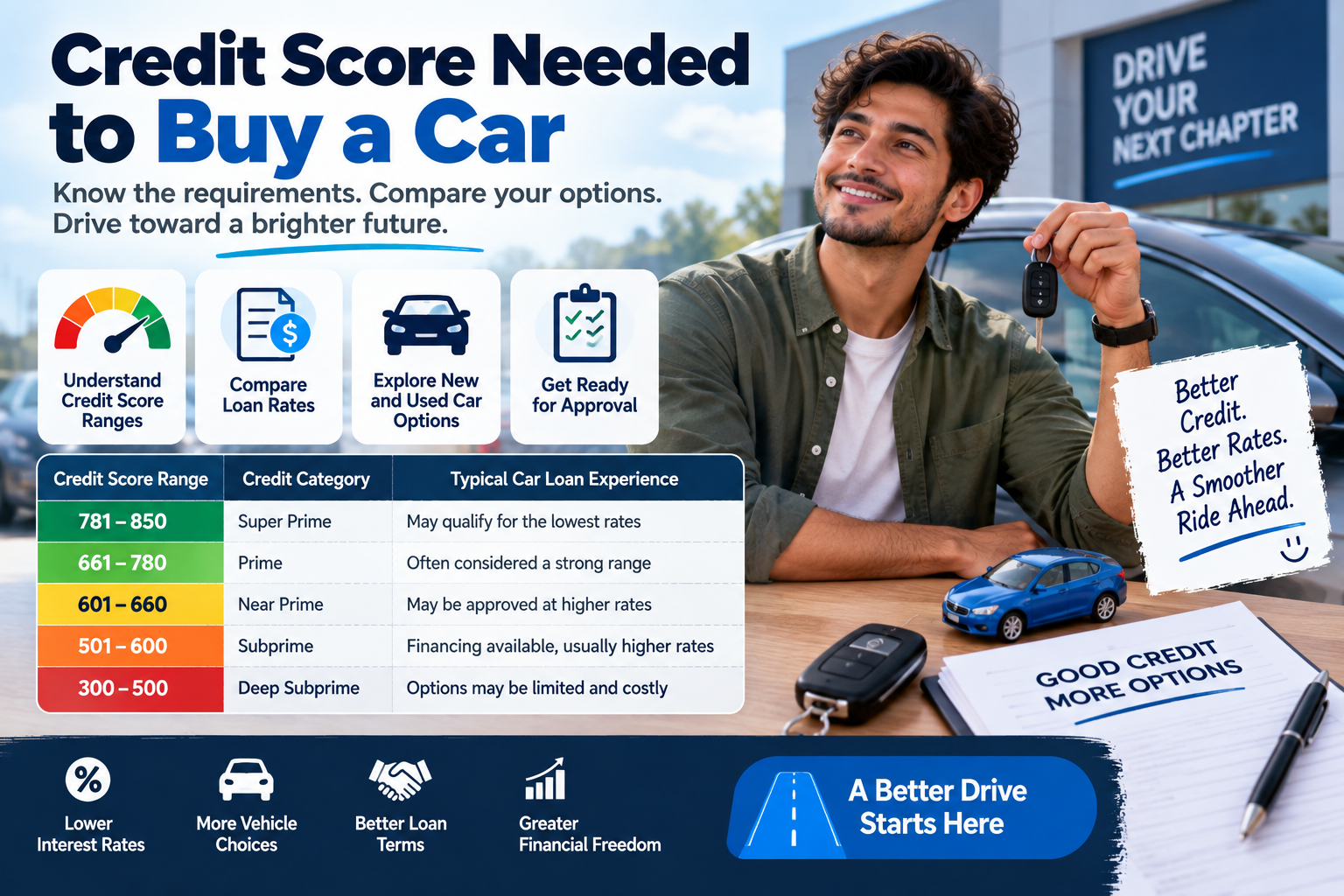
As a general guide:
| Credit Score Range | General Credit Category | Potential Auto Financing Experience |
|---|---|---|
| 781–850 | Super prime | May qualify for competitive rates |
| 661–780 | Prime | Often considered a stronger borrowing range |
| 601–660 | Near prime | Approval may be available at higher rates |
| 501–600 | Subprime | Financing may be more expensive |
| 300–500 | Deep subprime | Options may be limited and costly |
These ranges are based on the VantageScore categories used in Experian’s Q2 2026 auto lending data. Credit categories and lender requirements vary.
Important: Your credit score is only one part of an auto lender’s decision.
Is a 600 Credit Score Enough to Buy a Car?
A 600 credit score may be sufficient for some auto loans, but approval and terms depend on the lender and your overall financial profile.
With a score around 600, you may encounter:
- Higher interest rates
- Larger down payment requirements
- More limited lender choices
- Restrictions on vehicle age or mileage
- Higher monthly payments
- Requests for proof of income or employment
Some lenders specialize in subprime financing, but you should compare the total cost of borrowing rather than focusing only on approval.
What can improve your application?
- A larger down payment
- Stable income
- Lower existing debt
- A reasonably priced vehicle
- A qualified co-signer, where appropriate
- A history of making payments on time
Do not accept an unaffordable loan simply because a lender approves your application.
Is a 700 Credit Score Good Enough to Buy a Car?
A 700 credit score is generally within the prime range for many credit scoring systems and may help you qualify for competitive auto financing.
However, the interest rate you receive can still depend on:
- Whether the vehicle is new or used
- Loan duration
- Your income
- Debt-to-income ratio
- Down payment
- Lender policies
- Current market interest rates
A 700 score does not guarantee the lowest available rate. Compare multiple offers before making a decision.
Average Car Loan Interest Rates by Credit Score
Experian’s Q2 2026 data provides average auto loan APRs by VantageScore category.
| Credit Score Range | Average New Car APR | Average Used Car APR |
|---|---|---|
| 781–850 | 4.41% | 6.29% |
| 661–780 | 6.15% | 8.81% |
| 601–660 | 9.71% | 13.93% |
| 501–600 | 13.52% | 19.10% |
| 300–500 | 16.11% | 21.62% |
Source: Experian, State of the Automotive Finance Market, Q2 2026.
These are historical average rates for specific credit groups, not guaranteed offers. Your actual APR may be higher or lower.
Why used-car loans may have different rates
Lenders consider factors such as:
- Vehicle age
- Vehicle value
- Loan amount
- Expected resale value
- Borrower credit history
- Loan term
A used vehicle may have a lower purchase price, but its financing rate can still be higher depending on the lender and vehicle.
10 Factors That Affect Your Car Loan Approval
1. Your Credit Score
Your credit score helps lenders assess your credit risk. Higher scores may improve your chances of receiving favorable terms, but lenders may use different scoring models.
Some auto lenders use specialized FICO Auto Scores, which may place additional emphasis on previous auto loan repayment behavior.
2. Your Income and Employment
Lenders may want to confirm that you have enough reliable income to make your monthly payments.
Documents may include:
- Recent pay stubs
- Bank statements
- Tax returns for self-employed applicants
- Employment verification
- Other proof of regular income
Income requirements vary by lender.
3. Your Debt-to-Income Ratio
Your debt-to-income ratio compares your monthly debt obligations with your gross monthly income.
Formula
Debt-to-Income Ratio = Monthly Debt Payments ÷ Gross Monthly Income × 100
For example:
- Gross monthly income: $5,000
- Monthly debt payments: $1,500
$1,500 ÷ $5,000 × 100 = 30%
Lenders may consider this ratio when evaluating whether you can afford another loan. Requirements differ among lenders.
4. Your Down Payment
A larger down payment reduces the amount you need to borrow.
Example
| Vehicle Price | Down Payment | Loan Amount Before Fees |
|---|---|---|
| $25,000 | $2,500 | $22,500 |
| $25,000 | $5,000 | $20,000 |
| $25,000 | $7,500 | $17,500 |
A larger down payment may reduce your monthly payment and loan-to-value ratio. However, do not use all your savings for a down payment if it leaves you without emergency funds.
5. The Vehicle You Choose
Lenders may consider:
- New versus used vehicle
- Vehicle age
- Mileage
- Purchase price
- Vehicle condition
- Loan-to-value ratio
Some lenders impose restrictions on older vehicles or cars with high mileage.
Choosing a less expensive vehicle may reduce your total borrowing costs.
6. Your Loan Term
A longer loan term may reduce your monthly payment but increase the total interest paid.
Illustrative example
Suppose you borrow $25,000 at an 8% annual percentage rate.
| Loan Term | Approximate Monthly Payment | Approximate Total Interest |
|---|---|---|
| 36 months | $783 | $1,180 |
| 48 months | $610 | $4,280 |
| 60 months | $507 | $5,420 |
| 72 months | $439 | $6,610 |
These figures are illustrative and rounded. Actual costs depend on the APR, fees, and loan structure.
Compare total repayment costs—not just the monthly payment.
7. Your Payment History
A history of missed payments, defaults, or repossessions may affect your ability to qualify for favorable financing.
Lenders may also consider whether you have successfully repaid previous auto loans.
If your credit history contains negative information, review your credit reports and work on building consistent payment habits before applying when possible.
8. Your Existing Credit Card Debt
High credit card balances may affect your credit score and overall debt obligations.
Before applying for an auto loan:
- Pay down balances where practical.
- Avoid unnecessary new credit applications.
- Make all required payments on time.
- Check your credit reports for errors.
Reducing debt may improve your financial position, but it does not guarantee auto loan approval.
9. The Lender You Choose
Banks, credit unions, online lenders, dealerships, and specialized auto finance companies may have different eligibility standards.
Compare:
- APR
- Loan term
- Origination or documentation fees
- Prepayment conditions
- Required down payment
- Total loan cost
Do not assume dealership financing is automatically the cheapest option.
10. Current Interest Rate Conditions
Market interest rates can affect the cost of auto financing.
Even if your credit score remains unchanged, available loan offers may vary over time due to broader lending conditions and lender-specific pricing.
Get current offers before finalizing your purchase.
Credit Score Needed for a New Car vs. Used Car
You may qualify for financing for either a new or used vehicle with a range of credit scores.
However, the loan terms may differ.
| Factor | New Car | Used Car |
|---|---|---|
| Purchase price | Often higher | Often lower |
| Vehicle age | Usually newer | Varies |
| Interest rate | Depends on credit and promotions | May be higher |
| Loan eligibility | Lender-specific | May include age and mileage restrictions |
| Monthly payment | Often higher due to price | Depends on price and financing |
A used car is not automatically cheaper to finance. Compare the APR, fees, vehicle price, and total repayment amount.
How Much Car Can You Afford Based on Your Income?
Your monthly car payment should fit comfortably within your budget.
Consider the complete cost of ownership:
- Loan payment
- Car insurance
- Fuel or charging
- Maintenance
- Registration
- Parking
- Repairs
- Taxes and fees
Example
Suppose your monthly take-home income is $4,000.
You may need to budget for:
| Expense | Illustrative Amount |
|---|---|
| Car payment | $400 |
| Insurance | $150 |
| Fuel | $150 |
| Maintenance reserve | $75 |
| Total vehicle cost | $775 |
These amounts are examples only. Your actual costs depend on your location, vehicle, driving habits, and insurance profile.
Avoid choosing a car based only on the maximum amount a lender is willing to approve.
How to Buy a Car With Bad Credit
If your credit score is low, you may still have financing options.
Step 1: Check Your Credit Reports
Review your credit reports before applying. Look for:
- Incorrect late payments
- Accounts that do not belong to you
- Incorrect balances
- Duplicate accounts
- Outdated information
You can access your credit reports through AnnualCreditReport.com.
Step 2: Set a Realistic Vehicle Budget
Calculate how much you can afford, including insurance and maintenance.
Avoid borrowing more than necessary simply because you qualify for a larger loan.
Step 3: Compare Prequalification Options
Some lenders offer prequalification tools that may use a soft credit inquiry. The process varies, and prequalification does not guarantee final approval.
Ask lenders:
- Which credit score they use
- Whether they conduct a hard inquiry
- The estimated APR range
- Loan amount requirements
- Vehicle restrictions
Step 4: Consider a Larger Down Payment
A larger down payment may reduce the amount financed and could improve the overall loan structure.
However, avoid draining your emergency savings.
Step 5: Be Careful With Buy-Here-Pay-Here Financing
Some dealerships offer financing directly rather than through a traditional bank or credit union.
Review the contract carefully, including:
- APR
- Payment schedule
- Total repayment amount
- Late payment consequences
- Vehicle repossession terms
- Additional fees
Ask questions before signing.
Should You Improve Your Credit Before Buying a Car?
If purchasing a car is not urgent, improving your credit before applying may help you access different loan options.
Consider:
- Paying every bill on time.
- Reducing credit card utilization.
- Checking credit reports for errors.
- Avoiding unnecessary credit applications.
- Paying down high-interest debt.
- Saving for a down payment.
Improvement is not guaranteed to produce a specific score increase by a particular date.
If you need a vehicle immediately, compare available financing options carefully and evaluate whether the payment is affordable.
Can You Buy a Car With No Credit History?
Some lenders may finance borrowers who have limited or no established credit history.
However, you may encounter:
- Higher interest rates
- Larger down payment requirements
- A co-signer request
- Additional income verification
- More limited vehicle options
You may also consider building credit before applying if your purchase timeline allows.
Do not open unnecessary credit accounts simply to qualify for an auto loan.
Common Mistakes to Avoid When Financing a Car
Mistake 1: Focusing Only on Monthly Payments
A lower monthly payment may result from a longer loan term and higher total interest.
Mistake 2: Applying With Multiple Lenders Without Planning
Multiple applications can create hard inquiries, although certain auto loan inquiries made within applicable shopping periods may be treated together by some scoring models.
Mistake 3: Ignoring the APR
The interest rate has a significant effect on total borrowing costs.
Mistake 4: Buying a Vehicle Beyond Your Budget
Approval does not necessarily mean the loan is affordable.
Mistake 5: Skipping a Vehicle Inspection
For used cars, an independent inspection may help identify mechanical problems before purchase.
Mistake 6: Ignoring Insurance Costs
A vehicle’s insurance cost can significantly affect your monthly budget.
Mistake 7: Accepting the First Loan Offer
Compare offers from banks, credit unions, online lenders, and dealerships when possible.
Frequently Asked Questions
1. What credit score is needed to buy a car?
There is no universal minimum credit score for buying a car. Some lenders approve borrowers with low credit scores, while a score around 661 or higher may improve access to more competitive financing terms.
2. Can I buy a car with a 500 credit score?
You may qualify with a 500 credit score through certain lenders, but financing may involve higher APRs, larger down payments, and stricter requirements.
3. Is a 700 credit score good for a car loan?
A 700 credit score is generally within the prime range for many scoring systems. It may help you qualify for competitive rates, but your income, debt, loan amount, and lender policies also matter.
4. Is 650 a good credit score to buy a car?
A 650 score may allow you to qualify for auto financing, but your interest rate may be higher than that offered to prime borrowers. Compare multiple offers before deciding.
5. What credit score is needed for a 0% car loan?
Promotional 0% APR offers generally have strict eligibility requirements and may be limited to certain vehicles or loan terms. A strong credit profile may be required, but eligibility depends on the lender and promotion.
6. Does buying a car improve your credit score?
An auto loan may contribute to your credit history if the lender reports payments to credit bureaus. Late payments can negatively affect your credit, so only borrow an amount you can repay reliably.
7. Should I get preapproved before visiting a dealership?
Preapproval can help you understand your potential financing terms and budget. Compare the preapproved offer with any dealership financing offer before signing.
8. Can I get a car loan without a down payment?
Some lenders may offer financing with no down payment, but eligibility depends on your credit profile, income, vehicle, and loan-to-value ratio. A down payment may reduce the amount you need to borrow.
9. Is it better to buy a new or used car with bad credit?
The better option depends on the vehicle price, APR, reliability, maintenance costs, and your budget. Compare the total cost rather than choosing solely based on whether the car is new or used.
10. How can I improve my chances of getting approved for a car loan?
Review your credit reports, reduce outstanding debt, maintain reliable income, save for a down payment, choose an affordable vehicle, and compare lenders before applying.
Why Maintain Market Is Different
At Maintain Market, we focus on practical financial education that helps readers understand borrowing costs and make informed decisions.
This guide explains:
- Credit score ranges
- Auto loan interest rates
- Down payments
- Loan terms
- Bad credit financing
- Income and debt considerations
- Common car financing mistakes
We do not promise guaranteed approval or a specific interest rate because lender decisions vary.
Before accepting an auto loan, compare the APR, fees, monthly payment, and total repayment cost.
Recommended Reads
References
- Experian — Good Credit Score for an Auto Loan
- Experian — Average Car Loan Interest Rates
- CFPB — Auto Loan Borrower Risk Profiles
- NerdWallet — Credit Score Needed to Buy a Car
- FTC — Buying a Car
Editorial Review
Content type: Personal finance and auto loan education
Search intent: Informational and commercial research
Review focus: Credit score requirements, financing costs, responsible borrowing, and lender differences
Disclaimer: This article is for educational purposes only and does not constitute personalized financial advice. Auto loan rates, eligibility requirements, and credit scoring practices vary by lender.