
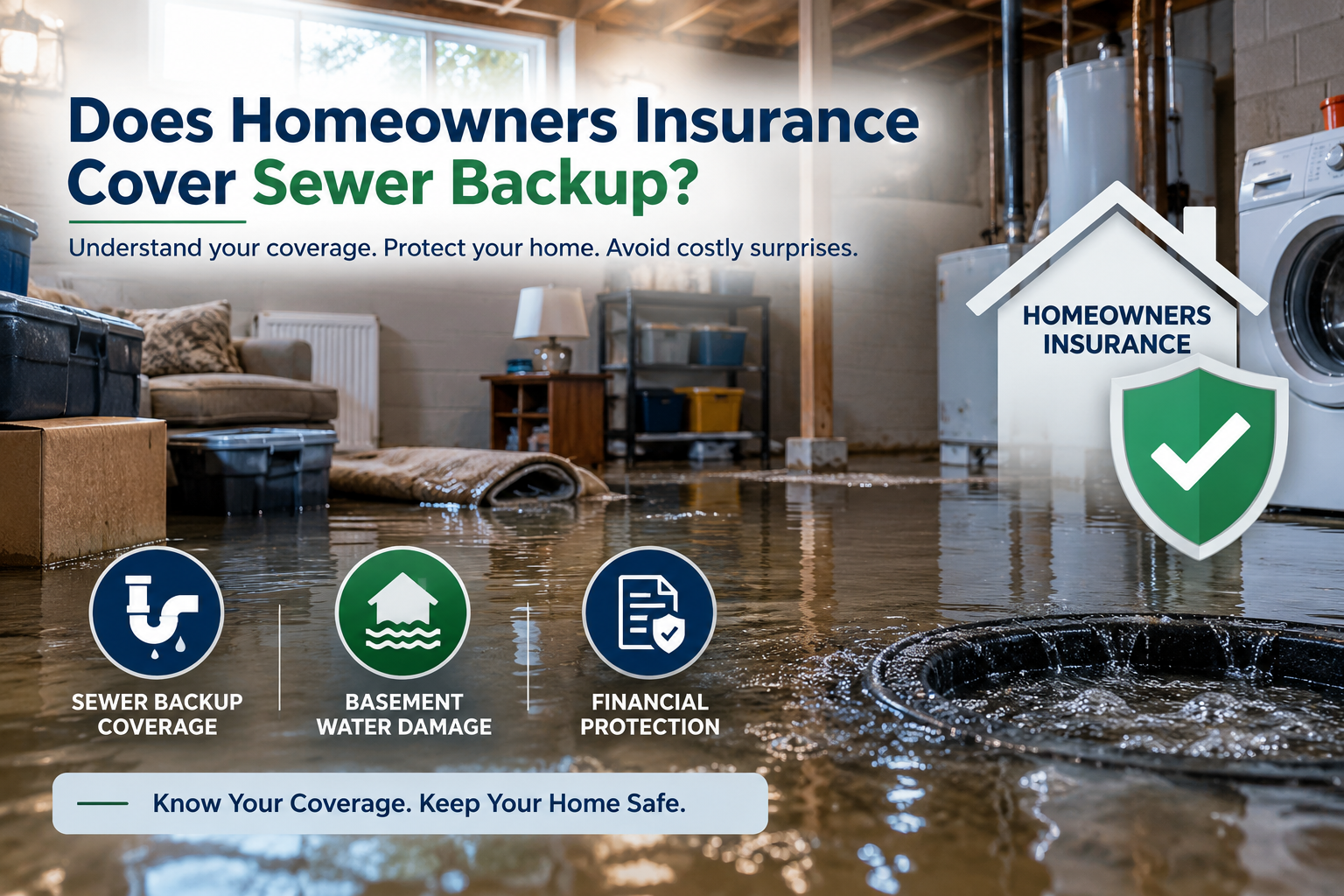
Sewer backups can send dirty water into your basement, damage flooring and furniture, and leave you with a large cleanup bill. If you are asking does homeowners insurance cover sewer backup, the answer is usually no under a standard policy unless you have specific sewer backup or water backup coverage. Understanding this difference before a backup happens can help you avoid an unexpected insurance gap.
Does Homeowners Insurance Cover Sewer Backup?
Standard homeowners insurance usually does not cover damage caused by sewer or drain backup. However, many insurers offer optional water backup, sewer backup, or sewer and drain backup coverage that can be added to a homeowners policy.
The National Association of Insurance Commissioners (NAIC) lists water backup of sewer as an additional coverage that can pay for certain losses caused by sewer or drain backup.
The exact coverage depends on your policy, limits, deductible, exclusions, and the cause of the water damage.
Quick Answer
| Situation | Is It Usually Covered? |
|---|---|
| Sewer backs up into your basement | Usually not under standard coverage |
| Sewer backup with water-backup endorsement | May be covered |
| Drain backs up into your home | May be covered with appropriate endorsement |
| Sump pump overflow | May be covered with water-backup coverage |
| Floodwater enters your home | Generally not covered by standard homeowners insurance |
| Burst interior pipe | May be covered under standard policy |
| Long-term plumbing leak | Often not covered |
| Sewer backup damages furniture | May be covered if your endorsement includes personal property |
| Sewer backup damages flooring | May be covered depending on policy |
| Mold following a sewer backup | Coverage depends on the policy and circumstances |
Insurance policies differ, so these examples should not be treated as guarantees of coverage.
1. Why Doesn’t Standard Homeowners Insurance Usually Cover Sewer Backup?
A standard homeowners policy generally protects against covered causes of loss listed in the policy. Sewer and drain backups are commonly excluded from the standard policy unless additional coverage has been purchased.
This is important because homeowners sometimes assume that having home insurance means every type of water damage is covered.
It doesn’t.
For example, your policy may cover certain sudden water damage caused by a burst pipe inside the house while excluding water that enters through a backed-up sewer or drain.
These are different causes of loss, and insurance can treat them differently.
2. What Is Sewer Backup Coverage?
Sewer backup coverage is additional protection that can help pay for certain damage caused when water or sewage backs up through a sewer, drain, or sometimes a sump pump.
Depending on the policy, it may help cover:
- Damage to floors
- Damaged drywall
- Furniture
- Personal belongings
- Cleanup
- Water removal
- Certain repairs
- Some mold-related expenses, depending on the policy
The NAIC identifies sewer backup as one of the additional coverages homeowners may be able to purchase.
Insurance companies may call this coverage different names, including:
- Sewer backup coverage
- Water backup coverage
- Backup of sewer or drain
- Sewer and drain backup coverage
- Water backup and sump pump overflow coverage
The name and coverage details depend on the insurer and policy.
3. Does Homeowners Insurance Cover Sewer Backup From Heavy Rain?
Heavy rain can contribute to sewer backups, but the answer depends on how the water entered the home.
If water backs up through a sewer or drain, standard homeowners insurance generally does not cover the damage. Optional sewer or water-backup coverage may provide protection.
Flooding is different.
If water enters your home because of external flooding, standard homeowners insurance generally does not cover the flood damage. Flood insurance is a separate type of coverage.
This distinction matters because a homeowner could experience both conditions during the same storm.
Example
Heavy rainfall overwhelms a local sewer system. Sewage backs up through the basement drain and damages the basement.
If you have water-backup coverage, the claim may qualify depending on the policy.
If you do not have that additional coverage, your standard homeowners policy may exclude the loss.
4. Does Sewer Backup Coverage Pay for a Sump Pump Failure?
It may.
Some water-backup endorsements include damage caused by sump pump overflow or failure, while others may have specific terms or limits.
The NAIC notes that homeowners may be able to purchase endorsements covering sewer or drain backup and sump pump overflow.
This can be particularly important if your basement relies on a sump pump.
Example
Your sump pump stops working during a heavy storm. Water accumulates in the basement and damages the floor and furniture.
Without appropriate coverage, your standard policy may not pay for the resulting water damage.
With an applicable water-backup endorsement, some of the damage may qualify for coverage.
Check the endorsement carefully because the coverage limit and exclusions can vary.
5. What Does Sewer Backup Insurance Usually Cover?
Coverage depends on the policy, but an endorsement may protect against certain damage to both the home and personal belongings.
Possible covered expenses can include:
Home Damage
- Flooring
- Drywall
- Walls
- Certain fixtures
- Other damaged building materials
Personal Property
Depending on the policy, coverage may apply to belongings such as:
- Furniture
- Clothing
- Electronics
- Rugs
- Other personal possessions
Cleanup
Some policies may cover certain costs associated with removing contaminated water and cleaning affected areas.
Temporary Living Expenses
If a covered sewer backup makes your home temporarily uninhabitable, your policy may provide additional living expense coverage if the circumstances qualify.
However, do not assume every cleanup or repair bill will be covered.
Your policy’s coverage limit, deductible, exclusions, and specific wording determine what the insurer may pay.
6. How Much Sewer Backup Coverage Do You Need?
There is no single coverage amount that works for every homeowner.
Think about the potential cost of:
- Basement flooring
- Drywall
- Furniture
- Appliances
- Electronics
- Cleanup
- Water extraction
- Repairs
- Temporary accommodation
A homeowner with a finished basement and expensive furniture may face a much larger potential loss than someone with an unfinished basement.
Example
Suppose a sewer backup damages:
- $4,000 of flooring
- $3,000 of furniture
- $2,000 of electronics
- $2,500 in cleanup and restoration
The potential loss could be more than $11,000 before considering other expenses.
If your water-backup coverage limit is much lower than the potential damage, you could still have a significant out-of-pocket expense.
Ask your insurer:
“What is my sewer or water-backup coverage limit, and does it include personal property and cleanup?”
7. Does Sewer Backup Coverage Have a Deductible?
It can.
Your policy may have:
- A standard homeowners deductible
- A separate deductible for water backup
- A percentage-based deductible
- Another deductible specified by the endorsement
Do not assume your normal homeowners deductible automatically applies.
Example
Suppose your sewer backup coverage has a $1,000 deductible and you have $8,000 of eligible covered damage.
The deductible would generally reduce the amount payable under the policy, subject to the policy’s terms and limits.
Always check your declarations page and endorsement for the exact deductible.
8. Does Homeowners Insurance Cover Sewer Backup and Mold?
Mold coverage after a sewer backup can be complicated.
Even when sewer backup coverage applies, mold may have its own exclusions, limits, conditions, or requirements.
For example, an insurer may cover certain water damage caused by a covered sewer backup but apply separate terms to mold remediation.
This is one reason you should act quickly after discovering a backup.
If a Backup Happens
- Stop the source if it is safe to do so.
- Keep people and pets away from contaminated water.
- Document the damage.
- Contact your insurance company.
- Ask whether professional cleanup is required.
- Keep receipts and invoices.
- Follow the insurer’s instructions.
Do not assume that waiting several days to report the problem will have no effect on your claim.
9. Does Flood Insurance Cover Sewer Backup?
Flood insurance and sewer backup coverage are not the same thing.
Standard homeowners insurance generally excludes flood damage. Separate flood insurance can provide protection for eligible flood losses.
However, whether a sewer backup is covered under flood insurance can depend on the cause and policy terms.
For example, if a sewer backup happens independently of a covered flood, a flood policy may not be the appropriate source of coverage.
This is why homeowners should understand the difference between:
Sewer backup → water-backup coverage
and
Flooding → flood insurance
They address different risks.
10. What Should You Do After a Sewer Backup?
A sewer backup can create both property damage and health concerns because the water may contain contaminants.
Step 1: Protect Yourself
Avoid direct contact with contaminated water whenever possible.
If the situation is serious, consider using a qualified cleanup professional.
Step 2: Stop the Water Source
If you can safely identify and stop the source, do so. Otherwise, contact the appropriate plumbing or emergency service.
Step 3: Photograph Everything
Take photos and videos of:
- Water levels
- Damaged floors
- Walls
- Furniture
- Appliances
- Personal belongings
- The affected basement or rooms
Step 4: Contact Your Insurance Company
Tell the insurer what happened and ask whether your policy includes sewer or water-backup coverage.
Step 5: Save Your Receipts
Keep receipts for:
- Emergency cleanup
- Temporary repairs
- Hotel expenses
- Damaged property
- Professional services
Step 6: Prevent Further Damage
Take reasonable steps to prevent additional damage when it is safe to do so.
Your insurance company may also provide specific instructions for documenting and handling the claim.
Sewer Backup vs. Other Types of Water Damage
Understanding the difference can make homeowners insurance much easier to understand.
| Water Problem | Standard Homeowners Insurance |
|---|---|
| Sudden burst interior pipe | May be covered |
| Sewer backup | Usually excluded without additional coverage |
| Sump pump overflow | Usually requires additional coverage |
| Flooding from outside | Generally excluded |
| Gradual plumbing leak | Often excluded |
| Roof leak from a covered event | May be covered |
| Groundwater seepage | Often excluded |
The cause of the water damage is extremely important when determining whether insurance applies.
How to Check Whether Your Policy Covers Sewer Backup
You do not need to wait for a disaster to find out.
Look at your homeowners insurance declarations page and policy documents.
Search for terms such as:
- Water backup
- Sewer backup
- Backup of sewer or drain
- Sump pump overflow
- Water backup and sump pump discharge
If you cannot find the information, contact your insurer or agent and ask:
“Do I have sewer or water-backup coverage on my homeowners policy?”
Then ask:
- What is my coverage limit?
- What is my deductible?
- Does it cover my personal belongings?
- Does it cover cleanup?
- Does it cover sump pump failure?
- Does it cover mold caused by a covered backup?
- Does it cover temporary living expenses?
- What exclusions apply?
Getting these answers before a loss can prevent an unpleasant surprise later.
Common Mistakes Homeowners Make
Assuming Standard Home Insurance Covers Everything
Having homeowners insurance does not mean every water-related event is covered.
Confusing Sewer Backup With Flooding
These are different risks and may require different insurance solutions.
Waiting to Report the Damage
Delaying action can allow water damage and mold to become worse.
Ignoring the Coverage Limit
Even if you have sewer backup coverage, there may be a maximum amount the insurer will pay.
Forgetting About the Sump Pump
A sump pump failure may require specific additional coverage.
Not Reading the Endorsement
The additional coverage attached to your policy can contain important exclusions and conditions.
Frequently Asked Questions
Does homeowners insurance cover sewer backup?
Standard homeowners insurance generally does not cover sewer or drain backup. However, you may be able to add sewer backup or water backup coverage to your policy.
How do I know if I have sewer backup coverage?
Check your declarations page and policy endorsements for terms such as “water backup,” “sewer backup,” or “backup of sewer or drain.” You can also contact your insurer and ask whether the coverage is included.
Is sewer backup insurance worth it?
Whether the coverage makes sense depends on your home, basement, local sewer conditions, sump pump use, potential repair costs, and the price and limits of the endorsement. Compare the potential financial exposure with the coverage available.
Does homeowners insurance cover sewage backup in a basement?
Standard coverage generally excludes sewer backup, but an applicable water-backup endorsement may cover eligible basement damage. Coverage limits and exclusions vary by policy.
Does homeowners insurance cover a backed-up toilet?
It depends on the cause. A simple toilet overflow may be treated differently from sewage backing up through a sewer or drain. Review your policy and determine the source of the water before assuming coverage.
Does sewer backup coverage cover personal belongings?
It may. Some water-backup coverage can apply to damage to personal property, but the policy determines what is covered and the applicable limits.
Does sewer backup insurance cover cleanup?
It may cover certain cleanup or restoration costs after an eligible loss. Ask your insurer what services are covered and whether you need to use an approved restoration company.
Does homeowners insurance cover sewer backup from heavy rain?
Standard homeowners insurance generally does not cover sewer backup. An optional water-backup endorsement may provide coverage for an eligible backup, while flood damage is generally handled separately.
Does sewer backup coverage include sump pump failure?
Some policies or endorsements cover sump pump overflow or failure, but this is not universal. Confirm the exact wording of your policy before assuming you have coverage.
Can I add sewer backup coverage after a backup happens?
Generally, insurance is designed to cover future losses, not damage that has already occurred. An insurer may also have eligibility requirements or waiting periods for certain additional coverage. Contact your insurer before assuming a newly purchased endorsement will cover an existing problem.
Final Thoughts: Does Homeowners Insurance Cover Sewer Backup?
So, does homeowners insurance cover sewer backup? Usually not under a standard homeowners policy. However, homeowners may be able to add sewer backup or water backup coverage to protect against certain losses caused by sewage or water backing up through drains.
The important thing is to check your policy before a backup happens. Find out your coverage limit, deductible, exclusions, and whether sump pump damage and personal belongings are included.
Sewer backup can become expensive very quickly, particularly when a finished basement, furniture, flooring, and electronics are involved.
The Moral of the story is: Don’t assume your homeowners policy covers sewer backup. Check for water-backup coverage before you actually need it.
Why Maintain Market Is Different
Maintain Market explains homeowners insurance in simple language for U.S. readers.
Instead of saying that a particular loss is automatically covered, we explain why coverage can change depending on the cause of the damage, the policy, endorsements, limits, and exclusions.
Our goal is to help homeowners understand their insurance before they need to file a claim, while encouraging them to verify important details directly with their insurer.
References
- National Association of Insurance Commissioners — Homeowners Insurance
- NAIC — Consumer’s Guide to Home Insurance
- Washington State Office of the Insurance Commissioner — Home Insurance
- State Farm — Home & Property Claims
- Allstate — Homeowners Insurance and Water Damage
- Travelers — Water Backup and Sump Pump Coverage
Editorial Review
This article is for general educational purposes and is not personalized insurance advice. Homeowners insurance coverage varies by insurer, state, policy wording, endorsements, exclusions, deductibles, and claim circumstances. Readers should review their policy and contact their insurance company or a licensed insurance professional for advice about their specific coverage.