
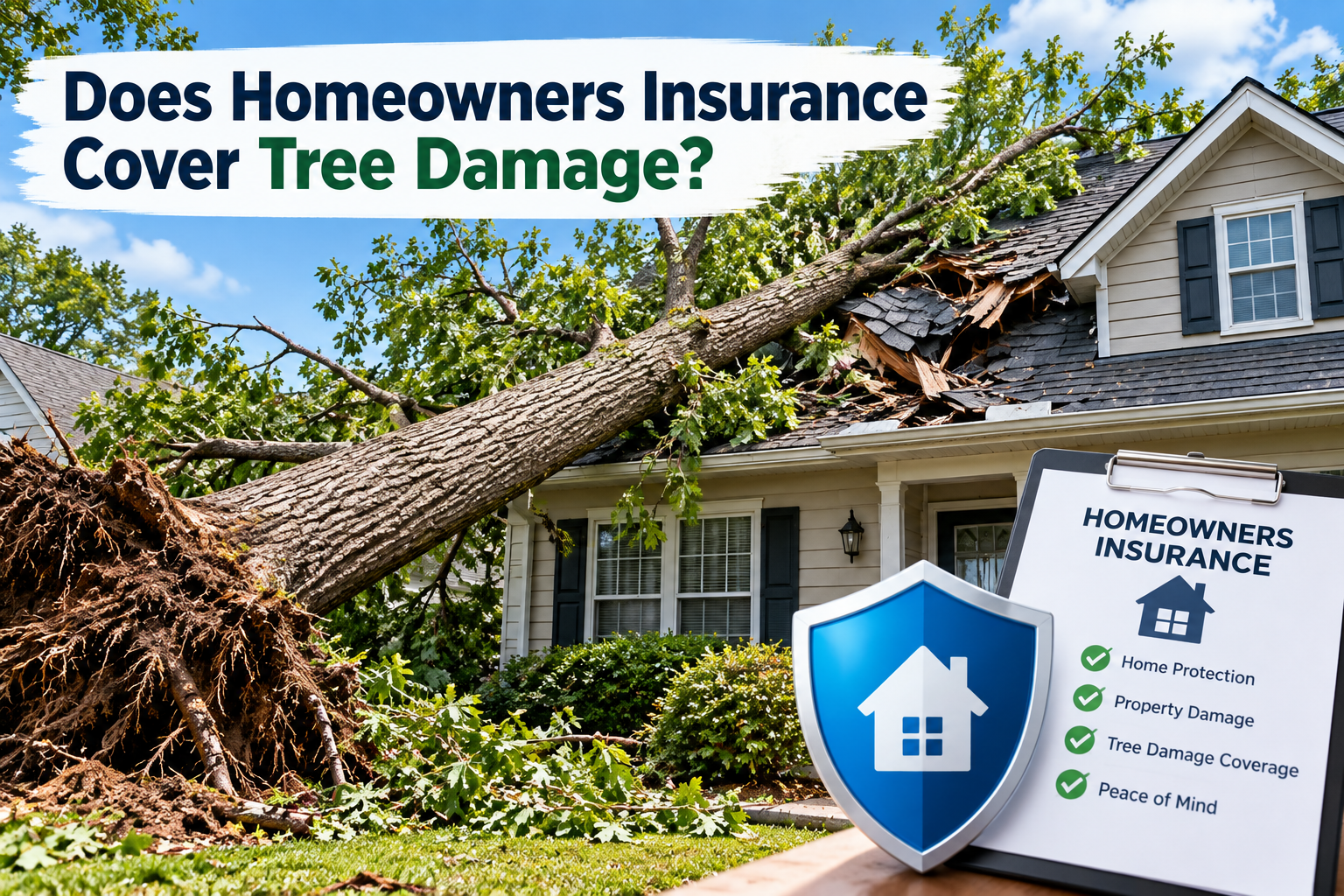
Does homeowners insurance cover tree damage? In many cases, yes—especially when a tree falls because of a covered event such as wind, lightning, or hail and damages your home or another covered structure. However, insurance may not pay for every fallen tree, tree removal, or damage caused by poor tree maintenance. Your policy terms, deductible, and the cause of the damage all matter.
Quick Answer: Does Homeowners Insurance Cover Tree Damage?
Yes, homeowners insurance often covers tree damage when a tree falls on your home, garage, or another covered structure because of a covered event.
For example, if strong wind causes a tree to fall onto your roof, your homeowners policy may cover the damage to the roof and other damaged parts of the home, subject to your deductible and policy limits.
Tree removal may also be covered when the fallen tree damages a covered structure. However, a tree that simply falls in your yard without damaging a covered structure may not qualify for tree removal coverage.
The exact coverage depends on your policy and the reason the tree fell.
1. When Does Homeowners Insurance Cover Tree Damage?
Homeowners insurance generally covers tree damage when the damage comes from a covered cause of loss.
Common examples can include:
- Wind
- Lightning
- Hail
- Fire
- Certain storms
- Vandalism
- Other covered events listed in your policy
For example, imagine a strong windstorm knocks a large tree onto your house. The tree damages your roof, wall, and bedroom.
If wind is a covered cause under your policy, your homeowners insurance may help pay for the covered repairs after your deductible.
The important point is that the cause of the damage matters.
Homeowners policies pay for damage caused by covered events listed in the policy. Some policies cover many causes unless they are specifically excluded, while other policies only cover named causes.
2. What If a Tree Falls on Your House?
This is one of the most common tree insurance questions.
If a tree falls on your house and damages the structure because of a covered event, your homeowners insurance will often cover the covered damage.
This can include damage to:
- Roof
- Walls
- Windows
- Ceilings
- Floors
- Attached structures
- Personal belongings damaged by the covered event
For example:
Tree falls → roof is damaged → rain enters the house → furniture is damaged.
Depending on your policy and the facts of the loss, your insurance may cover the covered damage to the house and personal belongings.
The deductible normally applies before the insurance company pays its share.
3. Does It Matter Who Owns the Tree?
Usually, the fact that someone else owns the tree does not automatically stop you from making a claim on your own homeowners insurance when the tree falls on your insured home.
For example, suppose your neighbor owns a large tree.
A storm causes the tree to fall onto your roof.
You can generally contact your own insurance company about the damage to your home.
The Insurance Information Institute explains that homeowners insurance can cover damage when a tree falls on an insured structure, even when the tree came from a neighbor’s property. In some cases, your insurer may later try to recover money from the neighbor’s insurer if the neighbor was responsible.
However, this can depend on the facts and state law.
4. Does Homeowners Insurance Pay for Tree Removal?
Sometimes.
If a fallen tree damages an insured structure, your homeowners policy may also provide some coverage for removing the tree.
The Insurance Information Institute says tree removal coverage is generally around $500 to $1,000, depending on the insurer and policy.
But there is an important difference.
Tree falls on your house
You may have coverage for:
- Damage to the house
- Covered damage to belongings
- Tree removal, subject to the policy
Tree falls in your yard
If the tree does not damage an insured structure, your policy may not pay to remove it.
Some policies may provide limited coverage when a fallen tree blocks access to the home or a qualifying ramp, but this depends on the policy.
So don’t assume that your insurance company will pay to remove every tree that falls in your yard.
5. What If the Tree Was Old, Rotten, or Poorly Maintained?
This is where things can become more complicated.
Homeowners are generally expected to take reasonable care of their property.
If a tree is clearly dead, diseased, or dangerous and the homeowner ignores the problem, the insurance company may look closely at the claim.
The Insurance Information Institute notes that poor tree maintenance is not covered by homeowners insurance.
For example, imagine you have a large tree that has been dead for years.
You know that large branches are falling regularly, but you do nothing to address the problem.
Later, the tree falls and damages your neighbor’s house.
The insurance situation could be different from a healthy tree that suddenly falls during a covered storm.
Smart step
If you have a large or damaged tree near your house, consider:
- Having it inspected
- Removing dead branches
- Keeping records of tree work
- Keeping receipts from professional tree services
- Taking photos before and after major storms
Good property care can also help reduce the chance of damage.
6. What If the Tree Damages Your Garage or Fence?
Coverage depends on what was damaged and how your policy treats that structure.
A detached garage, shed, or similar structure may fall under other structures coverage rather than dwelling coverage.
The NAIC explains that homeowners policies generally have separate coverage for the main home and other structures such as fences and sheds.
If a covered event causes a tree to fall onto a detached garage, your policy may cover the covered damage, subject to your limits and deductible.
A fence can be different because coverage may depend on the cause of the damage and your policy terms.
Always check the policy before assuming that every outdoor structure has the same coverage as your house.
7. What If a Tree Falls but Does Not Damage Anything?
This is an important situation.
Suppose a storm knocks down a tree in your backyard.
The tree is lying on the grass, but:
- Your house is fine
- Your garage is fine
- Your fence is fine
- Nothing insured was damaged
In many cases, homeowners insurance will not pay simply because the tree fell.
The Insurance Information Institute says policies generally do not cover removal of a fallen tree when it has not damaged an insured structure, although some policies may provide limited coverage in certain situations.
You may therefore have to pay the tree removal cost yourself.
8. Does Homeowners Insurance Cover Damage to the Tree Itself?
Sometimes, but not for every cause.
Homeowners insurance can provide limited coverage for trees, shrubs, and plants when they are damaged by certain covered events.
The Insurance Information Institute lists examples such as:
- Fire
- Lightning
- Theft
- Vandalism
- Certain accidents
It also notes that tree and plant coverage can have limits, including a total limit and a limit for each individual tree or plant.
This means you should not assume that insurance will pay the full cost of replacing an expensive tree.
If you have valuable landscaping, check your policy for the specific limits.
9. What If a Tree Falls on Your Car?
Your homeowners insurance generally is not the policy you should rely on for damage to your car.
If a tree falls onto your vehicle, comprehensive auto insurance may provide coverage, depending on your policy.
This is different from damage to your house.
Simple example
Tree falls on house:
Homeowners insurance may apply if the cause is covered.
Tree falls on car:
Your auto policy may apply if you have the right coverage.
This is why it is important to look at both your homeowners and auto insurance policies when dealing with storm damage.
10. What Should You Do After a Tree Falls?
If a tree falls and damages your home, take steps quickly to protect the property and document the damage.
Step 1: Stay safe
Do not go near a fallen tree if there are:
- Downed power lines
- Damaged electrical wires
- Serious structural damage
- Other immediate dangers
Contact the proper emergency or utility service when needed.
Step 2: Take photos and videos
Before cleaning everything up, take photos of:
- The fallen tree
- Your roof
- Walls
- Windows
- Floors
- Furniture
- Other damaged property
Try to take both close-up and wider photos.
Step 3: Prevent more damage
If it is safe, take reasonable steps to prevent further damage.
For example, you may need to cover an opening in the roof temporarily.
Keep receipts for reasonable emergency work and materials.
Step 4: Contact your insurance company
Tell your insurer what happened and ask about the claims process.
The NAIC recommends contacting your insurance company as soon as possible after a covered loss and keeping records of damaged property and repair costs.
Step 5: Do not throw away damaged items too quickly
Your insurance company may want to inspect the damage.
Keep damaged items when it is safe and practical to do so.
Tree Damage Insurance: What Is Usually Covered?
| Situation | Is it usually covered? |
|---|---|
| Tree falls on your house during a covered storm | Often yes |
| Tree falls on detached garage | Often yes, subject to policy |
| Tree falls in yard with no damage | Usually no tree-removal coverage |
| Tree blocks driveway | May have limited coverage |
| Tree damages roof | Often yes if caused by a covered event |
| Tree damages your car | Usually handled by auto insurance |
| Dead tree falls because of poor maintenance | Coverage may be limited or denied |
| Tree damages neighbor’s house | Their insurance may cover their home; responsibility can depend on the facts |
| Tree itself is damaged | May have limited coverage depending on cause |
| Tree removal | May be covered when it damages a covered structure |
These are general examples, not guarantees. Your policy wording, deductible, exclusions, and state rules can affect the claim.
Does Homeowners Insurance Cover Tree Damage From a Storm?
Often, yes.
Wind and other storm-related events can be covered causes of loss under homeowners insurance.
For example, if a strong windstorm causes a healthy tree to fall onto your roof, the resulting covered damage may be covered after your deductible.
The NAIC lists windstorm and hail among common covered perils in homeowners policies, while the Insurance Information Institute specifically notes that trees felled by wind, lightning, or hail can be covered when they damage an insured structure.
However, coverage can vary by policy and location.
Some homeowners in areas with higher storm risk may have special deductibles or exclusions for certain types of storm damage.
Does Homeowners Insurance Cover Tree Damage From Lightning?
It can.
Lightning is commonly listed as a covered cause of loss under homeowners insurance.
If lightning causes a tree to fall onto your home, the resulting covered damage may be covered, subject to your policy terms and deductible.
The important thing is to look at why the tree fell and what property was damaged.
Does Homeowners Insurance Cover Tree Damage From Hail?
It can.
Hail is another common covered peril under homeowners insurance.
If hail damages a tree and the tree later falls onto your insured structure, the claim may be covered depending on the facts and policy terms.
Document the damage and contact your insurer if you believe you have a covered claim.
What Tree Damage Is Usually Not Covered?
Homeowners insurance does not automatically cover every tree-related expense.
Common situations where coverage may be limited or unavailable include:
A tree falls without damaging an insured structure
Your policy may not pay for simply removing a tree from your yard.
Poor tree maintenance
If a tree was clearly dangerous and not properly maintained, the insurer may review the claim differently.
Excluded causes
If the reason the tree fell is excluded by your policy, the resulting damage may not be covered.
Damage to your car
Your auto insurance may be the policy that applies instead.
Landscaping costs above policy limits
Tree and plant coverage can have limits, so expensive landscaping may not be fully covered.
Always check your policy rather than assuming that every tree-related loss is covered.
How Much Will You Pay After a Tree Damage Claim?
Your deductible is one of the most important numbers to check.
For example, imagine:
- Covered damage: $8,000
- Homeowners deductible: $1,500
- Insurance payment before other policy limits or adjustments: $6,500
You would generally be responsible for the deductible, while the insurer would consider the remaining covered loss under the policy.
The actual payment can be different because of policy limits, exclusions, depreciation, coverage type, and other claim details.
The NAIC explains that a deductible is the part of a covered loss that the homeowner must pay before the insurer pays its share.
Actual Cash Value vs. Replacement Cost
Your policy may pay covered property losses using actual cash value (ACV) or replacement cost.
Actual Cash Value
The insurer considers depreciation when calculating the payment.
Replacement Cost
The policy may pay the cost to repair or replace covered damaged property with similar materials, subject to the policy terms and limits.
The NAIC explains that these two methods can lead to different amounts paid after a claim.
This is another reason why simply knowing that “tree damage is covered” does not tell you exactly how much money you will receive.
Example: A Tree Falls on a Roof
Let’s look at a simple example.
A homeowner has a large healthy tree in the backyard.
A major windstorm hits the area.
The tree falls onto the roof and damages:
- Roof shingles
- Roof decking
- Part of the ceiling
- Bedroom furniture
The homeowner takes photos, contacts the insurance company, and files a claim.
If wind is a covered cause under the policy, the insurer may cover the covered damage, subject to the deductible, policy limits, exclusions, and claim review.
The homeowner may also have some coverage for removing the fallen tree because it damaged an insured structure.
This is an example of how coverage can work. It is not a guarantee that every similar claim will be paid.
5 Mistakes to Avoid After Tree Damage
1. Removing everything before taking pictures
Photos can help show what happened.
Take pictures before major cleanup whenever it is safe.
2. Assuming the neighbor must pay
If a neighbor’s tree falls on your home, your own homeowners insurance may still be the first place to report the damage.
Responsibility can depend on the facts and state law.
3. Ignoring a dangerous tree
If you know that a tree is dead or unsafe, do not simply ignore it.
Proper tree care can help reduce the risk of damage and may matter when an insurer reviews a claim.
4. Assuming tree removal is always covered
A tree sitting in your yard is not the same as a tree that has damaged your house.
Tree removal coverage can depend on the circumstances and policy.
5. Waiting too long to contact your insurer
Insurance companies can have claim reporting rules.
The NAIC recommends contacting your insurance company as soon as possible after a loss.
What to Check in Your Homeowners Insurance Policy
If you have large trees around your home, check these parts of your policy:
1. Covered causes of loss
Find out which causes of tree damage are covered.
2. Tree removal limits
Look for limits on debris or tree removal.
3. Landscaping limits
Check whether there are limits for trees, shrubs, and plants.
4. Deductible
Know how much you would have to pay before insurance pays its share.
5. Other structures coverage
Check coverage for detached garages, sheds, fences, and similar structures.
6. Exclusions
Read the exclusions section carefully.
7. Your state’s rules
Insurance rules can vary from state to state.
If you are unsure, ask your insurance company or agent to explain the exact coverage.
Frequently Asked Questions
Does homeowners insurance cover a tree falling on your house?
Usually, a homeowners policy can cover damage when a tree falls on your home because of a covered event such as wind, lightning, or hail. The deductible, policy limits, exclusions, and exact cause of the loss can affect the claim.
Does homeowners insurance cover tree removal?
It may. When a fallen tree damages an insured structure, many policies provide some coverage for removing the tree. The amount can be limited, so check your policy before assuming the full removal cost will be paid.
Does homeowners insurance cover a tree that falls in the yard?
Usually, not simply because the tree fell. If the tree does not damage an insured structure, there may be no coverage for removing it. Some policies provide limited coverage in certain situations, such as when the tree blocks access to the home.
Does homeowners insurance cover a tree falling on a neighbor’s house?
The neighbor’s homeowners insurance may cover the damage to their house if the loss is covered. If your tree was involved, responsibility can depend on what caused the tree to fall and whether there was negligence or poor maintenance.
Does homeowners insurance cover damage to trees?
It can provide limited coverage for trees and shrubs when they are damaged by certain covered events. However, tree and landscaping coverage often has limits, including limits for each tree and total limits.
Does homeowners insurance cover a tree falling on a car?
Homeowners insurance generally is not the main policy for damage to your car. Comprehensive auto insurance may cover damage caused by a falling tree if you have that coverage.
What if a dead tree falls on my house?
A dead or poorly maintained tree can make a claim more complicated. Insurance companies may look at whether the homeowner knew about the danger and failed to take reasonable care of the tree.
What should I do when a tree falls on my house?
First, stay safe and avoid downed power lines or unsafe structures. Take photos of the damage, protect the home from further damage when it is safe, keep receipts, and contact your insurance company as soon as possible.
Final Takeaway
So, does homeowners insurance cover tree damage?
Often, yes—but it depends on why the tree fell, what it damaged, and what your policy covers.
If a covered storm causes a tree to fall onto your house, homeowners insurance will often cover the covered damage after your deductible.
But insurance may not pay for a tree that simply falls in your yard, and tree removal can have its own limits. Poor tree maintenance can also create problems when you file a claim.
Before a storm happens, take a few minutes to check your policy for tree removal, landscaping limits, deductibles, covered causes, and exclusions.
Knowing these details before you need them can save you from an unpleasant surprise after a storm.
Why Maintain Market Is Different
At Maintain Market, we focus on explaining insurance and money topics in simple language instead of filling articles with complicated insurance terms.
Our goal is to help U.S. readers understand:
- What their insurance may cover
- What may not be covered
- Where deductibles come in
- What questions to ask an insurer
- What to check before filing a claim
Insurance policies are contracts, so readers should always check their own policy and speak with their insurer or licensed insurance professional for advice about a specific claim.
References
- NAIC — Homeowners Insurance
- Insurance Information Institute — If a Tree Falls on Your House, Are You Covered?
- California Department of Insurance — Hurricane Hilary Consumer Alert
- NAIC — What You Need to Know When Filing a Homeowners Claim
Editorial Review
This article is intended for general educational purposes for U.S. homeowners. Insurance coverage varies by insurer, policy, state, deductible, exclusions, and the cause of damage. Readers should review their policy and contact their insurance company or a licensed insurance professional for advice about a specific situation.