
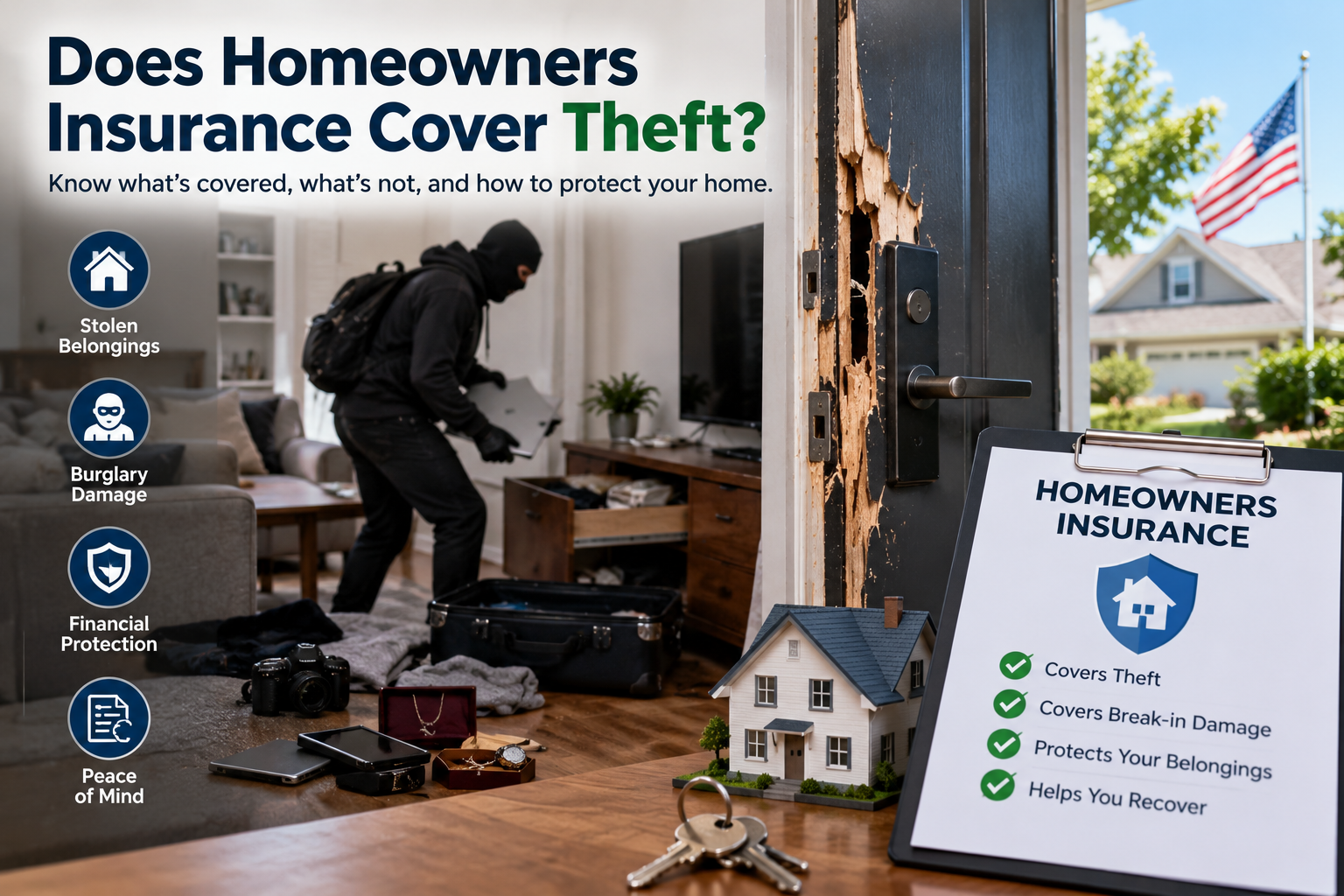
Does homeowners insurance cover theft? In most cases, yes. A standard homeowners insurance policy usually covers personal belongings that are stolen, as well as certain damage to your home caused by a break-in. However, coverage has limits, deductibles, and special rules for expensive items such as jewelry, watches, art, and collectibles.
Quick Answer: Does Homeowners Insurance Cover Theft?
Yes, homeowners insurance generally covers theft of covered personal belongings.
For example, if someone breaks into your home and steals your:
- Television
- Laptop
- Clothes
- Furniture
- Camera
- Bicycle
- Other covered belongings
Your personal property coverage may help pay for the loss, subject to your policy terms, limits, and deductible.
Homeowners insurance may also cover damage caused by the break-in, such as a damaged door, broken window, or damaged lock.
The exact amount you receive depends on your policy and whether your belongings are covered at replacement cost or actual cash value.
1. Does Homeowners Insurance Cover Stolen Personal Belongings?
Yes, this is one of the main protections provided by homeowners insurance.
Personal property coverage can help pay when covered belongings are stolen.
Common examples include:
| Stolen Item | May Be Covered? |
|---|---|
| Television | Yes, subject to policy |
| Laptop | Yes, subject to policy |
| Clothes | Yes, subject to policy |
| Furniture | Yes, subject to policy |
| Camera | Yes, subject to policy |
| Bicycle | Yes, subject to policy |
| Jewelry | Usually, but special limits may apply |
| Cash | Usually limited |
| Collectibles | May have special limits |
The key point is that not every item is covered for its full value.
Some types of property have special limits under homeowners policies. Expensive jewelry, art, collectibles, and similar items may need extra coverage if you want protection for their full value.
2. Does Homeowners Insurance Cover Theft From Your House?
Usually, yes.
Imagine you leave home for the weekend.
When you return, you find that someone broke a window and entered the house. Your laptop, television, camera, and some jewelry are missing.
You may be able to file a homeowners insurance claim for the covered stolen property.
The policy may also cover certain damage caused by the break-in.
For example:
Broken window + damaged door + stolen belongings
Your homeowners policy may cover the covered losses, subject to the policy terms and your deductible.
The NAIC says theft is one of the perils that homeowners policies can cover.
3. Does Homeowners Insurance Cover Damage From a Break-In?
It often can.
A burglary can cause more than just stolen property.
Someone may damage:
- Doors
- Locks
- Windows
- Walls
- Cabinets
- Security systems
- Other parts of the home
If the damage comes from a covered event, your homeowners insurance may help pay for repairs.
For example, someone breaks your front door while entering your home.
Your personal property coverage may deal with the stolen items, while your dwelling coverage may apply to covered damage to the home itself.
These are different parts of the same insurance policy.
Always check your policy before assuming every type of damage will be paid.
4. Does Homeowners Insurance Cover Theft Away From Home?
In many cases, yes.
This is something many homeowners do not realize.
Personal belongings may have coverage even when they are away from your home.
For example, imagine your laptop is stolen while you are:
- Traveling
- Staying at a hotel
- Visiting another city
- At school
- Away from your home
Your homeowners policy may still provide coverage for the stolen item.
However, there can be lower limits for belongings stolen away from your home.
The Insurance Information Institute says personal belongings can be covered off-premises, although some policies may limit the amount of coverage in certain situations.
So if you travel with expensive electronics or other valuable items, check your policy before assuming you have the same coverage everywhere.
5. Does Homeowners Insurance Cover Theft From Your Car?
This can be confusing.
If someone steals personal belongings from your car, your homeowners insurance may provide coverage for the stolen belongings, depending on your policy.
For example:
Someone breaks your car window while you are shopping and steals your laptop from inside the vehicle.
The damage to the car may be handled by your auto insurance.
The stolen laptop may be considered personal property under your homeowners policy.
These are two different losses.
Your auto policy and homeowners policy can work differently in this situation.
Always check both policies before filing a claim.
6. Does Homeowners Insurance Cover Jewelry Theft?
Usually, jewelry can be covered for theft, but there is an important catch.
Many homeowners policies place special limits on certain expensive items.
These can include:
- Jewelry
- Watches
- Furs
- Art
- Silverware
- Coins
- Collectibles
For example, imagine you own a diamond ring worth $15,000.
Your homeowners policy may cover jewelry theft, but the standard limit for stolen jewelry could be much lower than the ring’s value.
That means you might not receive enough money to replace the ring.
The NAIC warns that jewelry often has a maximum coverage limit and recommends checking the policy or asking your insurer about additional coverage.
What can you do?
You may be able to add:
- A scheduled personal property endorsement
- A jewelry endorsement
- A separate policy for the item
You may also need an appraisal or proof of value.
If you own expensive jewelry, do not assume your basic homeowners policy gives you full protection.
7. Does Homeowners Insurance Cover Stolen Cash?
Cash can be treated differently from normal personal belongings.
Many homeowners policies place a small limit on money that is stolen.
For example, your policy may cover stolen cash, but the amount may be much lower than the amount you actually had at home.
This is why keeping large amounts of cash at home can create a coverage problem.
If you regularly keep cash, check the exact limit in your policy.
Do not assume that homeowners insurance will replace every dollar that is stolen.
8. Does Homeowners Insurance Cover Theft of Expensive Electronics?
It can.
Items such as:
- Laptops
- Cameras
- Tablets
- Televisions
- Gaming systems
- Phones
- Smart devices
may fall under personal property coverage.
However, your insurer may ask you to show that you owned the item and prove its value.
This is one reason a home inventory can be useful.
A home inventory can include:
- Photos
- Receipts
- Serial numbers
- Purchase dates
- Product details
- Approximate values
The NAIC recommends keeping a record of your belongings so you can better document your property after a loss.
You do not need to make the process complicated.
Take photos of your important belongings and keep receipts for expensive purchases.
9. Does Homeowners Insurance Cover Theft If You Were Not Home?
Yes, being away from the house does not automatically mean theft is excluded.
For example, you could be:
- On vacation
- At work
- Visiting family
- Staying in another city
If someone breaks into your home while you are away, your homeowners policy may cover the covered loss.
The important issue is whether the theft and resulting damage are covered under your policy.
Your insurer may also ask questions about what happened and what property was stolen.
This is another reason it helps to keep a home inventory.
10. How Much Does Homeowners Insurance Pay for Theft?
There is no single amount that applies to every homeowner.
Your payment can depend on:
- Your personal property limit
- Your deductible
- The type of coverage you have
- The value of the stolen property
- Special limits for certain items
- Whether the property is covered at replacement cost or actual cash value
- Your policy exclusions
For example:
Imagine your stolen belongings have a covered value of $8,000.
Your homeowners deductible is $1,000.
If the full $8,000 loss is covered and there are no other limits or adjustments, the deductible would generally be your first $1,000 of the loss.
The insurer would then consider the remaining covered amount under your policy.
The actual payment can be different depending on the policy and how the property is valued.
Replacement Cost vs. Actual Cash Value for Stolen Items
This difference can have a big effect on a theft claim.
Replacement Cost
Replacement cost coverage generally looks at what it costs to replace the item with a similar item, subject to the policy terms and limits.
For example, suppose your five-year-old television is stolen.
A replacement cost policy may use the cost of buying a similar new television, depending on the policy.
Actual Cash Value
Actual cash value takes depreciation into account.
That means an older item may be worth less for the claim than what you would pay to buy a new replacement.
The NAIC explains that actual cash value takes age and wear into account, while replacement cost coverage can pay the cost to repair or replace covered property with similar materials or items, subject to policy terms.
Simple example
You bought a laptop for $1,500 several years ago.
Today, a similar new laptop costs $1,200.
Your claim payment could be different depending on whether your policy uses actual cash value or replacement cost.
Check your policy before assuming you will receive the original purchase price.
What Items Have Special Theft Limits?
Some belongings may have special limits under a standard homeowners policy.
These may include:
- Jewelry
- Watches
- Cash
- Coins
- Precious metals
- Stamps
- Collectibles
- Firearms
- Silverware
- Certain business property
The exact limits vary by policy.
The Insurance Information Institute notes that valuable items such as jewelry, art, collectibles, and silverware can have dollar limits when stolen. Additional coverage may be available for valuable items.
If you have expensive belongings, check the limits before you need to file a claim.
Does Homeowners Insurance Cover Theft From a Second Home?
It can, but the coverage depends on how the second property is insured.
A vacation home or second home may have a different policy from your main home.
If you own property in another location, check:
- Personal property coverage
- Theft coverage
- Policy limits
- Deductible
- Unoccupied-home rules
- Vacancy rules
Do not assume your main homeowners policy automatically provides the same protection for another property.
Does Homeowners Insurance Cover Theft by a Family Member?
This situation can be more complicated.
Homeowners policies have rules about who is considered an insured person and how property owned by people in the household is treated.
If you believe a family member took your property, do not assume the claim will be handled like a normal break-in.
The insurer may need more information about:
- Who took the property
- Where the property was located
- Who owned it
- Who was insured under the policy
- The circumstances of the loss
Read the policy and speak with your insurer before assuming you have coverage.
Does Homeowners Insurance Cover Identity Theft?
Identity theft is different from someone stealing physical property from your home.
Some homeowners insurance policies may include identity theft services or coverage, while others may offer it as an optional add-on.
Identity theft coverage can help with certain costs related to restoring your identity, depending on the policy.
However, identity theft insurance does not automatically mean the insurer will pay for all money stolen through identity fraud.
The NAIC notes that identity theft insurance can cover certain recovery costs but does not cover direct monetary losses.
So keep identity theft coverage separate from normal theft of physical belongings when reading your policy.
What If Your Home Is Damaged During a Burglary?
Your homeowners insurance may cover covered damage caused by the break-in.
For example:
A burglar breaks a window to enter your home.
The burglar also damages your front door and lock.
Your homeowners insurance may help pay for covered repairs.
The Insurance Information Institute says standard homeowners policies generally provide coverage for theft of personal possessions and damage to the home caused by a break-in.
You would still need to follow your policy’s claim rules and pay any applicable deductible.
What Should You Do After a Theft?
If someone breaks into your home, take these steps.
1. Make sure you are safe
Do not enter the home if you believe the person may still be inside.
Contact the police if necessary.
2. Report the theft
A police report can be important when you file an insurance claim.
Keep a copy of the report or the report number.
3. Do not clean up too quickly
Take photos of:
- Broken windows
- Damaged doors
- Broken locks
- Damaged rooms
- Missing property
- Other signs of the break-in
Photos can help show what happened.
4. Make a list of missing items
Write down everything you believe was stolen.
Include:
- Item name
- Brand
- Model
- Approximate purchase date
- Purchase price
- Current value
- Serial number, if available
5. Contact your insurance company
Tell your insurer about the theft as soon as possible.
The NAIC recommends notifying your insurance company promptly after a homeowners loss.
6. Gather proof of ownership
Useful documents can include:
- Receipts
- Photos
- Bank or credit card records
- Warranty documents
- Serial numbers
- Appraisals
The more clearly you can show what you owned, the easier it can be to document the claim.
Theft Claim Checklist
Before filing your claim, try to gather:
| Information | Why It Helps |
|---|---|
| Police report | Documents the theft |
| Photos | Shows damage and affected areas |
| Home inventory | Shows what you owned |
| Receipts | Helps prove purchase and value |
| Serial numbers | Helps identify items |
| Appraisals | Helps prove value of expensive items |
| Repair estimates | Helps show property damage |
| Insurance policy | Shows your coverage and limits |
You may not have every document.
Start with what you have and ask your insurer what else is needed.
Common Reasons a Theft Claim May Be Limited
A theft claim does not always mean you will receive the full amount you lost.
Here are some common issues to watch for.
1. Your deductible
You normally have to pay your policy deductible before the insurer pays its share of a covered loss.
2. Special limits
Jewelry, cash, art, collectibles, and other items may have lower limits.
3. Actual cash value
Depreciation can reduce the amount paid when your policy uses actual cash value.
4. Policy exclusions
Your policy may exclude certain situations.
5. Missing proof of ownership
The insurer may ask you to show that you owned the stolen property.
6. Policy limits
You cannot receive more than the applicable policy limit for a covered loss.
This is why reading your policy before a theft happens is much easier than trying to understand it during a stressful claim.
Should You File a Homeowners Insurance Claim for Theft?
It depends on the size of the loss and your policy.
Start by checking your deductible.
For example:
Stolen property: $900
Deductible: $1,000
If the loss is fully covered, there may be little or no insurance payment because the loss is below the deductible.
Now imagine:
Stolen property: $8,000
Deductible: $1,000
A claim may make more sense because the covered loss is much higher than the deductible.
The NAIC recommends considering your deductible before reporting a claim, especially when the damage or loss is small.
However, do not delay reporting a claim simply because you are unsure. Ask your insurer about the claim process and your policy requirements.
How to Protect Your Home From Theft
Insurance helps after a loss, but preventing theft can help you avoid the loss in the first place.
Simple steps include:
- Lock doors and windows
- Use strong door locks
- Install outdoor lighting
- Consider a home security system
- Keep valuable items out of plain sight
- Keep a home inventory
- Save receipts for expensive purchases
- Avoid sharing travel plans publicly
- Ask a trusted person to watch your home when you are away
A home inventory is especially useful because it can help you remember what you owned after a theft.
Does Homeowners Insurance Cover Theft of Items Outside the Home?
Often, yes.
Personal property coverage can extend beyond your home in many homeowners policies.
For example, your belongings may have coverage if they are stolen while you are traveling.
However, the amount of coverage can be lower in some situations.
The Insurance Information Institute says personal belongings can be covered away from the home, but some policies may set lower limits for property kept off the premises.
If you travel with expensive equipment, ask your insurer about the limits that apply.
Does Homeowners Insurance Cover a Stolen Bicycle?
A bicycle may be covered as personal property if it is stolen.
However, expensive bicycles may need special attention if the value is high.
For example, if your bicycle is worth $5,000, do not assume that the standard personal property limit will automatically give you $5,000 of protection for that specific item.
Check:
- Your personal property limit
- Special limits
- Deductible
- Actual cash value or replacement cost
- Any extra coverage available
Keep the receipt and take photos of expensive bicycles.
Does Homeowners Insurance Cover Theft of Business Property?
This can be different from normal personal property.
If you run a business from your home, your homeowners policy may have limits on business equipment and property.
For example, you may have:
- Work computers
- Cameras
- Tools
- Inventory
- Office equipment
The coverage may not be enough for a home-based business.
If you own a business, ask your insurer whether you need additional business property coverage.
Do not assume your normal homeowners policy fully covers everything used for your business.
Homeowners Insurance Theft Coverage: Simple Example
Imagine a homeowner named Sarah comes home after a weekend trip.
She finds that someone broke into her house.
The stolen items include:
- $1,000 television
- $1,200 laptop
- $800 camera
- $3,000 jewelry
- $500 clothing
The burglar also damaged the front door.
Sarah reports the incident to the police and contacts her insurance company.
Her insurer will look at:
- What was stolen
- Whether each item is covered
- The value of each item
- Special limits
- Her deductible
- Whether the policy uses actual cash value or replacement cost
- The damage to the house
Sarah should not assume she will automatically receive the full $6,500 value of everything stolen.
The final claim payment depends on her policy.
This is an illustrative example, not a real insurance claim.
7 Things to Check in Your Homeowners Policy
If you want to know exactly how theft protection works for your home, check these seven things.
1. Personal Property Limit
How much coverage do you have for your belongings?
2. Theft Coverage
Is theft listed as a covered peril under your policy?
3. Special Limits
What limits apply to jewelry, cash, collectibles, and other valuable items?
4. Deductible
How much do you pay before insurance pays its share?
5. Replacement Cost or Actual Cash Value
How will your stolen property be valued?
6. Off-Premises Coverage
Are your belongings covered when they are away from your home?
7. Business Property Limits
Do you have enough coverage if you work from home or run a business?
These seven checks can help you understand your protection before you ever need to file a claim.
Frequently Asked Questions
Does homeowners insurance cover theft?
Yes, standard homeowners insurance generally covers theft of covered personal belongings. It may also cover covered damage to your home caused by a break-in. Your deductible, policy limits, special item limits, and policy terms still apply.
Does homeowners insurance cover stolen money?
It may, but cash usually has a special and much lower limit than many other personal belongings. Check your policy to see how much coverage applies to stolen cash.
Does homeowners insurance cover stolen jewelry?
Usually, but jewelry often has a special theft limit. If you own expensive jewelry, you may need extra coverage or a scheduled item to protect its full value.
Does homeowners insurance cover theft away from home?
Often, yes. Personal property coverage can apply to belongings stolen away from the home, although some policies may have lower limits for property kept away from the insured home.
Does homeowners insurance cover theft from a car?
Your homeowners policy may cover the stolen personal belongings, while damage to the car itself may fall under your auto insurance. Check both policies for the exact coverage.
Does homeowners insurance cover a stolen laptop?
A stolen laptop can generally be covered as personal property if the theft is a covered loss. The amount paid can depend on your deductible, policy limit, and whether the policy uses replacement cost or actual cash value.
Does homeowners insurance cover a burglary?
It can. A standard homeowners policy generally covers theft of covered belongings and may cover covered damage to the home caused by the break-in.
Do I need a police report for a theft claim?
Your insurer may ask for a police report or report number after a theft. Contact the police and your insurance company as soon as possible and ask what documents are required for your claim.
Does homeowners insurance cover identity theft?
Some policies include identity theft services or coverage, while others offer it as an add-on. Identity theft coverage is different from coverage for stolen physical belongings and does not automatically cover direct financial losses.
Does homeowners insurance cover theft of expensive watches?
A watch may be covered as personal property, but expensive watches can have special limits. If the watch is worth a large amount, ask your insurer about extra coverage and keep proof of its value.
Does homeowners insurance cover theft of collectibles?
Collectibles may be covered, but special limits can apply. If you own valuable collectibles, check whether your policy provides enough coverage or whether you need additional protection.
Final Takeaway
So, does homeowners insurance cover theft?
In most cases, yes.
A standard homeowners insurance policy generally protects covered personal belongings against theft and may also help pay for covered damage caused by a break-in.
But there is an important point:
Covered does not always mean fully covered.
Your deductible, policy limit, special limits, exclusions, and the way your insurer values your property can all affect your payment.
This is especially important if you own expensive:
- Jewelry
- Watches
- Electronics
- Art
- Collectibles
- Bicycles
- Cameras
Before something goes wrong, make a home inventory, save receipts, take photos of valuable items, and check your policy limits.
A few minutes of preparation can make a theft claim much easier to handle.
Why Maintain Market Is Different
At Maintain Market, we explain insurance topics using simple words instead of making readers deal with long and confusing insurance terms.
For homeowners insurance, we focus on the questions people actually ask:
- Is theft covered?
- What items are protected?
- How much could insurance pay?
- What happens to expensive jewelry?
- Does coverage work outside the home?
- What should you do after a burglary?
- What should you check before filing a claim?
Insurance policies are contracts, so coverage can differ between insurers and states.
Our goal is to help readers understand the basic rules and know what questions to ask their insurance company.
References
- NAIC — Homeowners Insurance
- NAIC — My Insurance Doesn’t Cover What?
- NAIC — Homeowners and Renters Insurance
- NAIC — Filing a Homeowners Claim
- NAIC — Settling a Homeowners Insurance Claim
- NAIC — Identity Theft Insurance
Editorial Review
This article is for general educational purposes for homeowners in the United States. Homeowners insurance policies differ by insurer, state, coverage type, deductible, limits, and exclusions. Always review your policy and contact your insurer or a licensed insurance professional for advice about a specific theft or burglary claim.
Last reviewed: September 2026