
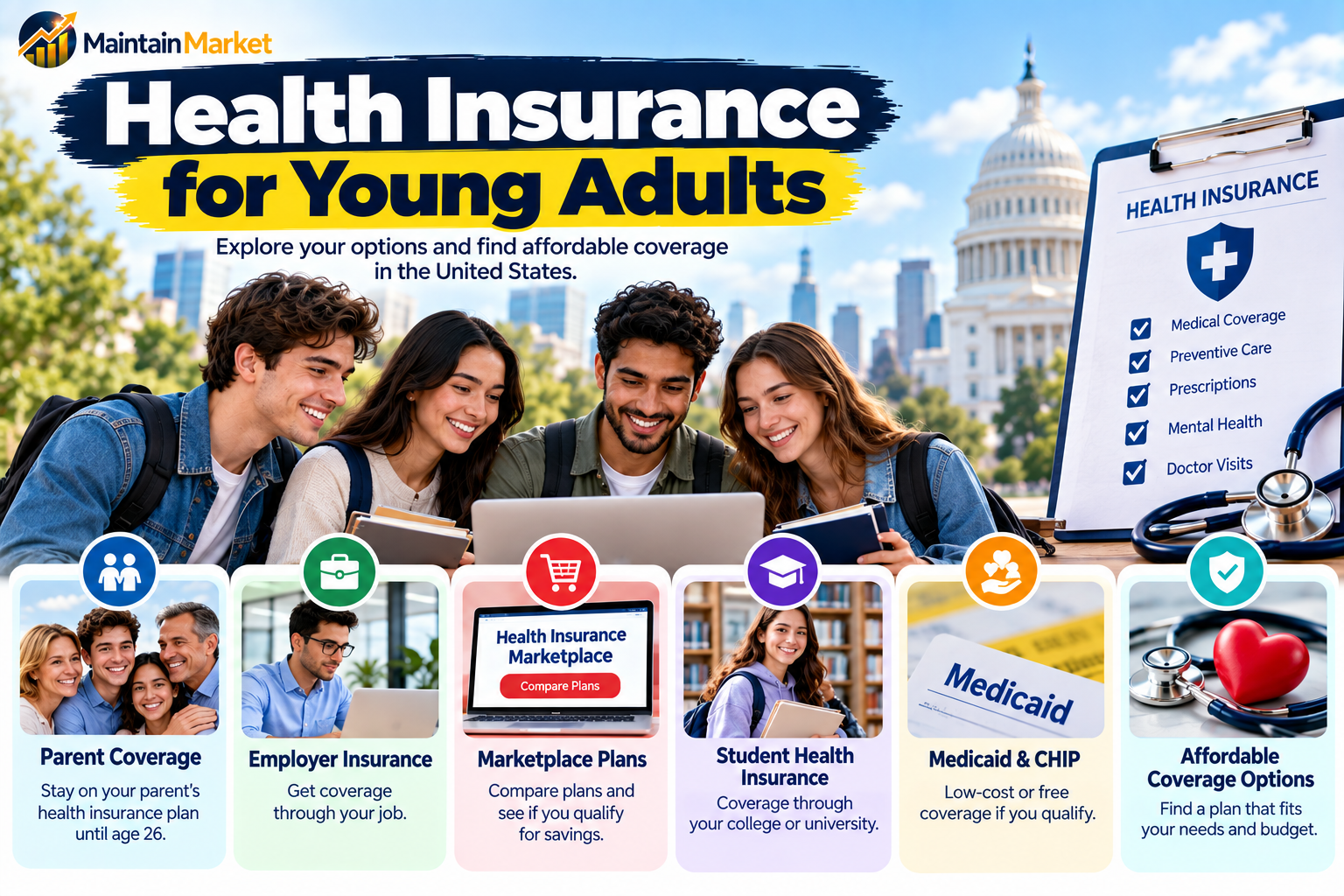
Finding health insurance for young adults can be confusing, especially when you’re starting a first job, leaving college, turning 26, or no longer covered by a parent. In the U.S., young adults can have several options, including a parent’s plan, employer coverage, Marketplace insurance, student health plans, Medicaid, and other qualifying coverage.
Quick Answer: What Health Insurance Options Do Young Adults Have?
If you’re a young adult in the U.S., your options may include:
- Staying on a parent’s health insurance plan
- Employer-sponsored health insurance
- Marketplace health insurance
- Student health insurance
- Medicaid
- Catastrophic health plans
- Other qualifying coverage
The right option depends on your age, income, employment, student status, location, and whether someone claims you as a tax dependent.
1. You May Be Able to Stay on Your Parent’s Health Insurance Until 26
One of the most important rules for young adults is the ability to stay on a parent’s health insurance plan.
If a parent’s plan covers dependents, you can generally stay on that plan until you turn 26.
This generally applies even if you:
- Get married
- Have or adopt a child
- Start or leave school
- Live away from your parents
- Aren’t claimed as a tax dependent
- Turn down an offer of job-based coverage
For job-based plans, your parent generally needs to add you during the employer’s Open Enrollment or a qualifying Special Enrollment Period.
Marketplace plans have their own enrollment rules.
If you’re approaching 26, start researching your next coverage option before your existing coverage ends.
2. Employer Health Insurance May Be an Option After College
If you have a full-time job, your employer may offer health insurance.
Employer-sponsored coverage can be attractive because the employer may pay part of the premium.
When comparing an employer plan, don’t look only at the monthly premium.
Check:
- Monthly premium
- Deductible
- Copay
- Coinsurance
- Out-of-pocket maximum
- Doctor network
- Hospital network
- Prescription coverage
- Mental health benefits
- Preventive care
- Employer contribution
Example
Imagine your employer offers:
Plan A
- $100 monthly premium
- $2,000 deductible
Plan B
- $40 monthly premium
- $5,000 deductible
Plan B has the lower monthly premium, but you could pay more when you actually need medical care.
That’s why young adults should compare the total potential cost, not just the premium.
3. Marketplace Health Insurance Can Be an Option
If you don’t have affordable employer coverage or another qualifying option, you may be able to purchase insurance through the Health Insurance Marketplace.
HealthCare.gov says young adults can apply for Marketplace coverage and may qualify for savings based on their income and circumstances.
A Marketplace application can also determine whether you may qualify for Medicaid.
Marketplace plans can vary by:
- Monthly premium
- Deductible
- Provider network
- Copays
- Coinsurance
- Prescription coverage
- Out-of-pocket maximum
- Plan type
Before choosing a plan, check whether your preferred doctors and hospitals are included in the network.
4. Your Income Can Affect Marketplace Savings
Young adults with lower or moderate household income may qualify for financial assistance when purchasing Marketplace coverage, depending on their circumstances.
Your eligibility can depend on factors such as:
- Household income
- Household size
- Tax-dependent status
- State
- Other available health coverage
One important point is tax dependency.
If someone claims you as a tax dependent, you can still buy Marketplace coverage, but the way your eligibility for savings is calculated can be different.
Don’t estimate your eligibility only from your personal income without considering your household and tax situation.
5. College Students Have Additional Health Insurance Options
If you’re a college student, your school may offer a student health plan.
A student plan can be convenient because it may be designed around the medical providers and services available near your school.
But you don’t necessarily have to use the student plan.
Depending on your situation, you may also be able to:
- Stay on a parent’s plan
- Purchase Marketplace coverage
- Qualify for Medicaid
- Use another qualifying health plan
If you attend college in another state, pay special attention to the provider network.
A plan that works well in your parent’s state may have limited providers where you attend school.
6. Turning 26 Is an Important Health Insurance Milestone
Turning 26 can change your health insurance situation.
If you’ve been covered through a parent’s plan, you’ll generally need to transition to your own coverage when that dependent coverage ends.
Your options may include:
- Employer coverage
- Marketplace coverage
- Medicaid
- Student health insurance
- Other qualifying coverage
Don’t wait until your 26th birthday to investigate your options.
Start checking your eligibility and enrollment deadlines ahead of time.
HealthCare.gov also provides a Special Enrollment pathway for people who lose coverage after aging off a parent’s plan when the applicable requirements are met.
7. Medicaid May Provide Low-Cost Coverage for Eligible Young Adults
Medicaid can provide free or low-cost health coverage to eligible people.
Eligibility depends on factors that can include:
- Income
- State
- Household circumstances
- Disability
- Pregnancy
- Other eligibility rules
Medicaid rules aren’t identical in every state.
If your income is relatively low, it is worth checking Medicaid eligibility before assuming that private insurance is your only option.
You can apply for Medicaid and CHIP throughout the year.
8. Catastrophic Health Plans May Be Available to Some Young Adults
Catastrophic health plans are designed primarily to protect against major medical expenses rather than provide the lowest possible cost for routine care.
HealthCare.gov notes that people under 30 may be eligible to choose a Catastrophic plan.
These plans generally have lower premiums but high deductibles.
They can therefore be very different from a plan with a higher monthly premium and lower deductible.
Before choosing one, compare:
- Premium
- Deductible
- Out-of-pocket maximum
- Covered services
- Provider network
- Prescription coverage
A lower monthly premium doesn’t necessarily mean a lower total cost if you need significant medical care.
9. Losing Your Job Can Change Your Health Insurance Options
If you lose job-based health insurance, you may have options outside the normal Open Enrollment period.
HealthCare.gov states that losing job-based coverage can qualify you for a Special Enrollment Period.
If you lose job-based coverage, you may be able to:
- Enroll in Marketplace coverage
- Apply for Medicaid
- Consider COBRA continuation coverage if eligible
- Review other qualifying coverage options
The timing matters.
For example, HealthCare.gov says people who lose job-based health coverage generally have 60 days to enroll in Marketplace coverage through a Special Enrollment Period.
Don’t assume that you have to remain uninsured until the next Open Enrollment period.
10. Compare More Than the Monthly Premium
One of the biggest mistakes young adults make is choosing health insurance based only on the monthly premium.
Instead, compare the complete cost structure.
| Cost | What It Means |
|---|---|
| Premium | Monthly amount you pay for coverage |
| Deductible | Amount you generally pay before the plan begins paying for many covered services |
| Copay | Fixed amount you pay for certain covered services |
| Coinsurance | Percentage of covered costs you pay after the deductible, depending on the plan |
| Out-of-pocket maximum | Maximum amount you pay for covered services during the plan year, subject to plan rules |
| Network | Doctors, hospitals and other providers contracted with the plan |
Simple example
Suppose:
Plan A
- $150/month premium
- $1,500 deductible
Plan B
- $80/month premium
- $6,000 deductible
Plan B saves:
$70 per month
or:
$840 per year
But if you have significant medical expenses, the higher deductible could make Plan B much more expensive overall.
Health Insurance for Young Adults: Which Option Should You Check First?
Instead of automatically choosing one type of insurance, work through your available options.
If you’re under 26
Check whether you can remain on a parent’s plan.
If you have a job
Compare your employer’s plan with Marketplace options if you’re eligible to enroll in the Marketplace.
If you’re a college student
Check your school’s student health plan and compare it with your parent’s coverage or Marketplace options.
If your income is low
Check Medicaid eligibility.
If you’re turning 26
Start planning your transition away from your parent’s plan before coverage ends.
If you’ve recently lost coverage
Check whether you qualify for a Special Enrollment Period.
What Should Young Adults Look for in a Health Insurance Plan?
Before enrolling, check these items:
1. Monthly premium
How much will you pay every month?
2. Deductible
How much could you have to pay before the plan starts paying for many covered services?
3. Out-of-pocket maximum
What’s the most you could pay for covered services during the plan year, subject to the plan’s terms?
4. Doctor network
Are your preferred doctors included?
5. Hospital network
Are nearby hospitals covered?
6. Prescription coverage
Check whether your medications are covered and what tier they fall into.
7. Mental health coverage
Check the plan’s behavioral health and mental health benefits.
8. Preventive care
Review which preventive services are covered and under what conditions.
9. Emergency care
Understand how emergency services are handled.
10. Out-of-state coverage
This can be particularly important for students and young adults who travel or live in another state.
Health Insurance Mistakes Young Adults Should Avoid
Assuming you’re automatically uninsured after leaving college
You may have several coverage options.
Waiting until your parent’s plan ends
Start researching your next plan before your coverage ends.
Choosing only by premium
A low premium can come with a high deductible or other out-of-pocket costs.
Ignoring provider networks
A plan may look affordable until you discover that your preferred doctor isn’t in-network.
Forgetting about Medicaid
If your income is low enough, Medicaid may be an option depending on your state and circumstances.
Assuming every student plan is the same
Student health plans can differ significantly by school and location.
Missing a Special Enrollment deadline
Some qualifying events have limited enrollment windows.
Frequently Asked Questions
What is the best health insurance for young adults?
There isn’t one health insurance plan that is best for every young adult. Your options can include a parent’s plan, employer coverage, Marketplace insurance, student coverage, Medicaid, or a Catastrophic plan depending on your circumstances.
Can I stay on my parents’ health insurance after 26?
Generally, federal dependent-coverage rules allow coverage on a parent’s plan until age 26. Some states and plans may have additional rules, so check the specific plan before your coverage ends.
Can a 25-year-old get their own health insurance?
Yes. A 25-year-old can potentially obtain their own Marketplace coverage, employer coverage, student coverage, Medicaid, or other qualifying insurance. They may also remain on a parent’s plan if eligible.
What happens to health insurance when I turn 26?
If you’re covered through a parent’s plan, you’ll generally need to transition to your own coverage when that dependent coverage ends. Losing dependent coverage may qualify you for a Special Enrollment Period.
Can college students stay on their parents’ health insurance?
Generally, yes, if they meet the applicable dependent-coverage rules. Living in another state for college can make provider-network considerations especially important.
Is health insurance expensive for young adults?
Costs vary significantly depending on the plan, location, income, employer contribution, age, household circumstances and other factors. Some young adults may qualify for financial assistance or Medicaid.
Can young adults get Medicaid?
Potentially. Medicaid eligibility depends on state rules and factors such as income and household circumstances. You can apply throughout the year.
What happens if I lose my job and health insurance?
Losing job-based coverage may qualify you for a Special Enrollment Period for Marketplace coverage. You may also have other options, including Medicaid or COBRA if eligible.
A Simple Health Insurance Checklist for Young Adults
Before choosing coverage, ask:
- Can I stay on my parent’s plan?
- Does my employer offer health insurance?
- Does my college offer a student health plan?
- Could I qualify for Medicaid?
- Could I qualify for Marketplace savings?
- What is the monthly premium?
- What is the deductible?
- What is the out-of-pocket maximum?
- Are my doctors in-network?
- Are nearby hospitals in-network?
- Are my medications covered?
- Do I have out-of-state coverage?
- Am I approaching age 26?
- Do I qualify for a Special Enrollment Period?
Final Takeaway
Health insurance for young adults doesn’t have to mean choosing the first plan you see.
If you’re under 26, start by checking whether you can remain on a parent’s plan. If you’re working, compare your employer’s coverage. If you’re in college, review your student health plan. If your income is low, check Medicaid eligibility. And if you need individual coverage, explore Marketplace plans and any available savings.
The most important thing is to compare the full cost of coverage, including premiums, deductibles, copays, coinsurance, out-of-pocket limits and provider networks.
Why Maintain Market Is Different
Maintain Market explains health insurance in practical terms instead of focusing only on monthly premiums.
For young adults, we break down the major coverage paths—parent plans, employer insurance, Marketplace plans, student coverage, Medicaid and Catastrophic plans—so readers can understand what options may apply to their situation.
References
- HealthCare.gov — Health Coverage Options for Young Adults
- HealthCare.gov — Coverage Under a Parent’s Plan Until 26
- HealthCare.gov — Health Coverage Options for College Students
- HealthCare.gov — Medicaid & CHIP Coverage
- HealthCare.gov — Special Enrollment Periods
- HealthCare.gov — Qualifying Life Events
- HealthCare.gov — Health Insurance for People Under 30
Editorial Review
Reviewed for U.S. health insurance terminology, young-adult coverage options, age-26 dependent coverage, Marketplace enrollment, Medicaid and Special Enrollment Period guidance. Rules and plan availability can vary by state and change over time, so readers should verify current eligibility and plan details before enrolling.
Recommended Reads
- Best Car Insurance Companies for Low Credit Score — Learn how credit history can affect auto insurance costs and what options may be available to drivers with lower credit scores.
- Insurance Claim Under Investigation — Understand what an insurance investigation means, what documents may be requested, and what steps you can take when a claim is delayed.