

Insurance claim under investigation what to do USA? Learn why insurers delay claims in 2026 and the exact steps to speed up approval and get paid faster.
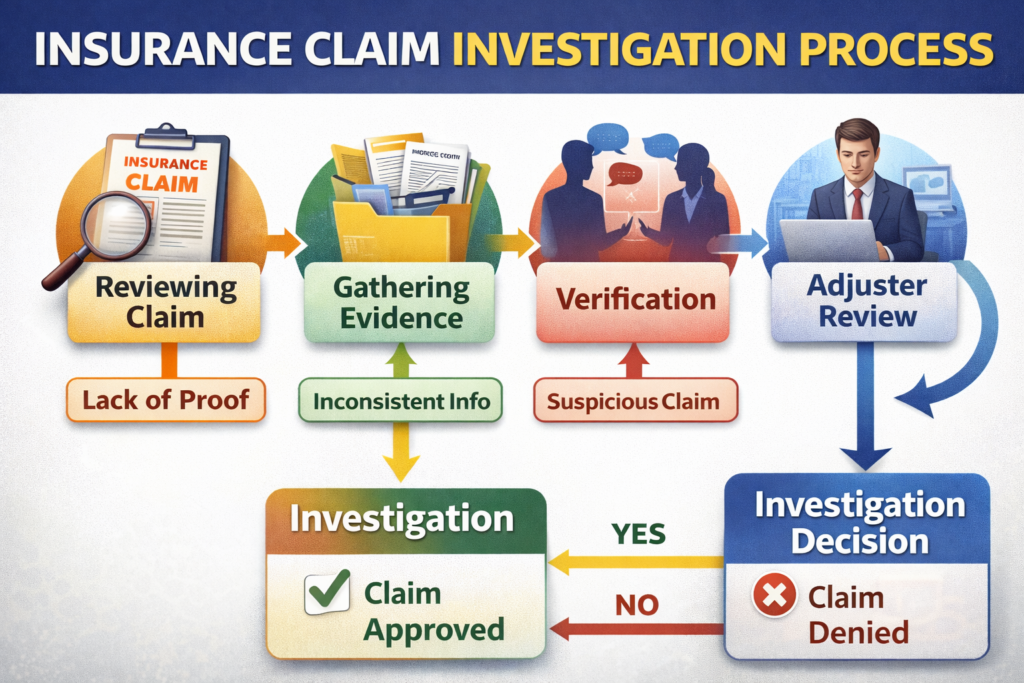
QUICK ANSWER BOX
If your insurance claim is under investigation in the USA, do this immediately:
- Ask for written reason for investigation
- Submit all documents (proof, bills, photos, reports)
- Stay in regular contact with adjuster
- Avoid giving inconsistent statements
- Track deadlines (most investigations: 15–45 days)
- Escalate if delayed (supervisor / state regulator)
👉 Most investigations are about verification, not rejection
INTRODUCTION (REAL TALK)
You filed your insurance claim expecting relief…
Instead, you got this message:
👉 “Your claim is under investigation.”
Now you’re stuck.
No timeline. No clear answer. No payment.
And the worst part?
You start thinking:
- “Did I do something wrong?”
- “Are they going to deny my claim?”
- “How long will this take?”
In the U.S., this situation is more common than people realize—especially in 2025–2026, where insurance companies are aggressively verifying claims due to fraud risks.
But here’s the truth:
Investigation doesn’t mean rejection.
It means they’re trying to protect their money.
And if you understand how the system works—you can speed up your claim and avoid delays.
1. Why Insurance Claims Go Under Investigation (Real US Logic)
Insurance companies don’t randomly investigate.
They investigate when something looks “risky” or “unclear.”
Common triggers:
- High claim amount
- Recent policy purchase
- Inconsistent information
- Missing documents
- Multiple past claims
- Suspicious timing (e.g., claim right after buying policy)
👉 Example:
You buy car insurance… and within 10 days file a large claim.
That’s a red flag.
2. What “Under Investigation” Actually Means
Most people panic here.
But let’s break it down simply:
👉 It means:
- They are verifying facts
- Checking documents
- Reviewing policy coverage
- Looking for fraud or errors
It does NOT mean:
- Your claim is denied
- You did something wrong
3. Step-by-Step: What You Should Do Immediately
Step 1: Ask for the Exact Reason
Call or email your insurer and ask:
👉 “Why is my claim under investigation?”
Get it in writing.
Step 2: Submit Complete Documentation


Include:
- Photos/videos
- Bills/receipts
- Police reports (if applicable)
- Medical reports
- Proof of ownership
Step 3: Stay Consistent
This is critical.
If your story changes even slightly:
👉 It raises suspicion
Step 4: Follow Up Regularly
Don’t wait silently.
👉 Follow up every 5–7 days
Step 5: Track Deadlines
In most U.S. states:
- Insurance companies must respond within 15–45 days
4. Comparison Table: Smart vs Risky Claim Behavior
| Behavior | Result |
|---|---|
| Clear documentation | Faster approval |
| Regular follow-up | Keeps claim active |
| Inconsistent statements | Delay or rejection |
| Missing paperwork | Investigation extends |
| Aggressive communication | Can backfire |
5. Real-Life Case Study (USA)
Case: Mike (Florida)
- Filed home damage claim ($18,000)
- Claim went under investigation
Reason:
- Damage reported 3 days after policy purchase
What he did:
- Submitted timestamped photos
- Provided contractor report
- Followed up weekly
Result:
👉 Claim approved in 32 days
6. Mistakes That Make Investigation Worse
- Ignoring calls/emails
- Submitting incomplete documents
- Giving different statements
- Getting impatient and aggressive
- Applying pressure without proof
7. Expert Insights (Insurance Company Tricks)
Let’s be honest.
Insurance companies sometimes:
- Delay intentionally to test patience
- Look for small inconsistencies
- Ask repeated questions
- Request extra documents
👉 Why?
Because:
The longer you wait, the higher chance you give up or settle low
8. Timeline: What to Expect
| Stage | Timeline |
|---|---|
| Initial review | 3–7 days |
| Investigation phase | 15–45 days |
| Final decision | 7–10 days |
👉 Total:
Usually 3–6 weeks
9. Strategy Breakdown (How Insurance Companies Think)
Insurance companies evaluate:
- Risk
- Accuracy
- Consistency
- Policy terms
They are not emotional.
They are calculating.
10. How to Speed Up Your Claim (Real Hacks)
- Submit everything at once
- Use written communication (email proof)
- Ask for supervisor review if delayed
- Keep records of every interaction
11. When to Escalate (Important)
Escalate if:
- No response for 30+ days
- No clear reason given
- Repeated delays
Options:
- State insurance department
- Legal consultation
12. Where to Apply (USA Insurance Providers)
You can compare or apply here:
- https://www.geico.com
- https://www.progressive.com
- https://www.statefarm.com
- https://www.allstate.com
- https://www.lemonade.com
13. What Your Insurance Policy Actually Says (But You Probably Missed)
Most claim investigations come down to one thing:
👉 Policy wording
Not what you thought was covered—what is actually written.
Key areas to check immediately:
- Deductible clause → You may need to pay first
- Coverage limits → Maximum payout cap
- Exclusions → Situations NOT covered
- Waiting periods → Especially for health policies
- Filing deadlines → Missing this can trigger investigation
Example:
You file a water damage claim.
Policy says:
👉 “Gradual damage not covered”
Insurance may investigate to check:
- Was it sudden?
- Or long-term leakage?
👉 Small wording = big difference
14. How Insurance Companies Build a Case During Investigation
Think like them for a second.
They are not just “checking”—they are building a case file.
They verify:
- Timeline of the incident
- Your past claim history
- Policy start date vs claim date
- Supporting documents consistency
- Third-party verification (police, hospital, repair shops)
👉 Their goal:
Eliminate doubt before releasing money
What this means for you:
- Every document must match
- Every statement must align
- Every date must be correct
Even small mismatches:
👉 Can extend investigation or reduce payout
15. Digital Tracking: How to Monitor Your Claim Status Properly
Most people just “wait” after filing.
That’s the wrong approach.
Use these methods:
- Log into your insurer’s online portal
- Track claim ID regularly
- Save all email communication
- Maintain a timeline log (calls, updates, responses)
Smart tracking habit:
Create a simple note:
- Date claim filed
- Documents submitted
- Last response received
- Next follow-up date
👉 This makes you look organized + serious
And insurers respond faster to such users.
16. Hidden Reasons Why Your Claim Is Still Under Investigation
Most websites won’t tell you this clearly.
Sometimes your claim is under investigation not because of fraud—but because of internal insurance triggers.
16.1 Internal Risk Scoring System
Insurance companies use automated systems that flag:
- High claim amount
- First-time large claim
- Claim filed too quickly after policy start
👉 Even genuine claims get flagged here.
16.2 Third-Party Verification Delays
Your insurer may be waiting for:
- Hospital confirmation
- Police report
- Repair estimate
- Contractor inspection
👉 Delay is not always from your side.
16.3 Adjuster Workload (Underrated Reality)
In the U.S., adjusters often handle:
- 30–100 claims at once
👉 Your claim might simply be sitting in queue
16.4 Special Investigation Unit (SIU) Involvement
If your claim is flagged:
- It goes to SIU (fraud team)
- Investigation becomes deeper
- Timeline increases significantly
17. Documents That Can Speed Up Approval (Most People Miss These)


Beyond basic documents, submit these:
- Timestamped photos/videos
- Witness statements
- Repair estimates from certified vendors
- Bank/payment proof
- Email communication records
👉 These reduce back-and-forth delays
18. How to Talk to Your Insurance Adjuster (Important Skill)
Most people mess this up.
What NOT to do:
- Don’t argue emotionally
- Don’t give extra unnecessary details
- Don’t change your story
What TO do:
- Stay calm and factual
- Answer only what is asked
- Keep communication documented
👉 Treat it like a professional conversation, not a complaint
19. Red Flags That Can Lead to Claim Rejection After Investigation
Watch this carefully.
If these happen, your claim may be denied:
- Contradicting statements
- Fake or unclear documents
- Policy exclusion discovered
- Delayed reporting of incident
- Lack of proof
👉 Investigation → can turn into rejection if mishandled
20. How to Handle a Delayed Investigation (30+ Days)
If your claim is stuck:
Step 1: Send Written Follow-Up
Ask:
👉 “What is pending from my side?”
Step 2: Ask for Supervisor
If no response:
👉 Escalate to claim manager
Step 3: Mention Regulatory Timeline
Politely say:
👉 “As per state guidelines, I expect a timeline update”
Step 4: File Complaint (If Needed)
- State insurance department
- Consumer complaint portal
👉 This often speeds things up instantly
21. Settlement Negotiation After Investigation
Even if approved:
👉 You may not get full amount
What to do:
- Review settlement breakdown
- Compare with actual expenses
- Ask for justification
Negotiation Tips:
- Use repair estimates
- Provide market cost comparison
- Stay firm but professional
👉 Many users increase payout by 10–30%
22. Difference Between Investigation vs Delay vs Denial
| Situation | Meaning | Action Needed |
|---|---|---|
| Investigation | Verification phase | Submit proof |
| Delay | Internal slow process | Follow up |
| Denial | Claim rejected | Appeal |
👉 Don’t confuse these—strategy changes
23. Claim Types That Get Investigated More Often (USA Trend)
High-risk claims:
- Auto accidents (recent policy)
- Water damage (home insurance)
- Theft claims
- Health claims with high bills
- Liability claims
👉 These categories need extra documentation
24. How to Avoid Investigation in Future Claims
Prevention is powerful.
Do this:
- Understand your policy clearly
- Report incidents immediately
- Maintain proof (photos, bills)
- Avoid exaggeration
- Keep records organized
👉 Clean claims = faster approvals
25. Advanced Strategy: Build “Claim-Proof” Profile
Smart policyholders do this:
- Maintain long policy history
- Avoid frequent small claims
- Keep consistent records
- Build trust with insurer
👉 Result:
Less investigation + faster approvals
26. Emotional Reality (What People Go Through)
Let’s be real.
When your claim is under investigation:
- You feel stuck
- You lose trust in insurer
- You feel financially stressed
👉 This is exactly where people make mistakes
27. Psychological Advantage
Insurance companies expect:
- Panic
- Confusion
- Incomplete responses
If you stay:
👉 Calm + documented + consistent
You gain advantage.
If your claim is under investigation and you’re unsure what’s missing, the smartest step is to review your full policy and claim status with proper documentation. Most delays happen because users don’t see what insurers are actually checking.
28. Why MaintainMarket is Different
We don’t give generic advice.
We explain:
- How companies actually behave
- What real users experience
- What actually works
29. Final Action Plan
Do this now:
- Ask for investigation reason
- Submit full documents
- Follow up weekly
- Track timeline
- Escalate if needed
30. FINAL INSIGHT
Your claim being under investigation is not a problem.
Losing control of the process is the problem.
Once you:
- Understand their system
- Provide the right proof
- Follow the right steps
👉 You shift from waiting → to controlling
FAQs – Insurance Claim Under Investigation
Q1. How long can an insurance investigation take?
Usually 15–45 days.
Q2. Does investigation mean rejection?
No
Q3. Can I speed up my claim?
Yes, with documentation + follow-up.
Q4. Should I hire a lawyer?Q4.
Only if delays are extreme.
Q5. What if they deny after investigation?
You can appeal.
People also searched for: Lost 50–100 Credit Score Dropped Suddenly? Fix It Before It Costs You Loans
Also read: How to Get Out of Debt Fast in 2026 (USA) — The Brutal Truth About Credit Card Traps
Why Your Tax Refund Is Delayed in 2026 (IRS) — And How to Get It Faster
3 thoughts on “Insurance Claim Under Investigation What To Do USA (2026): Why It Happens & How to Get Paid Faster”