
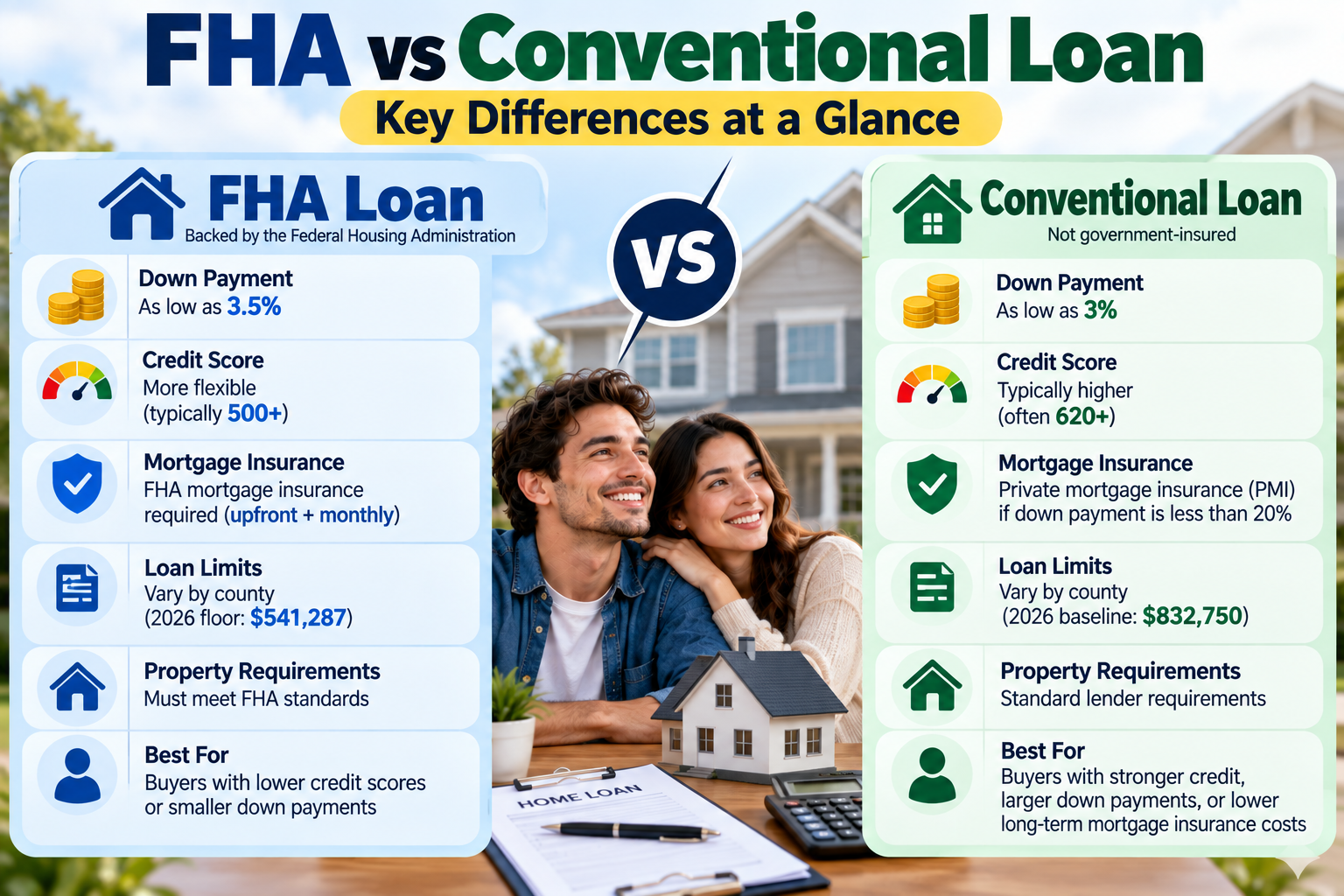
If you are comparing an FHA vs conventional loan, the biggest differences usually come down to credit requirements, down payment, mortgage insurance, loan limits, property requirements, and total borrowing costs. Neither mortgage is automatically right for every buyer, so comparing the complete loan offer is more useful than looking at just the interest rate or minimum down payment.
Quick Answer: FHA vs Conventional Loan
An FHA loan is a mortgage insured by the Federal Housing Administration and made through an FHA-approved private lender. FHA loans can allow down payments as low as 3.5% for qualifying borrowers and generally accommodate lower credit scores than most conventional loans.
A conventional loan is not insured or guaranteed by the federal government. Conventional mortgages can offer competitive pricing for borrowers with stronger credit and can have lower mortgage-insurance costs in some situations.
The important question is not simply which loan has the smaller down payment. Compare the interest rate, mortgage insurance, closing costs, monthly payment, loan term, and total cost.
FHA vs Conventional Loan: Side-by-Side Comparison
| Feature | FHA Loan | Conventional Loan |
|---|---|---|
| Government insurance | FHA-insured | Not government-insured |
| Minimum down payment | As low as 3.5% for qualifying borrowers | Some programs allow as little as 3% |
| Credit flexibility | Generally more flexible | Requirements vary by lender/program |
| Mortgage insurance | FHA mortgage insurance generally required | PMI may apply with less than 20% down |
| PMI cancellation | Different FHA rules | PMI may be cancellable under applicable rules |
| Loan limits | Vary by county | Vary by county/program |
| Property requirements | FHA requirements apply | Conventional program/lender requirements apply |
| Primary residence | Generally required for standard FHA financing | Primary residence, second homes and investment properties may be possible depending on program |
| Best comparison method | Total loan cost | Total loan cost |
CFPB says conventional loans can have PMI when the down payment is below 20%, while FHA loans generally require mortgage insurance.
1. FHA Loans Can Have a Lower Down Payment
One reason buyers consider FHA financing is the relatively low minimum required investment.
For qualifying borrowers, FHA financing can require as little as 3.5%.
For example:
| Home price | 3.5% down payment |
|---|---|
| $200,000 | $7,000 |
| $250,000 | $8,750 |
| $300,000 | $10,500 |
| $350,000 | $12,250 |
| $400,000 | $14,000 |
| $500,000 | $17,500 |
The minimum FHA investment depends on the applicable FHA requirements and borrower circumstances.
You can read the full Maintain Market guide on FHA loan down payment for a detailed breakdown of the 3.5% minimum, gift funds, assistance programs, and other cash requirements.
2. Conventional Loans Can Also Have Low Down Payments
A common misconception is that conventional mortgages always require 20% down.
That is not true.
Some conventional programs can allow down payments as low as 3%, depending on the borrower, property, program, and lender requirements.
However, a low down payment can mean private mortgage insurance is required.
CFPB notes that some conventional loans with down payments below 20% require PMI, although specific requirements vary.
So a buyer comparing:
- 3% conventional
- 3.5% FHA
- 5% conventional
- 10% conventional
- 20% conventional
should compare the complete monthly payment and loan costs instead of focusing only on the initial cash requirement.
3. FHA Can Be More Flexible With Lower Credit Scores
Credit score requirements are one of the major differences buyers consider.
FHA loans generally allow lower credit scores than most conventional loans.
Under the FHA framework, qualifying borrowers with a score of 580 or higher can generally qualify for the 3.5% minimum required investment, while borrowers with scores between 500 and 579 may generally need a 10% minimum investment.
However, lenders can have their own underwriting requirements.
CFPB specifically notes that FHA loans allow lower credit scores than most conventional loans.
For more detail, see Maintain Market’s FHA loan requirements guide.
4. Mortgage Insurance Works Differently
This is one of the most important differences.
FHA mortgage insurance
FHA loans generally require mortgage insurance.
FHA mortgage insurance includes an upfront component and a monthly component under the applicable FHA rules. The upfront premium may be financed into the loan, which increases the loan balance and overall borrowing cost.
Conventional PMI
Conventional loans may require private mortgage insurance (PMI) when the down payment is below 20%.
CFPB says PMI rates can vary based on factors including down payment and credit score and that PMI can generally be cancelled under applicable circumstances.
This difference can have a major impact on your long-term mortgage cost.
5. FHA Mortgage Insurance Can Affect the Total Cost
A low down payment can make it easier to purchase a home, but it doesn’t necessarily mean the loan will cost less overall.
FHA mortgage insurance is generally required for FHA loans, and the cost becomes part of the overall mortgage expense.
For example, a buyer could compare:
FHA
- Lower minimum down payment
- More flexible credit requirements
- FHA mortgage insurance
versus:
Conventional
- Potentially higher credit requirements
- Potentially lower mortgage insurance costs for stronger borrowers
- PMI when applicable
CFPB notes that borrowers with good credit and a medium down payment may find conventional financing less expensive than FHA, while FHA can be less expensive for borrowers with lower credit scores or smaller down payments.
6. Conventional PMI May Be Removed Later
One potential advantage of conventional financing is that PMI can generally be cancelled under certain conditions.
For many conventional mortgages, homeowners can request PMI cancellation when the principal balance reaches 80% of the home’s original value, subject to applicable requirements. Automatic termination can also apply at a later point under federal law if certain conditions are met.
FHA mortgage insurance follows different rules.
This means you should not compare FHA and conventional mortgages based only on their starting monthly payment.
Think about what the mortgage insurance could cost over time.
7. FHA and Conventional Loans Have Different Loan Limits
Loan limits matter because you cannot simply borrow any amount under every mortgage program.
For 2026, FHA’s national one-unit loan-limit floor is $541,287, while the high-cost ceiling is $1,249,125. Actual FHA limits vary by county and property size.
For conventional conforming loans, the 2026 baseline limit for a one-unit property is $832,750 in most of the United States, with higher limits in designated high-cost areas.
2026 one-unit comparison
| Loan type | 2026 national baseline/floor | High-cost ceiling |
|---|---|---|
| FHA | $541,287 floor | $1,249,125 |
| Conventional conforming | $832,750 baseline | $1,249,125 |
These figures are not the same as your personal borrowing limit. Your actual maximum can depend on location, property type, lender rules, income, debts, credit, and other factors.
8. FHA Has Specific Property Requirements
FHA financing isn’t based only on the borrower’s finances.
The property must also meet applicable FHA requirements.
FHA appraisal and property standards are designed to address the condition and suitability of the property for FHA financing.
That means a property that might qualify for conventional financing could require additional work before it meets FHA requirements.
HUD’s current FHA Single Family Housing Policy Handbook 4000.1 is the primary source for FHA single-family policy, and HUD published an updated version in August 2026.
9. Conventional Loans May Offer More Property Flexibility
Conventional financing covers a wide range of property and borrower situations.
Depending on the specific program and lender, conventional financing may be available for:
- Primary residences
- Second homes
- Investment properties
- Different property types
FHA’s standard single-family program is primarily designed around owner-occupied residential properties.
If you’re buying a second home or investment property, conventional financing may be one of the programs worth discussing with lenders.
The exact eligibility rules depend on the specific mortgage program.
10. Your Credit and Down Payment Can Change the Cost Difference
There isn’t one fixed answer for how much more or less an FHA loan will cost compared with a conventional loan.
The difference can change depending on:
- Credit score
- Credit history
- Down payment
- Loan amount
- Interest rate
- Mortgage insurance
- Property location
- Loan term
- Closing costs
- Lender pricing
For example, a borrower with strong credit and 10% to 15% available for a down payment may receive a very different conventional offer from someone with a lower credit score and only 3.5% available.
That’s why CFPB recommends comparing actual loan offers rather than relying on general rules.
FHA vs Conventional Loan: Example
Suppose you are buying a $300,000 home.
FHA at 3.5%
Down payment:
$300,000 × 3.5% = $10,500
Base amount financed before applicable FHA mortgage insurance and other adjustments:
$289,500
Conventional at 3%
Down payment:
$300,000 × 3% = $9,000
Base amount financed:
$291,000
The conventional option starts with $1,500 less cash required for the down payment in this illustration.
But that doesn’t mean it will automatically be cheaper.
You would still need to compare:
- Interest rate
- PMI
- FHA mortgage insurance
- Closing costs
- Loan fees
- Monthly payment
- Total interest
- Cash needed at closing
This is why the down payment alone isn’t enough to determine the total cost.
FHA vs Conventional Loan for First-Time Homebuyers
Both options can be relevant to first-time buyers.
FHA may be worth comparing if:
- Your credit profile is weaker
- You have limited cash for a down payment
- You need more flexible qualification criteria
- The property meets FHA requirements
Conventional may be worth comparing if:
- You have stronger credit
- You can make a larger down payment
- You want to potentially reduce or eventually eliminate PMI
- You qualify for competitive conventional pricing
These are comparison points, not guarantees. Actual loan offers can differ considerably between borrowers.
FHA vs Conventional Loan With a 580 Credit Score
A borrower with a 580 credit score may qualify for the FHA 3.5% minimum investment framework if other FHA and lender requirements are met.
For conventional financing, qualification depends on the specific lender and program.
If your credit score is around 580, don’t assume you have only one option.
Ask lenders for actual quotes for both FHA and conventional financing if you qualify for each.
Compare the Loan Estimates rather than relying on a general online calculator.
FHA vs Conventional Loan With 700+ Credit
A borrower with stronger credit may qualify for more competitive conventional pricing.
That doesn’t mean FHA automatically becomes a poor choice.
The comparison should include:
- Interest rate
- Mortgage insurance
- Down payment
- Closing costs
- Monthly payment
- Total loan cost
CFPB specifically notes that FHA can be more expensive for borrowers with good credit and a medium down payment, while FHA may be less expensive for borrowers with lower credit scores or smaller down payments.
FHA vs Conventional Loan: 5% Down
With 5% available for a down payment, you could potentially compare both options.
For a $300,000 home:
5% down = $15,000
At this point, the comparison should focus heavily on mortgage insurance and the interest rate offered.
A conventional loan may have PMI, while an FHA loan generally has FHA mortgage insurance.
Ask both lenders for official Loan Estimates so you can compare the actual numbers.
Can You Switch From FHA to Conventional Later?
A homeowner may potentially refinance an FHA mortgage into a conventional mortgage later if they qualify.
For example, a borrower might refinance after:
- Building home equity
- Improving credit
- Increasing income
- Reducing debt
- Improving the loan-to-value ratio
But refinancing isn’t automatically beneficial.
You may have to pay closing costs and other fees, and the new interest rate and loan terms matter.
Always compare the total cost of refinancing with the potential savings.
FHA vs Conventional Loan: Which Costs Less?
There is no universal answer.
CFPB’s guidance is particularly useful here: conventional loans typically cost less than FHA loans overall but can be harder to qualify for. However, for borrowers with lower credit scores or smaller down payments, FHA can sometimes be less expensive.
Your actual offer matters more than the general rule.
Ask lenders to provide comparable Loan Estimates for:
- FHA
- Conventional
Then compare the same:
- Purchase price
- Loan amount
- Loan term
- Down payment
- Interest-rate assumptions
- Closing costs
How to Compare FHA and Conventional Offers
When you receive Loan Estimates, look at these sections carefully:
Interest rate
Compare the actual rate offered.
APR
APR can help you compare the broader cost of credit, although it should not be viewed as the only measure.
Monthly principal and interest
Check the basic mortgage payment.
Mortgage insurance
Compare FHA mortgage insurance with conventional PMI.
Upfront costs
Look at lender fees, mortgage insurance charges and other closing costs.
Cash to close
This tells you more than the down payment alone.
Total interest
Consider the long-term cost if you expect to keep the mortgage for many years.
CFPB recommends shopping around and comparing official Loan Estimates before choosing a mortgage.
Common FHA vs Conventional Mistakes
Mistake 1: Choosing based only on the down payment
A lower down payment doesn’t automatically mean a lower-cost mortgage.
Mistake 2: Looking only at the interest rate
Mortgage insurance and fees can significantly affect the overall cost.
Mistake 3: Assuming 20% down is always necessary for conventional
Some conventional programs allow substantially lower down payments.
Mistake 4: Assuming FHA is only for first-time buyers
FHA eligibility isn’t limited exclusively to first-time homebuyers.
Mistake 5: Assuming a credit score alone guarantees approval
Lenders also consider income, debts, credit history, property, documentation and other factors.
Mistake 6: Ignoring PMI cancellation rules
If you’re considering conventional financing with PMI, understand how and when PMI can be cancelled.
Mistake 7: Comparing different loan amounts
When comparing FHA and conventional offers, make sure you’re comparing equivalent loan amounts and terms.
FHA vs Conventional Loan Checklist
Before choosing a mortgage, compare:
- Purchase price
- Down payment
- Credit score
- Interest rate
- APR
- Monthly principal and interest
- FHA mortgage insurance
- Conventional PMI
- Closing costs
- Cash to close
- Loan term
- Loan limits
- Property requirements
- Prepayment considerations
- Expected time in the home
- Total borrowing cost
Frequently Asked Questions
Is FHA better than a conventional loan?
Neither loan is automatically better for every borrower. FHA can provide more flexible qualification options, while conventional financing may offer lower costs for some borrowers with stronger credit and larger down payments.
Is FHA cheaper than conventional?
It depends on the borrower. CFPB says conventional loans can be less expensive for borrowers with good credit and medium down payments, while FHA can sometimes be less expensive for borrowers with lower credit scores or smaller down payments.
What is the minimum down payment for FHA?
For qualifying borrowers, FHA financing can require as little as 3.5%. Borrowers with different credit profiles may have different minimum-investment requirements.
Can conventional loans have a 3% down payment?
Yes. Some conventional mortgage programs allow down payments as low as 3%, depending on borrower and program requirements.
Which has lower mortgage insurance, FHA or conventional?
It depends on the borrower. Conventional PMI pricing can vary based on factors including credit score and down payment, while FHA mortgage insurance follows FHA program rules.
Can I remove PMI from a conventional loan?
In many cases, yes. Federal rules provide for PMI cancellation under certain circumstances, including when the mortgage balance reaches a specified percentage of the home’s original value.
Does FHA mortgage insurance go away?
FHA mortgage insurance follows different rules from conventional PMI. Whether and when it ends depends on factors including the loan’s origination terms, down payment, and applicable FHA rules.
Can I buy a second home with an FHA loan?
Standard FHA financing is generally intended for owner-occupied primary residences. Conventional financing can offer options for second homes subject to program and lender requirements.
What credit score is needed for FHA vs conventional?
FHA has a framework that can allow qualifying borrowers with scores as low as 500, although the required investment changes and lenders may have additional requirements. Conventional credit requirements vary by program and lender.
Are FHA loans only for first-time homebuyers?
No. FHA loans are not exclusively limited to first-time buyers. Eligibility depends on the applicable FHA program requirements.
Final Takeaway
The FHA vs conventional loan decision comes down to your individual financial profile and the actual loan offers available to you.
FHA financing can be useful for borrowers who need a smaller down payment or more flexible credit requirements. Conventional financing can be attractive to borrowers with stronger credit, larger down payments, or a desire for conventional PMI that can potentially be cancelled under applicable rules.
Don’t choose based only on the minimum down payment.
Get comparable FHA and conventional Loan Estimates and compare the interest rate, mortgage insurance, closing costs, monthly payment, cash to close, and total borrowing cost.
That comparison will give you a much clearer picture of how each mortgage could affect your finances.
Why Maintain Market Is Different
Maintain Market focuses on making complicated financial decisions easier to understand without reducing them to a single “best” answer.
For mortgage comparisons, we look beyond the headline interest rate and down payment and explain the factors that can change the real cost of borrowing, including mortgage insurance, credit requirements, loan limits and closing costs.
References
- CFPB — FHA Loans
- CFPB — Conventional Loans
- CFPB — Mortgage Insurance & PMI
- CFPB — PMI Cancellation
- CFPB — Shopping for a Mortgage
- HUD — FHA Handbook 4000.1
- HUD — FHA Loan Limits
- FHFA — Conforming Loan Limits
Editorial Review
Reviewed for U.S. FHA and conventional mortgage terminology, down-payment rules, mortgage insurance, PMI, FHA loan limits conforming loan limits. Mortgage eligibility, rates, fees and lender requirements vary by borrower, property, location and lender. Readers should compare current Loan Estimates before choosing a mortgage.
Recommended Reads
- FHA Loan Requirements — Understand FHA credit, income, mortgage insurance, property and qualification requirements.
- FHA Loan Down Payment — Learn how the 3.5% FHA minimum works and what other cash you may need to close.