
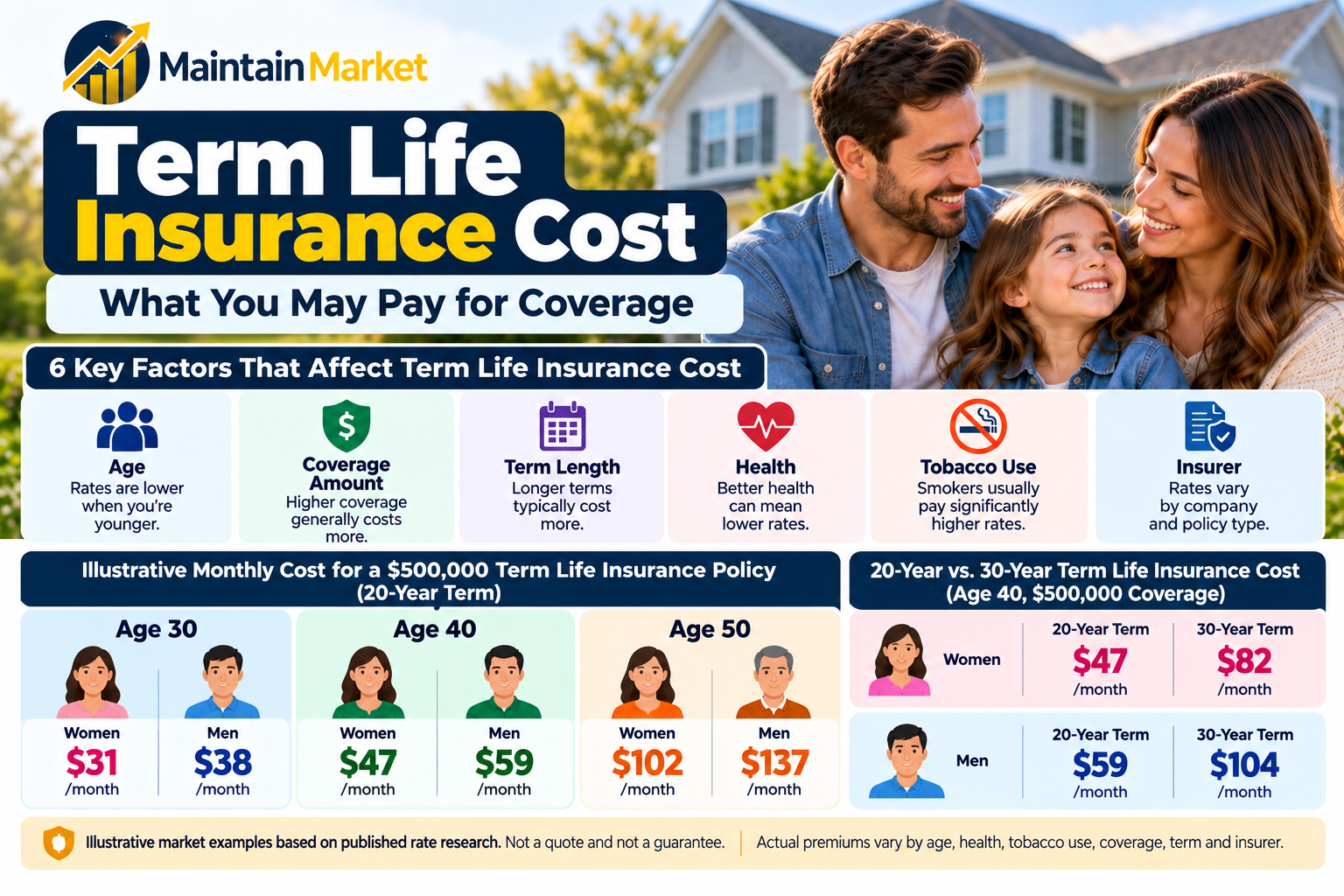
Term life insurance cost can range from relatively affordable monthly premiums for younger, healthy applicants to several hundred dollars per month for older applicants or people with higher-risk profiles. Age, coverage amount, term length, health, tobacco use and the insurer you choose can all affect the price.
There is no single “average” price that applies to everyone. Data provides useful benchmarks, but your actual premium will depend on your individual underwriting profile.
Quick Answer: How Much Does Term Life Insurance Cost?
For a healthy nonsmoker, a $500,000, 20-year term life insurance policy can cost roughly:
| Age | Women | Men |
|---|---|---|
| 25 | $30/month | $37/month |
| 30 | $31/month | $38/month |
| 35 | $37/month | $47/month |
| 40 | $47/month | $59/month |
| 45 | $69/month | $90/month |
| 50 | $102/month | $137/month |
| 55 | $168/month | $231/month |
| 60 | $286/month | $395/month |
| 65 | $415/month | $591/month |
These are 2026 published rate estimates, not guaranteed quotes. The underlying analysis assumes a $500,000 policy, a 20-year term and a nonsmoker with average health. Actual premiums can differ substantially.
The biggest takeaway is simple:
Buying term life insurance earlier can lock in a substantially lower premium for the policy term.
1. What Is the Average Term Life Insurance Cost?
There isn’t one universal average because life insurance is individually underwritten.
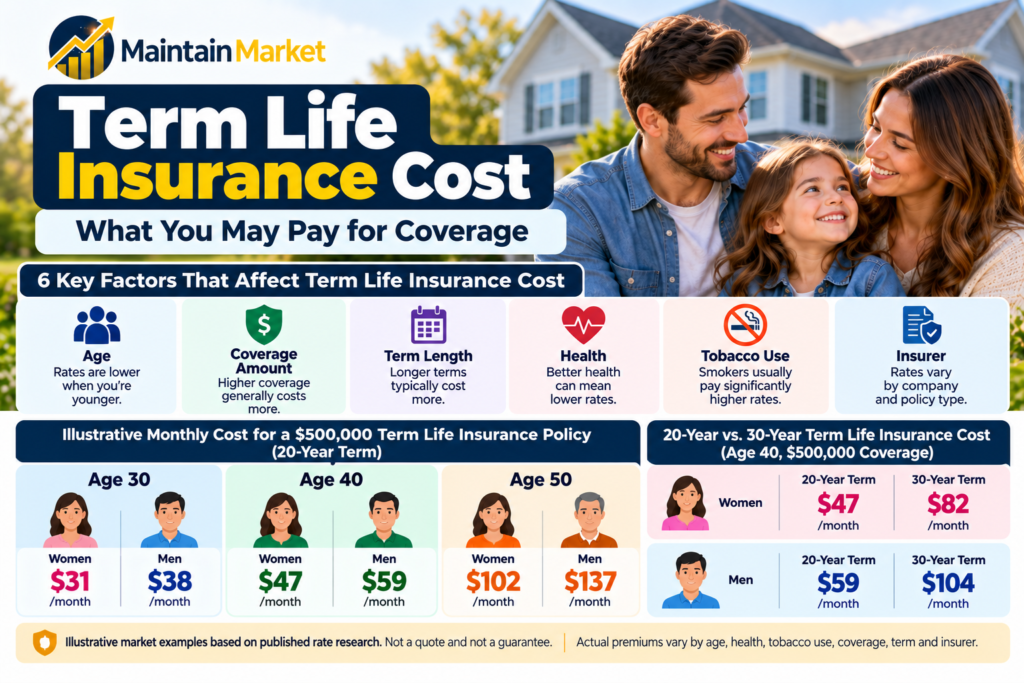
For a useful benchmark, current 2026 rate research shows that a healthy 40-year-old nonsmoker purchasing $500,000 of 20-year term coverage may see an average of approximately:
- $47 per month for women
- $59 per month for men
That works out to approximately:
- $564 per year for the $47/month example
- $708 per year for the $59/month example
Over 20 years, if the premium stayed exactly the same:
- $47 × 12 × 20 = $11,280
- $59 × 12 × 20 = $14,160
These calculations are simply the premium multiplied over time. They are not an investment return or guaranteed financial value.
2. Term Life Insurance Cost by Age
Age is one of the biggest factors affecting life insurance pricing.
Consider the same:
- $500,000 coverage
- 20-year term
- Nonsmoker
- Average health
The published 2026 rate examples show:
| Age | Women | Men |
|---|---|---|
| 25 | $30 | $37 |
| 30 | $31 | $38 |
| 35 | $37 | $47 |
| 40 | $47 | $59 |
| 45 | $69 | $90 |
| 50 | $102 | $137 |
| 55 | $168 | $231 |
| 60 | $286 | $395 |
| 65 | $415 | $591 |
Notice what happens after age 40.
The premium doesn’t simply rise by a few dollars every year. The increase becomes much more pronounced at older ages.
That’s why applying earlier can make a major difference when you know you’ll need coverage for a long period.
3. How Much Does $500,000 Term Life Insurance Cost?
$500,000 is a common coverage amount used in life insurance rate comparisons.
For a 40-year-old nonsmoker, current 2026 published examples show:
| Term | Women | Men |
|---|---|---|
| 10 years | $34/month | $41/month |
| 20 years | $47/month | $59/month |
| 30 years | $82/month | $104/month |
This illustrates an important point:
Term length matters almost as much as coverage amount when comparing premiums.
A 30-year policy costs more because the insurer is agreeing to provide coverage for a longer period.
4. How Much Does a $1 Million Term Life Insurance Policy Cost?
A $1 million policy doesn’t necessarily cost exactly twice as much as a $500,000 policy.
For a 40-year-old nonsmoker, current 2026 published rate examples show:
| Term | Women | Men |
|---|---|---|
| 10 years | $60/month | $74/month |
| 20 years | $86/month | $109/month |
| 30 years | $154/month | $198/month |
For a 20-year policy:
$1 million coverage
- Woman: approximately $86/month
- Man: approximately $109/month
That is more coverage than the $500,000 examples, but the premium is less than double.
This is one reason it can be useful to compare several coverage levels instead of automatically choosing the smallest policy.
5. How Much Does Term Life Insurance Cost at Age 30?
Let’s look at an illustrative 30-year-old nonsmoker.
Suppose the applicant wants:
- $500,000 coverage
- 20-year term
- Level premiums
A current 2026 published rate benchmark is approximately:
$31/month for women
or
$38/month for men.
That is approximately:
- $372 per year
- $456 per year
The actual quote could be higher or lower depending on the applicant’s health, tobacco status, location, insurer and underwriting classification.
6. How Much Does Term Life Insurance Cost at Age 40?
At age 40, the difference becomes more noticeable.
For a healthy nonsmoker seeking $500,000 of coverage for 20 years, current published 2026 data gives approximately:
$47/month for women
and
$59/month for men.
That equals roughly:
| Applicant | Monthly | Annual |
|---|---|---|
| Woman | $47 | $564 |
| Man | $59 | $708 |
Again, these are market benchmarks, not personalized quotes.
7. How Much Does Term Life Insurance Cost at Age 50?
At age 50, premiums can be considerably higher.
For the same $500,000, 20-year policy:
| Applicant | Monthly | Annual |
|---|---|---|
| Woman | $102 | $1,224 |
| Man | $137 | $1,644 |
Compare that with age 40:
Woman: $47 → $102/month
Man: $59 → $137/month
This demonstrates why waiting to purchase coverage can become expensive.
8. How Much Does a 20-Year Term Life Insurance Policy Cost?
A 20-year policy is commonly considered when the financial need has a defined period.
For example:
- Children are currently young
- You have a mortgage
- You want income replacement while working
- You want to protect a spouse
- You have debts that would otherwise fall on your family
Current 2026 published examples for $500,000 of coverage show:
| Age | Women | Men |
|---|---|---|
| 30 | $31 | $38 |
| 40 | $47 | $59 |
| 50 | $102 | $137 |
| 60 | $286 | $395 |
The same coverage amount can therefore have dramatically different costs depending on when you apply.
9. How Much Does a 30-Year Term Life Insurance Policy Cost?
A 30-year policy generally costs more than a 20-year policy because coverage lasts longer.
For a 40-year-old nonsmoker seeking $500,000:
| Term | Women | Men |
|---|---|---|
| 10 years | $34 | $41 |
| 20 years | $47 | $59 |
| 30 years | $82 | $104 |
The additional cost may make sense if your financial need is expected to continue for three decades.
For example, someone with very young children may value a longer coverage period more than someone whose children are already financially independent.
10. How Much Does Term Life Insurance Cost for Smokers?
Tobacco use can have a major effect on life insurance premiums.
Current 2026 published rate research shows that smokers can pay substantially more than nonsmokers for comparable term coverage.
For example, the same $500,000, 20-year policy can have dramatically different pricing depending on tobacco status.
That is because insurers use tobacco use as an important underwriting factor.
If you currently use tobacco, don’t assume that every insurer will price you identically.
Comparing multiple insurers can be especially important.
11. How Does Health Affect Term Life Insurance Cost?
Your health can significantly affect the premium you receive.
An insurer may consider factors such as:
- Medical history
- Current medical conditions
- Prescription medications
- Height and weight
- Blood pressure
- Cholesterol
- Family medical history
- Tobacco use
- Certain lifestyle activities
Two people who are the same age and request exactly the same coverage can receive very different quotes because their underwriting profiles differ.
This is why online averages should be treated as benchmarks rather than promises.
12. Why Does Age Affect Term Life Insurance Cost?
The basic reason is risk.
As people get older, the statistical likelihood of death during a particular policy period generally increases.
Life insurance pricing reflects that risk.
For example, consider the same $500,000, 20-year policy:
Age 30 woman: ~$31/month
Age 40 woman: ~$47/month
Age 50 woman: ~$102/month
Age 60 woman: ~$286/month
The difference becomes particularly large later in life.
NAIC explains that term life insurance generally provides lower-cost coverage for a specific period, while premiums and renewal costs can change depending on the policy structure.
13. Term Life Insurance Cost by Coverage Amount
The amount of coverage you purchase also affects your premium.
For a 40-year-old nonsmoker with a 20-year term, current 2026 published examples show:
| Coverage | Women | Men |
|---|---|---|
| $100,000 | $16/month | $19/month |
| $250,000 | $28/month | $35/month |
| $500,000 | $47/month | $59/month |
| $750,000 | $67/month | $85/month |
| $1 million | $86/month | $109/month |
Notice that doubling coverage from $500,000 to $1 million does not double the monthly premium in these published examples.
That doesn’t mean everyone should buy more coverage.
The right amount depends on the financial loss you want the policy to protect against.
14. What Factors Determine Term Life Insurance Cost?
Your premium can be affected by several factors.
Age
Younger applicants generally receive lower premiums.
Coverage amount
A $1 million policy generally costs more than a $250,000 policy.
Term length
A 30-year policy generally costs more than a 10-year or 20-year policy.
Health
Better underwriting classifications can result in lower premiums.
Tobacco use
Smoking and other tobacco use can substantially increase rates.
Policy features
Riders and additional benefits can increase the overall cost.
Insurer
Different insurers use different underwriting guidelines and pricing models.
NAIC describes life insurance pricing as risk-based and notes that factors such as age affect the cost of life insurance.
15. Term Life Insurance Cost vs. Whole Life Insurance Cost
Term and permanent life insurance serve different purposes.
Term insurance provides coverage for a defined period.
Permanent insurance is designed to provide longer-term coverage and may include cash-value features.
Because of these differences, permanent life insurance generally costs more than term insurance for comparable death-benefit protection during the early years.
NAIC describes term insurance as generally having lower premiums in the early years and no cash value, while permanent policies can include a cash-value component.
So don’t compare policies solely on monthly premium.
Compare:
- Coverage period
- Death benefit
- Premium structure
- Cash value
- Renewal provisions
- Conversion options
- Policy guarantees
16. Does No-Medical-Exam Life Insurance Cost More?
Not necessarily.
“No medical exam” does not automatically mean “no underwriting.”
Depending on the insurer and policy, underwriting can use:
- Application questions
- Prescription databases
- Medical records
- Electronic data
- Automated underwriting
- Other information
Some applicants may qualify without a traditional medical exam, while others may still be asked for additional information.
The premium depends on the actual policy and underwriting result.
For that reason, don’t choose a policy solely because the application doesn’t require an exam.
Compare the premium, coverage, term and policy conditions.
17. Illustrative Example: Two Buyers, Same Coverage
Let’s compare two hypothetical applicants.
Buyer A
- Age: 30
- Nonsmoker
- $500,000 coverage
- 20-year term
Illustrative published rate:
~$31–$38/month
Buyer B
- Age: 50
- Nonsmoker
- $500,000 coverage
- 20-year term
Illustrative published rate:
~$102–$137/month
Both applicants want exactly the same death benefit and term.
Yet their estimated premiums are dramatically different.
Why?
Age is one of the major underwriting factors.
This is an illustrative scenario using published rate benchmarks, not a real customer or guaranteed quote.
18. Illustrative Example: 20-Year vs. 30-Year Term
Consider a hypothetical 40-year-old nonsmoker who wants $500,000 of coverage.
| Term | Women | Men |
|---|---|---|
| 10 years | $34/month | $41/month |
| 20 years | $47/month | $59/month |
| 30 years | $82/month | $104/month |
The longer policy costs more because it provides protection for a longer period.
But the cheapest policy isn’t necessarily the best one.
If your financial obligation lasts 25 years, choosing a 10-year policy simply because it is cheaper may leave you without the protection you originally needed.
19. How to Calculate Your Annual Term Life Insurance Cost
The calculation is simple:
Monthly Premium × 12 = Annual Premium
Example:
$59 × 12 = $708 per year
To estimate premiums over 20 years:
$708 × 20 = $14,160
This assumes the premium remains unchanged throughout the period.
For a level-term policy, the scheduled premium is generally designed to remain level during the stated term, but always confirm the actual policy terms.
20. How Can You Lower Your Term Life Insurance Cost?
You can’t control every factor insurers use, but you can make some decisions that may reduce your premium.
Apply earlier
Age is a major factor in life insurance pricing.
Compare insurers
Different companies can price the same applicant differently.
Avoid tobacco
Tobacco use can significantly increase premiums.
Choose the right coverage amount
Buying substantially more coverage than your financial needs require can increase your cost.
Choose the right term
A longer term usually costs more.
Maintain good health
Health can affect your underwriting classification.
Be accurate
Never hide medical conditions or tobacco use to obtain a lower premium.
Misrepresentation can create serious coverage problems.
21. What Should You Compare Besides the Premium?
The lowest monthly premium isn’t necessarily the best policy.
Compare:
| Factor | Why It Matters |
|---|---|
| Monthly premium | Your ongoing cost |
| Death benefit | Amount paid to beneficiaries |
| Term length | How long protection lasts |
| Premium guarantee | Whether the stated premium is guaranteed |
| Renewal | What happens when the term ends |
| Conversion | Whether you can convert to permanent coverage |
| Riders | Additional benefits and costs |
| Exclusions | Situations that may affect coverage |
| Insurer financial strength | Important for long-term policy obligations |
NAIC recommends understanding policy provisions, affordability, renewal terms and other policy details before purchasing.
22. Is Cheap Term Life Insurance Always Better?
No.
A $20/month policy may sound attractive, but the more important questions are:
How much coverage does it provide?
How long does it last?
What happens when the term ends?
Is the premium guaranteed?
Can the policy be converted?
Does it actually cover the financial need you are trying to protect?
The purpose of life insurance is financial protection—not simply obtaining the lowest monthly bill.
23. Common Mistakes When Comparing Term Life Insurance Cost
Looking at only one insurer
Rates can vary between insurers.
Treating online averages as quotes
Published averages are benchmarks.
Buying too little coverage
A cheap policy may not provide enough financial protection.
Choosing a term that’s too short
The cheapest policy may expire before your financial obligations end.
Ignoring tobacco classification
Tobacco use can dramatically change pricing.
Hiding medical information
Always answer the application honestly.
Comparing only monthly premiums
Look at the entire policy.
Waiting unnecessarily
Premiums generally rise with age.
Term Life Insurance Cost: Quick Comparison
| Situation | Likely Cost Direction |
|---|---|
| Younger applicant | Lower |
| Older applicant | Higher |
| Nonsmoker | Lower |
| Smoker | Higher |
| Better health | Often lower |
| Poorer health | Often higher |
| Lower coverage | Lower |
| Higher coverage | Higher |
| Shorter term | Lower |
| Longer term | Higher |
| Different insurer | Can vary significantly |
Frequently Asked Questions
How much does term life insurance cost per month?
It depends on age, coverage, term length, health, tobacco use and insurer. As a 2026 benchmark, a healthy 40-year-old nonsmoker buying $500,000 of 20-year coverage averages about $47/month for women and $59/month for men in one current rate analysis.
Is $500,000 term life insurance expensive?
For some younger, healthy applicants, $500,000 of term coverage can be relatively affordable. However, premiums can rise significantly with age, tobacco use, health conditions and longer terms.
How much does a $1 million term life insurance policy cost?
For a 40-year-old nonsmoker, current 2026 published data gives an average of about $86/month for women and $109/month for men for a 20-year, $1 million policy. Your actual quote can differ.
Is term life insurance cheaper than whole life insurance?
Generally, term insurance has lower premiums during the early years because it provides coverage for a specified period and generally doesn’t build cash value. Permanent insurance can cost more because of its longer-duration coverage and cash-value features.
Does smoking make term life insurance more expensive?
Yes. Tobacco use can substantially increase premiums. Current published 2026 rate data shows smokers paying considerably more than comparable nonsmokers.
Does age affect term life insurance cost?
Yes. Age is a major pricing factor. Current 2026 published data shows a $500,000, 20-year policy rising from roughly $31–$38/month at age 30 to approximately $102–$137/month at age 50.
Does a 30-year term cost more than a 20-year term?
Generally, yes. For a 40-year-old nonsmoker with $500,000 of coverage, current published data shows approximately $47/$59 per month for 20 years versus $82/$104 for 30 years.
Can I get term life insurance with health problems?
Possibly. Having a health condition doesn’t automatically mean you cannot obtain coverage. Insurers use different underwriting guidelines, so comparing multiple companies can be useful.
Can I get term life insurance without a medical exam?
Some policies use accelerated or simplified underwriting and may not require a traditional medical exam for every applicant. However, no-exam does not necessarily mean no underwriting.
Does term life insurance have cash value?
Generally, standard term life insurance does not build cash value. Its primary purpose is to provide a death benefit during the specified term.
What happens when term life insurance expires?
Depending on the policy, coverage may end, renew at a higher premium, or potentially be converted to a permanent policy if a conversion provision is included. Check the specific policy before purchasing.
Should I buy 20-year or 30-year term life insurance?
Choose the term based on how long your financial need is expected to last. A 30-year policy generally costs more, but it may make sense if you have young children, a long mortgage or other obligations that could continue for decades.
Term Life Insurance Cost Checklist
Before buying a policy, check:
- Coverage amount
- Term length
- Monthly premium
- Annual premium
- Premium guarantee
- Your age
- Health classification
- Tobacco status
- Renewal terms
- Conversion option
- Policy exclusions
- Riders
- Insurer financial strength
- Quotes from multiple insurers
Final Takeaway
Term life insurance cost is highly individual.
A healthy nonsmoker in their 20s or 30s may qualify for relatively affordable coverage, while premiums can become much higher as age increases.
The biggest factors to pay attention to are:
Age + coverage amount + term length + health + tobacco use + insurer
Current 2026 published rate data provides useful benchmarks, but your personalized quote is what ultimately matters.
Don’t choose a policy simply because it has the lowest premium.
Choose coverage that provides an appropriate death benefit for the financial need you’re protecting, lasts for the right amount of time, and has a premium you can comfortably maintain.
Why Maintain Market Is Different
At Maintain Market, we don’t present one “average” life insurance price as though it applies to everyone.
For term life insurance, we focus on:
- Current published rate benchmarks
- Cost comparisons by age
- Coverage amount comparisons
- 10-, 20- and 30-year term comparisons
- Illustrative calculations
- Transparent assumptions
- Clear distinction between published rates and personalized quotes
- Practical factors that affect premiums
- Authoritative insurance sources
Our goal is to help readers understand why the price changes and what they should compare before buying, rather than simply giving them a single monthly number.
References
- NAIC — Life Insurance
- NAIC — Life Insurance Topics
- NAIC — Consumer’s Guide to Life Insurance
- MoneyGeek — How Much Does Term Life Insurance Cost?
- MoneyGeek — 20-Year Term Life Insurance Rates
- MoneyGeek — 30-Year Term Life Insurance Cost
- MoneyGeek — Average Life Insurance Cost
- MoneyGeek — Term Life Insurance Calculator
Editorial Review
Reviewed for U.S. term life insurance terminology, premium factors, coverage amounts, term lengths and 2026 published rate examples.
Published rate examples are illustrative benchmarks and are not guaranteed quotes. Actual premiums vary based on age, health, tobacco use, location, coverage amount, term length, insurer underwriting and other factors.