
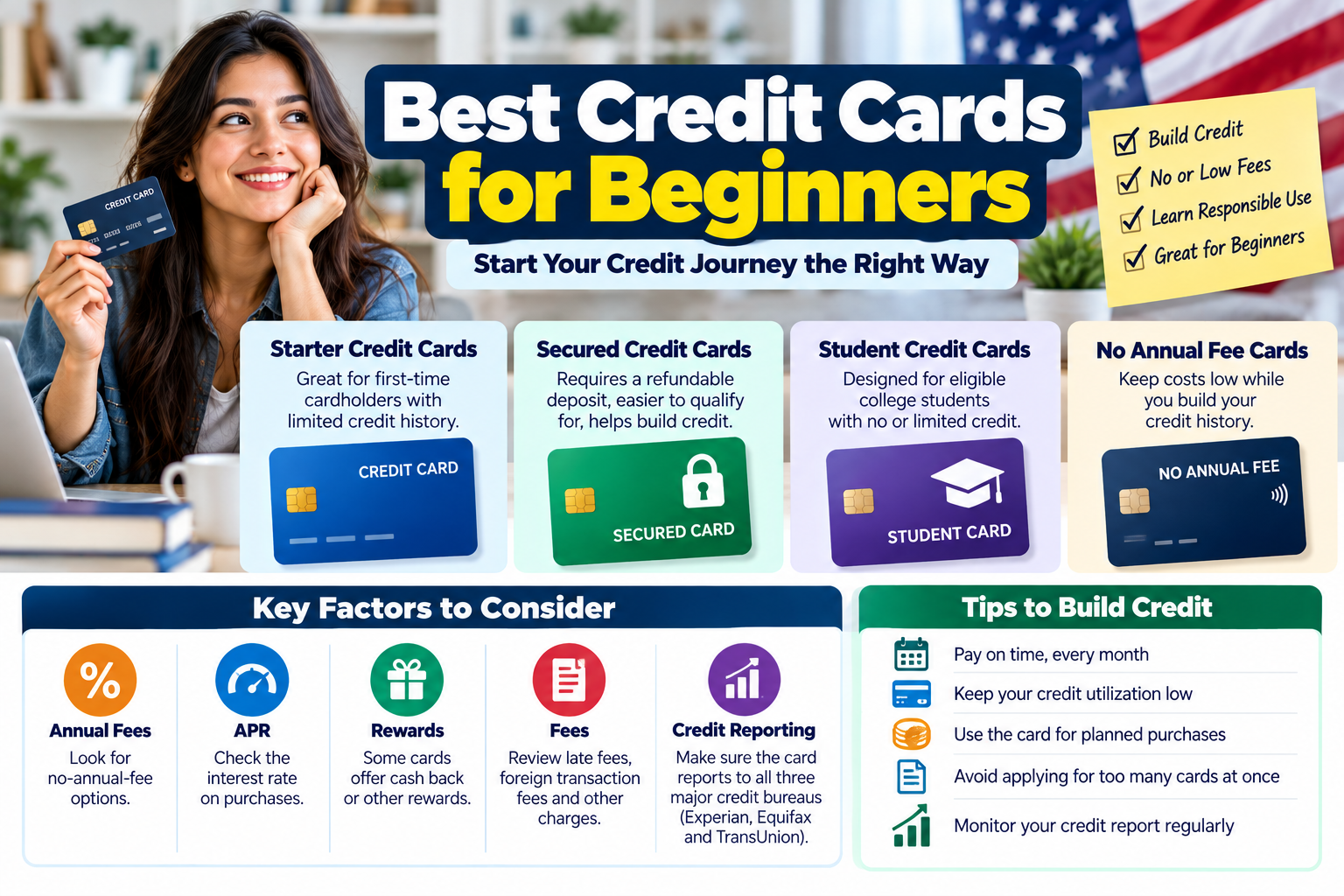
The best credit cards for beginners make it easier to establish a credit history, manage everyday spending, and learn how credit works without paying unnecessary fees. If you are applying for your first credit card in the United States, you may have little or no credit history, which can limit the cards available to you.
The right first card should be easy to manage, affordable to keep, and suitable for your current credit profile. You do not need a premium travel card or complicated rewards program to get started. In many cases, a no-annual-fee starter card or a secured credit card is a better choice.
Quick Answer: What Is the Best First Credit Card?
For beginners with no credit history, start by comparing a basic unsecured starter card, a student card if you qualify, and a secured credit card if approval is difficult.
Here are some options worth researching:
| Credit card or category | Best for | Main consideration |
|---|---|---|
| Chase Freedom Rise | Beginners seeking an unsecured card | Approval is not guaranteed; review current eligibility requirements |
| Discover it Student Cash Back | Eligible college students | Student eligibility and current card terms apply |
| Secured credit card | People with no credit or limited credit | Usually requires a refundable security deposit |
| Credit-union starter card | Applicants who already use a credit union | Membership and approval requirements vary |
| No-annual-fee starter card | Beginners who want to keep costs low | Check the APR and other fees |
| Authorized-user account | Someone who has a trusted family member with established credit | The account’s history and management can affect the benefit |
These options are not a guarantee of approval or a universal ranking. Card terms, eligibility, and availability can change. Always check the issuer’s official offer before applying.
1. Chase Freedom Rise: A Starter Card to Consider
The Chase Freedom Rise is an unsecured credit card that may be worth considering if you want to begin building credit without putting down a security deposit.
It is designed for people who are new to credit, and it offers rewards on eligible purchases. However, having little credit history does not guarantee approval.
Before applying, review:
- The current annual fee
- Purchase APR and other rates
- Rewards and redemption conditions
- Credit requirements
- Any current application or account-opening conditions
Best for: Beginners who want an unsecured card and are comfortable managing monthly payments.
Official information: Chase Freedom Rise.
2. Discover it Student Cash Back: For Eligible College Students
If you are a college student, a student credit card may be a suitable starting point. Student cards are designed for eligible students who may have limited credit history.
The Discover it Student Cash Back card is one option to research. It offers a rewards structure, but you should understand its categories and redemption rules before choosing it.
Compare:
- Student eligibility requirements
- Annual fee
- Rewards categories and activation requirements, if applicable
- Purchase APR
- Late payment fees and other charges
Best for: Eligible college students who want to establish credit while earning rewards on eligible purchases.
Do not apply for a student card if you do not meet its eligibility conditions. If you are not a student, compare general starter and secured cards instead.
Official information: Discover Student Credit Cards.
3. A Secured Credit Card: For Applicants Who Cannot Get Approved
A secured credit card is one of the most practical alternatives if you have no credit history or have difficulty qualifying for a traditional credit card.
You typically provide a refundable security deposit, and the issuer uses that deposit as collateral. The deposit often influences your starting credit limit, although the issuer’s terms determine the exact amount.
For example, if a card requires a $200 deposit, that money is generally held as security rather than being available for everyday spending.
Before choosing a secured card, check:
- Whether it charges an annual fee
- The minimum security deposit
- Whether it reports payment activity to the major credit bureaus
- Whether the deposit is refundable and under what conditions
- Whether you can qualify for an upgrade or deposit refund later
Best for: People starting from scratch or rebuilding their credit who can afford the deposit without sacrificing emergency savings.
A secured card can help establish a credit record, but it does not guarantee a particular score increase.
4. A No-Annual-Fee Starter Card: For Keeping Costs Low
If you are new to credit, a card with no annual fee can be a sensible starting point. You can keep the account open without paying a recurring fee simply for having the card, provided the issuer does not introduce different terms under its agreement.
However, no annual fee does not mean the card is free to use in every situation.
Check for:
- Purchase APR
- Late payment fees
- Foreign transaction fees
- Balance transfer fees
- Cash advance fees
- Other account charges
If you pay your statement balance in full by the due date, you can generally avoid interest on purchases when your card has a grace period and you maintain it. Cash advances and certain other transactions can have different rules.
Best for: Beginners who want a simple card without an annual ownership cost.
5. A Credit-Union Starter Card: For Existing Members
Some credit unions offer credit cards designed for members who are building credit. If you already have a checking or savings account with a credit union, it may be worth asking about its starter-card options.
Credit unions may have their own membership, income, credit-history, and application requirements.
Compare the card’s interest rate, fees, deposit requirements, credit-reporting practices, and eligibility rules with offers from other issuers.
Best for: People who already belong to a credit union and want to compare its products with national card issuers.
Do not assume that a credit-union card will automatically have a lower rate or an easier approval process. Review the actual terms.
6. A Basic Unsecured Card: For Beginners With Some Credit History
If you have already established a limited credit history through a student loan, an authorized-user account, or another reported credit account, you may qualify for a basic unsecured card.
Unlike a secured card, an unsecured card generally does not require a security deposit. Approval depends on the issuer’s underwriting criteria, which can include your credit history, income, existing debts, and other information.
Before applying, check whether the card has an annual fee, a high APR, or limited benefits.
Best for: Beginners who have some credit history and want to avoid tying up money in a security deposit.
If you have no credit history at all, a secured card or a starter product specifically designed for new borrowers may be more realistic.
7. An Authorized-User Account: For Someone With a Trusted Family Member
Another way to begin establishing credit may be to become an authorized user on a family member’s credit card.
The primary account holder remains responsible for paying the bill. Depending on the issuer’s reporting practices and the credit-scoring model, the account’s history may appear on your credit report and influence your credit profile.
Before agreeing, make sure the primary cardholder:
- Pays on time
- Keeps the balance relatively low
- Maintains the account responsibly
- Understands whether the issuer reports authorized users to the credit bureaus
There are risks. If the account has late payments or high balances, being an authorized user may not help your credit profile and could potentially hurt it.
Best for: Beginners with a trusted family member who manages credit responsibly.
You do not need to become an authorized user to build credit. A starter or secured card can also help establish an independent credit history.
8. A Card That Reports to All Three Major Credit Bureaus
If your main goal is to establish a credit history, check whether the issuer reports your account activity to Equifax, Experian, and TransUnion.
Credit reporting matters because a card cannot help establish a reported payment history with a bureau if the relevant activity is not reported there.
Before applying, confirm:
- Which credit bureaus receive account information
- Whether the issuer reports payment history regularly
- Whether it reports the balance and credit limit
- Whether the account is eligible to appear on your credit reports
Do not assume every card reports in exactly the same way.
Best for: Beginners whose primary goal is building a credit record rather than earning rewards.
9. A Card With a Manageable Credit Limit: For Learning Responsible Use
A large credit limit may sound attractive, but beginners often benefit more from learning how to manage a smaller limit responsibly.
Your credit utilization ratio measures how much of your available revolving credit you are using. For example, a $100 balance on a $500 credit limit represents 20% utilization.
Keeping balances low relative to your limits can help your credit profile, although scoring models differ and no single utilization percentage guarantees a particular score.
A manageable limit can help you control spending and avoid accumulating debt.
Best for: First-time cardholders who want to build good habits before taking on more credit.
Remember that your credit limit is not extra income. Only spend what you can afford to repay.
10. A Starter Card With a Clear Upgrade Path: For Long-Term Flexibility
Some secured cards may allow eligible customers to move to an unsecured product or receive their security deposit back after demonstrating responsible account management.
However, an upgrade is not guaranteed. The issuer may review your payment history, account status, and other eligibility factors.
Before selecting a secured card, ask:
- Does the issuer review accounts for graduation?
- Is the deposit refundable if the account graduates?
- How are upgrade decisions made?
- Can the account remain open if you move to another product?
- Are there fees or changes to the card’s terms after an upgrade?
Best for: Beginners who expect to keep building credit and want a potential path beyond their first card.
Choose a card that makes sense under its current terms, even if an upgrade never happens.
How to Choose the Best Credit Card for Your First Application
The best card for a beginner depends on your situation. Use this comparison to narrow down your options.
| Your situation | What to consider first | Why |
|---|---|---|
| No credit history | Starter card or secured card | These may be designed for applicants with limited credit |
| College student | Student credit card | Student-specific eligibility and benefits may suit your needs |
| Application denied elsewhere | Secured card or credit-union option | You can compare products designed for credit building |
| Some credit history | Basic unsecured card | You may qualify without paying a security deposit |
| Want to avoid recurring fees | No-annual-fee starter card | Reduces the cost of keeping the account open |
| Have a trusted family member with strong credit habits | Authorized-user account | May help establish a reported credit history, depending on reporting and scoring |
| Want to keep spending under control | Card with a manageable limit | Makes it easier to stay within your budget |
What Credit Score Do You Need for Your First Credit Card?
There is no universal minimum credit score for every beginner credit card.
Some cards are designed for people with no established credit history, so they may evaluate applicants without requiring a traditional score. Other cards require a stronger credit profile.
Card issuers may consider several factors, including:
- Existing credit history
- Income and ability to make payments
- Current debt obligations
- Recent credit applications
- The issuer’s own approval criteria
If you have no credit score because you have not used credit before, that is not necessarily the same as having a poor credit score.
Check the issuer’s stated eligibility criteria before applying. A score alone cannot guarantee approval.
How to Build Credit With Your First Credit Card
Opening a credit card is only the beginning. How you manage the account matters more than the number of cards you own.
Pay the statement balance in full
Whenever possible, pay the full statement balance by the due date. This helps you avoid interest on purchases when your card has an applicable grace period.
You do not need to carry a balance or pay interest to build credit.
Never miss a payment
Payment history is an important factor in many credit-scoring models. Set up automatic payments or reminders so that you do not forget the due date.
If you use autopay, make sure sufficient money is available in your bank account.
Keep your balance manageable
Avoid using most of your credit limit. A lower reported balance can help your utilization profile, although the impact depends on the scoring model and the rest of your credit report.
Apply selectively
Applying for several cards in a short period can result in multiple hard inquiries and may affect your credit profile. Research your options and apply for a card that matches your situation.
Review your credit reports
Check your credit reports for incorrect information, unfamiliar accounts, or reporting errors. Dispute inaccurate information with the relevant credit bureau and follow the appropriate process.
Use the card for planned purchases
You do not need to spend more to earn rewards or build credit. Use the card for expenses already included in your budget, then pay the bill responsibly.
Common Mistakes Beginners Should Avoid
Choosing rewards over affordability. Rewards are not worth paying a high annual fee or interest charges you cannot afford.
Applying for too many cards. Multiple applications can create hard inquiries and make it harder to manage accounts.
Paying only the minimum. Minimum payments keep the account current when paid on time, but interest can accumulate on the remaining balance.
Carrying a balance to build credit. You do not need to pay interest to establish a credit history.
Ignoring fees. Review annual fees, late fees, foreign transaction fees, cash advance charges, and other terms.
Using the full credit limit. A high balance relative to your limit can hurt your credit utilization profile.
Assuming approval is guaranteed. No card recommendation can promise that an issuer will approve your application.
Closing an account without considering the consequences. Closing a card may affect your available credit and utilization, depending on your overall profile. Consider fees, benefits, and your circumstances before making a decision.
Frequently Asked Questions
1. What is the best credit card for beginners?
The best first credit card is one that matches your credit history, has manageable fees, and helps you build responsible habits. A no-annual-fee starter card may suit some applicants, while a secured card can be useful for people who have trouble qualifying for an unsecured card.
Compare the APR, fees, credit-reporting practices, eligibility requirements, and security deposit before applying.
2. Can I get a credit card with no credit history?
Yes. Some issuers offer starter cards for applicants with limited or no credit history. A student card may be suitable if you qualify, while a secured card is another option.
Approval depends on the issuer’s requirements and your overall application. Having no credit history does not guarantee approval or automatic rejection.
3. Should I get a secured or unsecured credit card first?
A secured card usually requires a security deposit and may be easier to access for some applicants with limited credit history. An unsecured card generally does not require a deposit but may have stricter approval criteria.
Compare the fees, APR, deposit refund rules, and credit-reporting practices. Choose based on your eligibility and ability to manage the account.
4. Does my first credit card need an annual fee?
No. Many starter cards have no annual fee. A card with an annual fee should offer benefits that genuinely justify the cost for your circumstances.
If you are just starting to build credit, a straightforward no-annual-fee card can help keep account ownership costs low.
5. How long does it take to build credit with a first credit card?
Building credit takes time, and the results depend on your overall credit history and the scoring model used. Your first reported account may help establish a credit file, but there is no guaranteed timeline for reaching a particular score.
Pay on time, keep balances manageable, and avoid unnecessary applications. Continue reviewing your credit reports for accuracy.
6. Do I need to carry a balance to build credit?
No. You do not need to carry a balance or pay interest to build credit. Paying your statement balance in full by the due date is generally a sensible way to use a credit card.
Carrying a balance can lead to interest charges and does not guarantee a better credit score.
7. Will applying for my first credit card hurt my credit score?
If the issuer performs a hard inquiry, the application can affect your credit score. The impact varies, and applicants with limited credit history may be more sensitive to new credit activity.
Check whether an issuer offers prequalification with a soft inquiry, where available, and avoid applying for multiple cards without a clear reason.
8. Can I build credit without a credit card?
Yes. Depending on the account and whether it is reported, certain loans and other credit-building products can establish credit history. Some rent or bill payments may also be reportable through specific services, but reporting and scoring treatment vary.
A credit card is one possible tool, not the only way to begin building credit.
Final Takeaway
The best credit cards for beginners are not necessarily the cards with the biggest welcome bonuses or the most complicated rewards. Your first card should help you establish a credit history while keeping fees, spending, and repayment manageable.
Start by comparing no-annual-fee starter cards, student cards if eligible, and secured cards if you need another route to approval. Read the terms carefully, apply selectively, and pay your statement balance on time.
Responsible use over time is more important than collecting multiple cards quickly.
Why Maintain Market Is Different
Maintain Market focuses on helping readers understand the financial decision behind a product recommendation. Instead of suggesting that every beginner should choose the same card, this guide compares options based on credit history, fees, eligibility, and long-term credit-building goals.
Our goal is to help readers make informed decisions and avoid common borrowing mistakes—not to promise approval, a particular credit score, or guaranteed rewards.
Official Reference Links
- CFPB — How to Rebuild Your Credit
- CFPB — How to Get and Keep a Good Credit Score
- CFPB — Ways to Start or Rebuild a Good Credit History
- Discover — Student Credit Cards
- NerdWallet — Best Starter Credit Cards for No Credit
Editorial Review
This article is for general educational purposes and focuses on credit cards available in the United States. Issuer terms, annual fees, APRs, rewards, and eligibility requirements may change. Verify the current offer and pricing disclosures directly with the card issuer before applying.