
How long does it take to improve your credit score? The answer depends on what is affecting your credit today. If your score is low because of high credit card balances, you may see a change after your lenders report lower balances. If your credit history includes late payments, collections, or other negative information, rebuilding may take months or longer.
There is no guaranteed number of points you can gain within 30, 60, or 90 days. Your starting score, credit history, scoring model, and the information reported by lenders all influence how quickly your score changes.
This guide explains realistic credit improvement timelines, what can change relatively quickly, what takes longer, and how to build healthier credit habits without relying on quick-fix promises.
Quick Answer: How Long Does It Take to Improve Your Credit Score?
You may see credit score changes within a few weeks or one to two billing cycles after a lender reports updated information, such as a lower credit card balance. However, building a consistent positive payment history or recovering from serious negative information can take months or years.
Here is a practical overview:
| Situation | What to expect |
|---|---|
| High credit card utilization | Your score may respond after lower balances are reported |
| Incorrect information on a credit report | Improvement may follow a successful correction and score recalculation |
| Recent late payments | Recovery often takes longer and depends on your subsequent payment history |
| Collections or other negative records | The timeline depends on the information, scoring model, and circumstances |
| Little or no credit history | Building a reliable record generally takes months or longer |
| Multiple credit applications | The effect of hard inquiries may fade over time, while new accounts can affect other score factors |
These are general expectations, not guaranteed deadlines. Creditors do not all report information on the same schedule, and different credit scoring models can respond differently to the same change.
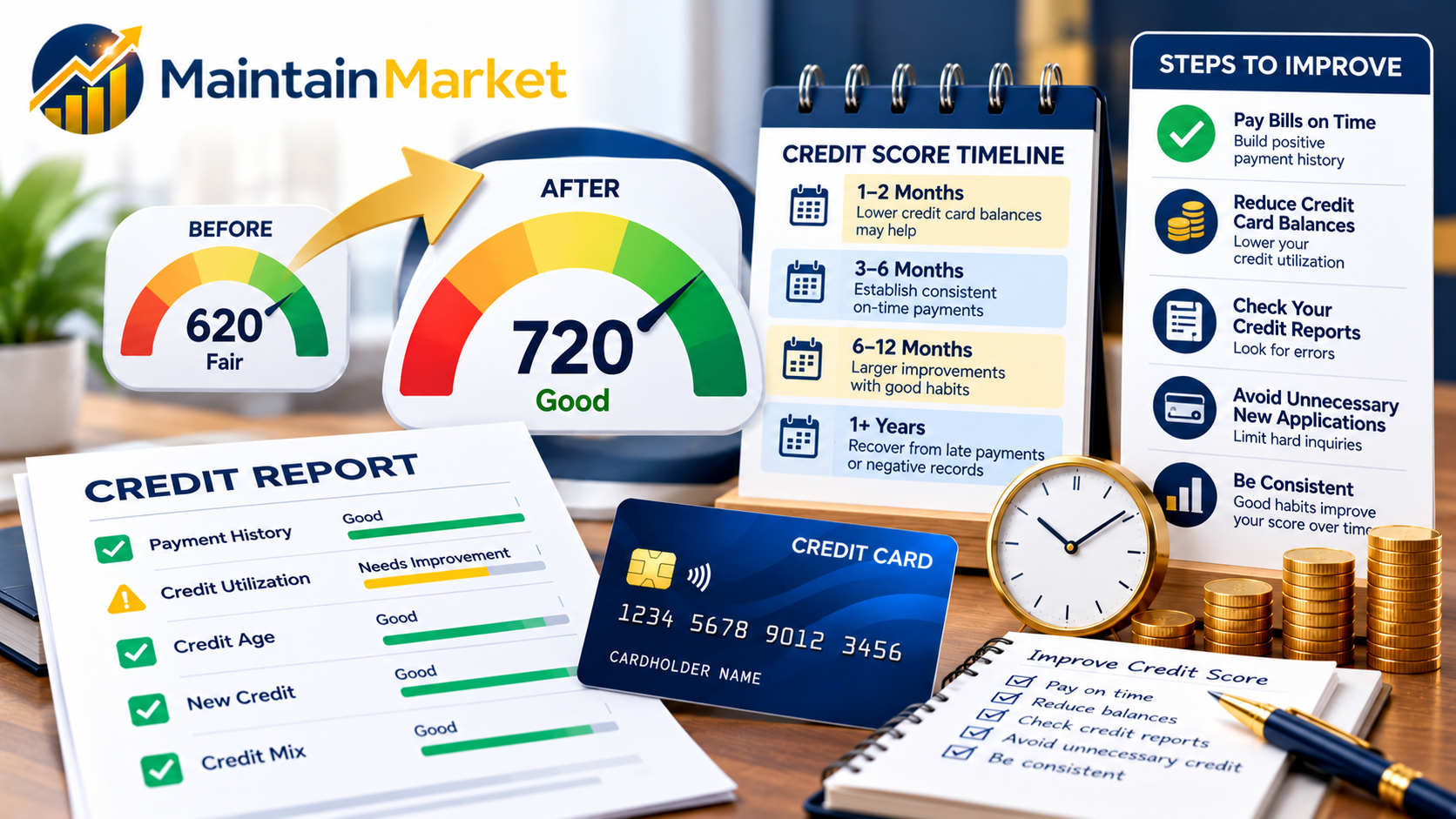
What Determines How Quickly Your Credit Score Improves?
Your credit score is calculated from information in your credit report. As that information changes, your score may change too.
1. Your current credit history
Someone with a long history of on-time payments may experience a different result from someone who has several missed payments or a limited credit history.
The same financial action can affect two people differently. For example, reducing a high credit card balance may help one person’s score more noticeably than another person’s score.
2. Credit card utilization
Credit utilization measures how much of your available revolving credit you are using. Higher utilization can negatively affect many credit scoring models.
Suppose you have a credit card limit of $5,000 and a reported balance of $4,000. Your utilization is 80%.
If you reduce the reported balance to $1,000, your utilization falls to 20%.
That change may help your score once the lower balance is reported and included in a new calculation. The amount of improvement depends on your complete credit profile.
3. Payment history
Making payments on time helps establish a positive credit history. However, a record of missed payments is not erased simply because you start paying on time again.
Consistent on-time payments can strengthen your credit profile, but recovering from previous delinquencies may take substantially longer than lowering a credit card balance.
4. Errors and inaccurate information
If your credit report contains an incorrect balance, an inaccurately reported late payment, or an account that does not belong to you, a successful correction may improve your score.
However, filing a dispute does not guarantee that information will be removed. The information must be inaccurate, incomplete, or otherwise eligible for correction.
5. The scoring model being used
You may have more than one credit score. FICO and VantageScore models can use different methods, and lenders may use different versions of a scoring model.
This means your score may change by different amounts across services, even when they use similar credit information.
How Long Does It Take to Improve Credit Score by Situation?
If Your Credit Card Utilization Is High
Possible timeline: After the updated balance is reported.
Reducing high credit card balances is one of the changes that may affect a score relatively quickly. Many card issuers report balances around the statement cycle, but reporting schedules vary.
For example, suppose your credit limit is $10,000 and your reported balance is $7,000. Your utilization is 70%.
You pay down the balance to $2,000, bringing utilization to 20%. Once the issuer reports the lower balance, your score may improve if utilization was holding it back.
You do not need to carry a balance or pay interest to build credit.
For more detail, read Maintain Market’s Credit Utilization Ratio guide.
If You Have Missed Payments
Possible timeline: Several months or longer, depending on your credit history.
A missed payment can have a significant effect, particularly if you previously had a strong payment record.
Start by bringing overdue accounts current if possible and making every future payment on time. Over time, recent positive payment behavior can help strengthen your credit profile.
However, accurate negative payment information can generally remain on a credit report for up to seven years under federal reporting rules. Its effect on your score can change during that period, so the reporting period is not the same as a fixed recovery timeline.
If a late payment was reported incorrectly, dispute the error with the credit reporting company and the business that supplied the information.
If Your Credit Report Contains an Error
Possible timeline: After the dispute is investigated and the report is corrected, if appropriate.
An error may include a payment incorrectly marked late, a balance that does not match your records, or an account that belongs to someone else.
Obtain your reports from AnnualCreditReport.com and review the information held by Equifax, Experian, and TransUnion.
If you identify an error, submit a dispute with supporting documents. Under the general federal dispute process, credit reporting companies usually have 30 days to investigate, although certain cases can take up to 45 days.
The time required for your score to change may also depend on when corrected information becomes available and a new score is calculated.
If You Have Collections or Other Negative Information
Possible timeline: Varies considerably.
Collections, charge-offs, and other negative records can affect credit scores differently depending on the scoring model and the details of the account.
Paying or settling a collection may resolve a debt, but it does not guarantee an immediate score increase or automatic removal from your report.
Before paying an unfamiliar collection, verify the debt and the information reported. If the entry is inaccurate, use the appropriate dispute process.
If You Are Building Credit From Scratch
Possible timeline: Several months to establish a score, followed by continued improvement over time.
For a FICO Score, you generally need at least one account open for six months or longer and recent credit activity reported to a credit bureau. Other scoring models may be able to generate a score with a shorter credit history.
Building a strong credit profile takes longer than simply generating a score.
Consider a credit-building product only if it suits your needs and you can manage its fees and payments. A secured credit card may be an option for some beginners, provided the issuer reports account activity to the credit bureaus.
You do not need to borrow money you cannot afford to repay just to build credit.
If You Recently Applied for Several Credit Cards or Loans
Possible timeline: The effect of hard inquiries may fade over time, but other factors also matter.
Hard inquiries can affect your score, usually by a relatively small amount. FICO Scores generally consider hard inquiries for up to 12 months, although inquiries may remain on credit reports for up to two years.
New accounts can also affect your credit history and the amount of credit you use.
Avoid unnecessary applications while working on your credit. Apply when you have a genuine need and understand the account terms.
Can You Improve Your Credit Score in 30 Days?
It is possible to see a credit score change within 30 days, but a substantial improvement is not guaranteed.
Changes that may be reflected relatively quickly include:
- A lower credit card balance being reported.
- An inaccurate item being corrected.
- An updated account balance or status.
- A new payment record being added to your credit report.
Other changes require more time. A consistent record of on-time payments cannot be created in a month, and negative information that is accurate cannot generally be removed simply because you want your score to rise.
If you have 30 days to prepare for a credit application, focus on actions you can control: check your reports, reduce high revolving balances if affordable, pay all bills on time, and avoid unnecessary new applications.
Do not assume that a particular action will produce a specific number of points.
What About Improving Your Credit Score in 60 or 90 Days?
A two- or three-month period gives you more time to establish consistent habits and for lenders to report updated information. However, it still does not guarantee a particular score.
During the first 30 days
- Review your credit reports.
- Identify high balances and potential errors.
- Bring overdue accounts current where possible.
- Set up reminders for upcoming payments.
During days 31–60
- Continue paying bills on time.
- Reduce credit card balances as your budget allows.
- Follow up on disputes.
- Avoid unnecessary applications for credit.
During days 61–90
- Review newly reported balances and account information.
- Check whether disputed errors have been corrected.
- Continue consistent payment habits.
- Evaluate your progress using the same score source and model when possible.
This plan is designed to improve your financial habits and help you identify changes. It does not guarantee a particular score increase within 90 days.
7 Practical Ways to Improve Your Credit Score
1. Pay Every Bill on Time
Payment history is a major factor in many credit scoring models. Set up reminders or automatic payments where practical, and ensure enough money is available in your account to cover scheduled payments.
If you cannot afford a payment, contact the lender early to discuss available options.
2. Reduce High Credit Card Balances
High revolving balances can increase utilization and negatively affect your score.
Make a realistic repayment plan that fits your budget. Continue paying at least the required minimum on every account while directing additional money toward the balances you want to reduce.
3. Check Your Credit Reports
Review your reports for incorrect account information, inaccurate late payments, unfamiliar inquiries, and accounts that do not belong to you.
You can access your reports through AnnualCreditReport.com.
4. Dispute Inaccurate Information
If you find an error, contact the credit reporting company and, where appropriate, the business that supplied the information.
Provide supporting documentation and keep records of your dispute. Do not dispute accurate information simply because it lowers your score.
5. Avoid Unnecessary Credit Applications
Applying for several accounts in a short period can create additional hard inquiries and new-account changes. Only apply for credit you genuinely need.
6. Keep Older Accounts When Appropriate
An older account may contribute to your credit history and available credit. However, keeping an account open is not always the right decision if it has costly fees, creates overspending risks, or no longer suits your needs.
Consider the full financial picture rather than keeping every card open solely for a score.
7. Monitor Your Progress Consistently
Check your score and reports periodically. Compare the same score source and model when possible, and focus on the information that has actually changed.
Avoid checking several different scores and assuming that every difference represents a real decline in creditworthiness.
How to Track Your Credit Score Improvement
A simple tracking table can help you understand your progress without becoming focused on daily score changes.
| What to track | Why it matters |
|---|---|
| Score source and model | Helps ensure you compare equivalent scores |
| Report date | Shows when the underlying credit information was available |
| Credit card balances | Helps you monitor utilization |
| Payment history | Helps you identify missed or late payments |
| New accounts and inquiries | Helps you understand recent credit activity |
| Dispute outcomes | Shows whether inaccurate information was corrected |
Remember that your score may fluctuate as lenders report information. One small increase or decrease does not necessarily mean your overall financial situation has changed substantially.
Mistakes to Avoid When Trying to Improve Your Credit Score
Expecting an instant increase: Credit scoring depends on reported information, and not every change appears immediately.
Paying interest to build credit: You generally do not need to carry a balance or pay interest to establish a positive credit history.
Opening unnecessary accounts: New accounts can add costs, inquiries, and repayment obligations.
Closing cards without checking the consequences: Closing an account may reduce available credit and affect utilization.
Ignoring accurate negative information: Focus on managing your accounts responsibly rather than trying to remove accurate records.
Trusting guaranteed credit repair claims: No legitimate service can guarantee a specific score increase within a fixed period.
Frequently Asked Questions
1. How long does it take to improve credit score by 100 points?
There is no universal timeline for a 100-point increase. Someone whose score is affected by high credit utilization or inaccurate information may see changes after those issues are addressed and reported. Someone rebuilding after serious negative information may need substantially more time.
2. Can my credit score improve in one month?
Yes, a score can change within a month, particularly if lower balances or corrected information are reported. However, the amount of improvement depends on your credit history and the scoring model.
3. How long does it take to rebuild credit after late payments?
The timeline varies with the severity and recency of the late payments and your subsequent credit behavior. Making every payment on time can help strengthen your history, but accurate negative information may remain on your credit report for years.
4. Will paying off my credit card improve my score immediately?
Not necessarily. Your score may respond after the issuer reports the lower balance, but reporting schedules vary. The exact effect depends on the rest of your credit profile and the scoring model.
5. Does checking my credit score lower it?
Checking your own credit score or obtaining your own credit report generally does not lower your score. These actions are typically treated as soft inquiries.
6. How long does it take to build credit from scratch?
You may need about six months of credit history to qualify for a FICO Score. Other scoring models may generate scores sooner. Building a strong, reliable credit profile generally takes continued responsible behavior beyond the initial scoring period.
7. Can I improve my credit score without taking out a loan?
Yes. You can work on your credit by paying existing accounts on time, reducing credit card balances, reviewing your reports, and correcting errors. You should not take out unnecessary debt solely to improve your score.
8. Does paying off a collection increase my credit score?
The effect depends on the scoring model, the account details, and how the collection is reported. Paying or settling a debt does not guarantee a specific score increase or automatic removal from your credit report.
9. How often should I check my credit score?
Check it periodically and whenever you need to investigate an unexpected change. You can review your credit reports more closely when preparing for a major credit application or checking for errors. Your own score checks generally do not lower your score.
Why Maintain Market Is Different
Maintain Market focuses on practical, evidence-based financial education. Improving credit is not a one-size-fits-all process, and the fastest route depends on what is affecting your credit today.
This guide separates changes that may appear relatively quickly from those that require consistent behavior over time. It also explains why reported information, scoring models, and individual credit histories can produce different results.
Our goal is to help readers make informed decisions without unrealistic promises about guaranteed points, instant results, or fixed recovery deadlines.
References
- myFICO — How to Repair and Improve Your FICO Score
- myFICO — How Credit Actions Affect FICO Scores
- Experian — How Long Does It Take to Build Credit?
- Consumer Financial Protection Bureau — How Long Does Information Stay on Your Credit Report?
- AnnualCreditReport.com — Official Free Credit Reports
Editorial Review
This article provides general educational information and is not individualized financial or legal advice. Credit scoring models, lender reporting practices, and the impact of credit actions vary.