
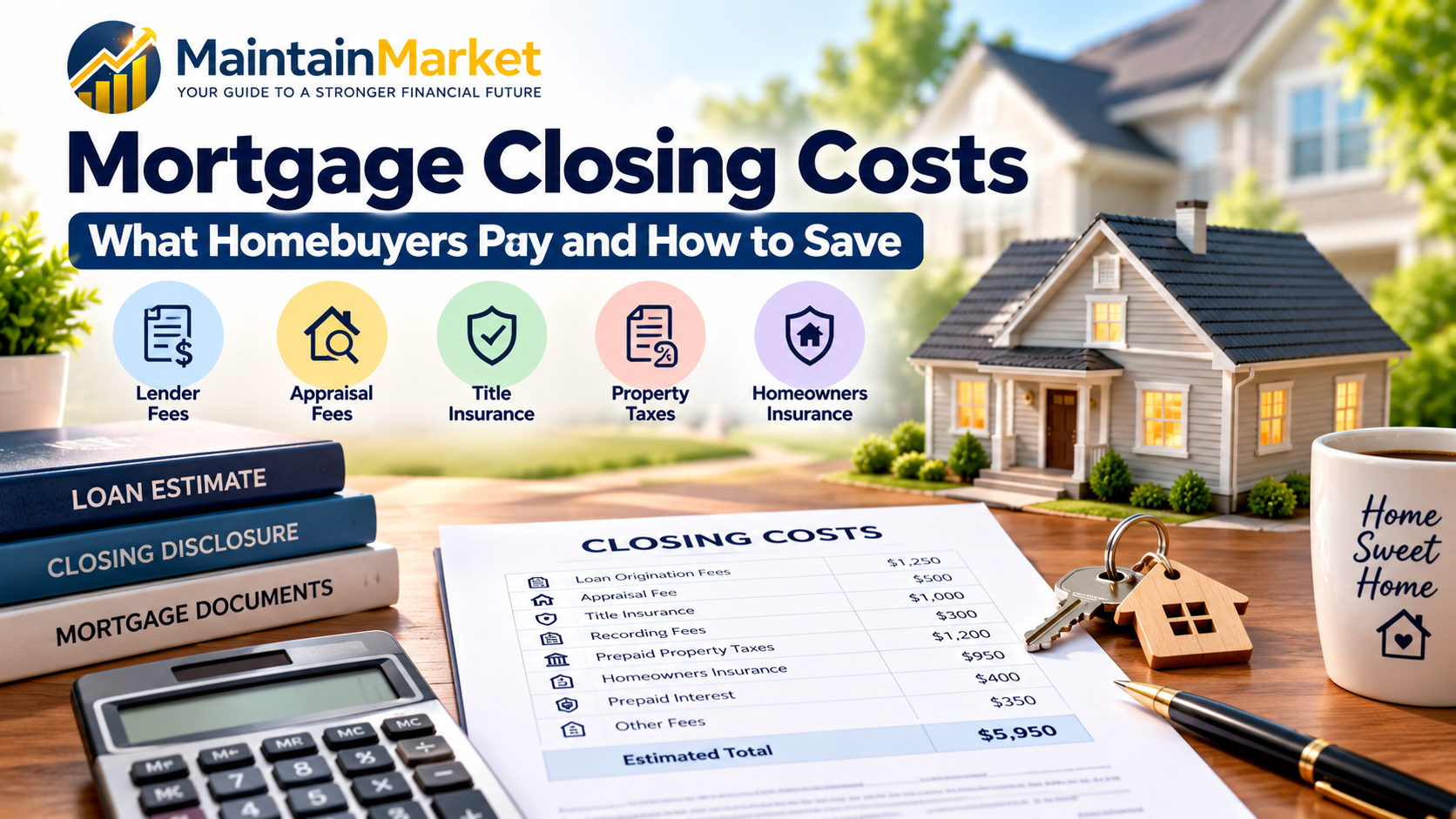
Mortgage closing costs are the fees and expenses you pay to finalize a home purchase and mortgage loan in the United States. These costs typically range from 2% to 5% of the home’s purchase price, according to Freddie Mac, although your actual expenses depend on the property, lender, location, and loan type.
For example, if you buy a $350,000 home, you could budget approximately $7,000 to $17,500 for closing costs, excluding your down payment. Some expenses, such as property taxes, homeowners insurance, and prepaid interest, may also affect the amount you need to bring to closing.
Understanding mortgage closing costs before making an offer can help you budget more accurately, compare mortgage lenders, negotiate seller concessions, and avoid last-minute financial surprises.
In this guide, you’ll learn what mortgage closing costs include, who pays them, how much they may cost, how to calculate your cash to close, and practical ways to reduce your expenses.
What Are Mortgage Closing Costs?
Mortgage closing costs are the upfront expenses associated with completing a real estate transaction and arranging your mortgage.
They can include lender fees, appraisal charges, title services, government recording fees, prepaid property taxes, homeowners insurance, and other transaction-related expenses.
These costs are separate from your down payment, although both contribute to the total amount of money you may need when purchasing a home.
Closing costs can vary significantly between lenders and locations. Two buyers purchasing similarly priced homes may receive different estimates because of their loan terms, property characteristics, local taxes, insurance premiums, and negotiated agreements.
According to Freddie Mac’s guide to homebuying costs, closing costs generally range from 2% to 5% of the purchase price.
Quick example: If your home costs $300,000, a 2% to 5% closing-cost estimate would equal $6,000 to $15,000. This is a planning range, not a guaranteed quote.
How Much Are Mortgage Closing Costs?
Your mortgage closing costs depend on your purchase price, loan amount, mortgage program, lender charges, property location, and other transaction details.
The following table illustrates the typical budgeting range using Freddie Mac’s general 2% to 5% guideline.
| Home purchase price | At 2% | At 3% | At 5% |
|---|---|---|---|
| $200,000 | $4,000 | $6,000 | $10,000 |
| $300,000 | $6,000 | $9,000 | $15,000 |
| $350,000 | $7,000 | $10,500 | $17,500 |
| $400,000 | $8,000 | $12,000 | $20,000 |
| $500,000 | $10,000 | $15,000 | $25,000 |
| $600,000 | $12,000 | $18,000 | $30,000 |
These figures are illustrative estimates based on the purchase price. They are not quotes from lenders and do not guarantee that every expense will fall within this range.
What is included in these estimates?
Depending on your transaction, closing costs may include:
- Mortgage origination and underwriting charges
- Appraisal and credit report fees
- Title search and title insurance
- Recording and transfer-related government charges
- Attorney or settlement agent fees, where applicable
- Homeowners insurance premiums paid in advance
- Property tax and insurance escrow deposits
- Prepaid mortgage interest
- Other permitted transaction-related fees
Your down payment is separate. If you are also paying for a home inspection before closing, remember to account for that expense in your overall homebuying budget, even if it is paid earlier.
What Do Mortgage Closing Costs Include?
Mortgage closing costs are not one single fee. They are a collection of charges paid to lenders, service providers, government offices, and other parties involved in the transaction.
Here are the most common categories.
1. Loan origination fees
Loan origination fees are charges associated with processing and arranging your mortgage.
Depending on the lender, these may include application processing, underwriting, origination, or administrative charges.
Not every lender uses the same fee structure. Some advertise lower origination fees but charge more elsewhere, so compare the complete Loan Estimate rather than focusing on one line item.
2. Appraisal fees
A lender may require an appraisal to estimate the property’s market value.
The appraisal helps the lender assess the collateral supporting the mortgage. The fee depends on factors such as the property, its location, and the complexity of the valuation.
An appraisal is different from a home inspection. An inspection focuses on the property’s condition and potential defects, while an appraisal estimates its value for lending purposes.
3. Credit report and related fees
Mortgage lenders generally review your credit history as part of evaluating your application.
A credit report fee may appear among the loan costs, although the exact amount and treatment vary by lender.
Ask for an itemized estimate so you can identify the services being charged.
4. Title search and title insurance
Title services help establish ownership history and identify potential issues affecting the property’s title.
Title insurance protects against certain covered title-related losses. A lender’s title insurance policy generally protects the lender’s interest, while an owner’s policy may protect the buyer, subject to the policy’s terms.
Whether an owner’s policy is required or customary, and who pays for each policy, can depend on state law, local practices, and the purchase agreement.
5. Attorney, settlement, or escrow fees
Depending on the state and transaction, a real estate attorney, title company, escrow agent, or settlement agent may help complete the closing.
Their responsibilities can include preparing or reviewing documents, coordinating funds, handling signatures, and recording the transfer.
The fees and the person responsible for paying them vary by location and transaction.
6. Recording and government fees
Local government offices may charge fees to record the deed, mortgage, or other documents associated with the transaction.
Some locations also impose transfer taxes or similar charges. These expenses depend on local rules, property value, and the type of transaction.
Do not assume that every state or county charges the same fees.
7. Discount points
Discount points are upfront charges you may choose to pay in exchange for a lower mortgage interest rate.
One discount point generally equals 1% of the loan amount, although the rate reduction associated with a point varies by lender and market conditions.
For example, one point on a $300,000 loan would cost $3,000.
Paying points may reduce your monthly principal-and-interest payment, but you need to calculate how long it would take for those savings to recover the upfront cost.
8. Prepaid homeowners insurance
Lenders may require you to pay an initial homeowners insurance premium at or before closing.
The amount depends on the policy, property, location, coverage, and insurer. Properties exposed to higher risks may have substantially different premiums.
Compare insurance quotes early so that you can budget for the actual premium rather than relying on a rough estimate.
9. Prepaid property taxes and mortgage interest
You may need to pay certain property taxes in advance or reimburse the seller for eligible amounts the seller already paid.
You may also owe prepaid mortgage interest covering the period between closing and the start of your regular payment schedule.
These amounts depend on the closing date, local tax schedule, loan terms, and transaction details.
10. Initial escrow deposits
Some lenders establish an escrow account to collect money for future property taxes and homeowners insurance.
At closing, you may need to deposit an initial amount into this account. The amount depends on the expected bills, payment dates, and applicable rules.
An escrow deposit is not necessarily a separate service fee. It is money collected to help pay future expenses.
Mortgage Closing Costs vs. Down Payment
Mortgage closing costs and your down payment are different expenses.
Your down payment is the portion of the purchase price you pay upfront rather than borrowing from the mortgage lender. Closing costs cover the fees and other expenses associated with completing the transaction.
Consider this example:
| Expense | Example amount |
|---|---|
| Home purchase price | $350,000 |
| Down payment at 10% | $35,000 |
| Estimated closing costs at 3% | $10,500 |
| Estimated total before other adjustments | $45,500 |
In this example, you would need approximately $45,500 before accounting for any earnest money deposit already paid, seller credits, lender credits, other applicable adjustments, or additional expenses.
Your actual cash requirement could be higher or lower.
The distinction matters because a buyer who saves enough for a down payment may still need additional funds to complete the purchase.
How to Calculate Your Mortgage Closing Costs
You can estimate your mortgage closing costs using a simple calculation.
Estimated closing costs = Home purchase price × Estimated closing-cost percentage
For example, suppose you are purchasing a $400,000 home and use 3% as your planning estimate.
$400,000 × 0.03 = $12,000
Your estimated closing costs would be $12,000.
If you use a 2% estimate, the amount would be $8,000. At 5%, it would be $20,000.
These calculations help you prepare a budget, but they do not replace a lender’s itemized estimate.
Calculate your estimated cash to close
Your cash to close is the amount you actually need to bring to closing after accounting for the down payment, closing costs, deposits already paid, credits, and other adjustments.
A simplified formula is:
Cash to close = Down payment + Closing costs + Other amounts due − Deposits already paid − Applicable credits
For example:
| Item | Amount |
|---|---|
| Down payment | $35,000 |
| Closing costs | $10,500 |
| Earnest money deposit already paid | −$5,000 |
| Seller credit | −$3,000 |
| Illustrative cash to close | $37,500 |
This example assumes the listed amounts are applicable to the transaction and excludes other adjustments.
Your actual Closing Disclosure will show the transaction-specific calculation. Review it carefully before sending money.
Who Pays Mortgage Closing Costs: Buyer or Seller?
In many home purchases, the buyer pays most mortgage-related expenses, while the seller may pay certain agreed costs or transaction expenses. However, there is no universal rule that assigns every closing cost to the same party in every transaction.
Responsibility depends on the purchase agreement, state and local rules, the type of charge, and any applicable loan-program requirements.
Closing costs commonly paid by the buyer
Depending on the transaction, the buyer may pay:
- Mortgage origination and underwriting charges
- Appraisal and credit report fees
- Certain title and settlement services
- Lender’s title insurance
- Prepaid interest
- Initial escrow deposits
- Homeowners insurance premiums
- Recording or other charges assigned to the buyer
Closing costs the seller may pay
Depending on the contract and local practice, the seller may pay:
- Agreed seller concessions toward the buyer’s eligible closing costs
- Certain transfer taxes or recording-related expenses
- Real estate brokerage compensation, as negotiated and agreed
- Other expenses assigned to the seller under the contract
The purchase agreement should clearly establish who is responsible for the relevant charges.
Can the seller pay your mortgage closing costs?
Yes. A seller may agree to contribute toward a buyer’s eligible closing costs, often through seller concessions or seller credits.
For example, if your eligible costs total $10,000 and the seller agrees to provide a $3,000 credit that is permitted under your loan program, your remaining amount could be reduced by that credit.
However, seller concessions are subject to loan-program limits, transaction requirements, and the terms of the agreement. They generally cannot be treated as unrestricted cash back to the buyer.
You should also consider the purchase price and the overall terms of the deal when negotiating seller contributions.
How to Reduce Mortgage Closing Costs
Closing costs can add thousands of dollars to your homebuying expenses, but there are several ways to manage them.
1. Compare Loan Estimates from multiple lenders
Request Loan Estimates from multiple lenders and compare similar mortgage products.
Review the interest rate, APR, origination charges, lender credits, third-party services, and total closing costs.
A lender offering a slightly lower rate may charge more upfront. Another lender may have lower fees but a higher rate.
Compare the overall cost of the mortgage rather than choosing based on a single advertised number.
2. Ask lenders to explain every fee
Ask your loan officer to explain charges you do not recognize.
Find out whether a fee is required, whether it can be negotiated, and whether you have the option to choose another provider for the service.
Your Loan Estimate identifies certain services you may shop for separately. Compare eligible providers where practical, while checking that the lender will accept the provider you choose.
3. Negotiate seller concessions
Depending on market conditions and the terms of your offer, you may ask the seller to contribute toward eligible closing costs.
Seller concessions can be particularly helpful when you need to preserve cash for moving expenses, repairs, furnishings, or emergency savings.
However, the seller must agree, and the contribution must comply with the relevant mortgage program’s rules.
4. Compare discount points carefully
Paying discount points may reduce your interest rate, but it increases your upfront costs.
Estimate the monthly savings and divide the cost of the points by those savings to calculate a simplified break-even period.
If you expect to sell the home or refinance before reaching that point, paying points may not be worthwhile.
5. Ask about lender credits
A lender may offer credits that offset some closing costs, often in exchange for a higher interest rate.
For example, one mortgage offer might have higher upfront fees and a lower rate, while another has lower upfront costs and a higher rate.
Compare both options over the period you expect to keep the loan. A lender credit reduces the upfront cash requirement, but the higher rate can increase your future payments and total interest.
6. Check first-time homebuyer assistance
Eligible buyers may qualify for state, local, or nonprofit homebuyer assistance programs.
Depending on the program, assistance may help with down payments, closing costs, or both. Eligibility can depend on income, location, purchase price, household circumstances, and homebuyer education requirements.
Start with your state’s housing finance agency or an official local housing program. Confirm whether the assistance is a grant, a forgivable loan, or a repayable second mortgage before accepting it.
7. Budget early for insurance and property taxes
Insurance premiums and property tax requirements can materially affect the amount needed at closing.
Get insurance quotes early and ask your lender or settlement agent how property taxes, prepaid interest, and escrow deposits will be calculated.
This can reduce the chance of an unexpected cash requirement immediately before closing.
8. Review the final figures before closing
Compare your Closing Disclosure with your most recent Loan Estimate and the terms you agreed to.
Check the loan amount, interest rate, monthly payment, closing costs, seller credits, lender credits, and cash to close.
If something differs from what you expected, ask your lender or settlement agent to explain it before signing.
What Are No-Closing-Cost Mortgages?
A no-closing-cost mortgage is a loan arrangement designed to reduce or eliminate the amount you pay directly for certain closing costs upfront.
Despite the name, it does not necessarily mean the costs disappear.
Depending on the offer, the lender may provide credits to offset eligible charges, often in exchange for a higher interest rate. Some costs may instead be financed into the loan balance where permitted.
Example of a no-closing-cost mortgage
Suppose one lender offers a mortgage with $6,000 in closing costs and a lower interest rate. Another offers a higher rate with lender credits that cover some or all of those eligible upfront charges.
The second option may require less cash at closing, but the higher rate could increase your monthly payment and total interest.
The right choice depends on your financial situation and how long you expect to keep the mortgage.
Before accepting a no-closing-cost offer, ask the lender to compare:
- The interest rate and APR
- The monthly principal-and-interest payment
- Total upfront costs and lender credits
- Whether any costs are added to the loan balance
- The expected cost over the period you plan to keep the mortgage
A no-closing-cost mortgage may be useful if preserving cash is a priority, but it is not automatically the cheapest option.
Can You Roll Closing Costs Into Your Mortgage?
Sometimes. Certain loan programs and transaction structures may allow eligible closing costs to be financed into the loan, subject to lender approval, loan limits, and other requirements.
For a purchase mortgage, financing costs may be restricted by loan-to-value limits, appraisal value, and program rules. You cannot assume that every fee can be added to the mortgage.
When costs are financed, you may need less cash upfront, but you will borrow more money and may pay additional interest over time.
For example, adding $5,000 to a mortgage increases the amount borrowed by $5,000. The total extra cost depends on the interest rate and how long the additional balance remains outstanding.
Ask your lender to explain which costs can be financed and compare the resulting monthly payment and total borrowing cost with an option where you pay those expenses upfront.
What Are Loan Estimates and Closing Disclosures?
Two documents are especially important when reviewing mortgage closing costs: the Loan Estimate and the Closing Disclosure.
Loan Estimate
A Loan Estimate provides information about a mortgage’s estimated interest rate, monthly payments, closing costs, and other key terms.
For covered mortgage applications, the lender generally must provide a Loan Estimate within three business days after receiving the application, subject to applicable rules.
Use it to compare offers from different lenders and identify charges that may be negotiable or eligible for comparison shopping.
Read the Consumer Financial Protection Bureau’s Loan Estimate guidance for help understanding the form.
Closing Disclosure
A Closing Disclosure provides the final details of the mortgage, including the loan terms, projected payments, closing costs, and cash to close.
For most covered mortgage transactions, the lender must provide the Closing Disclosure at least three business days before closing.
This gives you time to review the final figures and raise questions about unexpected changes.
Before signing, verify that the final numbers match your expectations and that any agreed seller or lender credits appear correctly.
See the CFPB’s official Closing Disclosure guide for a detailed explanation.
Mortgage Closing Costs When Refinancing
Mortgage closing costs also apply when you refinance an existing home loan, although the specific fees differ from those associated with purchasing a home.
A refinance replaces your current mortgage with a new loan. Depending on the transaction, you may pay lender origination charges, appraisal or valuation fees, title services, recording fees, and other expenses.
You may also encounter prepaid interest, escrow adjustments, or other charges associated with establishing the new loan.
Are refinance closing costs worth paying?
The answer depends on the new loan’s terms and your financial goals.
For example, a lower interest rate could reduce your monthly payment or total interest costs. However, you need to account for closing costs and the length of time you expect to keep the new mortgage.
Use this simplified formula to estimate the break-even period:
Break-even period = Total refinance costs ÷ Monthly payment savings
If refinancing costs $4,000 and your monthly payment falls by $100, the simplified break-even period is 40 months.
This calculation is only a starting point. It does not fully account for changes in loan term, principal balance, total interest, or other costs. A lower payment may also result from extending repayment rather than making the loan cheaper overall.
Compare the old and new mortgages carefully before deciding.
Mortgage Closing Costs by Loan Type
Your mortgage program can affect which fees apply, which costs may be financed, and whether particular forms of assistance are available.
Conventional mortgages
Conventional mortgages may include lender fees, appraisal charges, title services, recording fees, prepaid expenses, and escrow deposits.
The amount depends on the lender, property, loan terms, and location.
FHA loans
FHA-insured mortgages have program-specific requirements and may involve an upfront mortgage insurance premium in addition to other transaction costs.
The premium and other charges depend on the applicable FHA program and borrower circumstances. Consult the official HUD website or your lender for current requirements.
VA loans
Eligible borrowers may qualify for VA-backed home loans. Depending on the transaction, a VA funding fee may apply, although certain borrowers are exempt.
VA loans also have rules governing which fees a borrower may pay and how costs may be allocated. Verify the applicable requirements through the official VA home-loan website.
USDA loans
Eligible borrowers purchasing qualifying properties may be able to use USDA-backed mortgage programs.
Program fees, eligibility requirements, property restrictions, and financing rules differ from those of other mortgages. Check the official USDA Rural Development website for current program information.
Do not assume that one mortgage program will always have lower closing costs than another. Compare the complete loan terms and all applicable fees.
Mortgage Closing Costs Checklist Before You Close
Use this checklist to prepare for closing and reduce the risk of unexpected expenses.
- Obtain Loan Estimates from multiple lenders.
- Compare interest rates, APRs, origination charges, and lender credits.
- Confirm the estimated appraisal, title, and settlement expenses.
- Get homeowners insurance quotes and understand any prepaid premium.
- Ask how property taxes and escrow deposits will be calculated.
- Confirm whether the seller has agreed to pay any eligible closing costs.
- Verify whether discount points are included in the quoted rate.
- Review your Closing Disclosure at least three business days before closing, where required.
- Check the final loan amount, monthly payment, closing costs, and cash to close.
- Ask about any unexplained changes before signing.
- Verify wire instructions directly with your trusted closing professional using a known phone number. Do not rely solely on emailed changes to payment instructions.
The last step is especially important because real estate transactions can be targets for wire-transfer fraud. Always independently verify payment instructions before transferring funds.
Frequently Asked Questions About Mortgage Closing Costs
How much are mortgage closing costs on a $300,000 home?
Using Freddie Mac’s general 2% to 5% guideline, closing costs on a $300,000 home would be approximately $6,000 to $15,000. Your actual expenses depend on the lender, location, property, loan program, and transaction details.
Are mortgage closing costs included in the down payment?
No. The down payment is the portion of the purchase price you pay upfront. Closing costs are separate expenses associated with arranging the mortgage and completing the transaction. Your total cash to close may include both, minus applicable deposits and credits.
Can a seller pay my closing costs?
Yes. A seller may agree to contribute toward eligible closing costs, subject to the purchase agreement and applicable loan-program limits. The credit must be properly documented and cannot necessarily be used as unrestricted cash back to the buyer.
Can I negotiate mortgage closing costs?
Some costs may be negotiable, particularly certain lender charges. You can compare Loan Estimates, ask lenders to explain fees, shop for eligible third-party services, and explore seller concessions or lender credits.
Government fees and certain third-party charges may be less flexible. Always compare the overall cost of the loan rather than assuming every fee can be reduced.
Are mortgage closing costs tax-deductible?
Some mortgage-related expenses may receive different tax treatment depending on the type of expense, the purpose of the loan, the property, and your tax situation. Many closing costs are not immediately deductible.
Do not assume that all closing costs qualify for a tax deduction. Review current IRS guidance or consult a qualified tax professional for advice about your circumstances.
Can I buy a house with no closing costs?
You may be able to reduce your upfront closing costs through seller concessions, lender credits, or eligible assistance programs. However, these arrangements have conditions and may shift costs elsewhere, such as through a higher interest rate.
A no-closing-cost offer does not necessarily mean the transaction is free.
Can I add closing costs to my mortgage?
Some eligible costs may be financed into certain mortgages, subject to loan-program requirements, loan limits, appraisal value, and lender approval. Financing costs increases the amount borrowed and can increase the total interest paid.
Ask your lender which costs can be financed and compare the complete loan terms before deciding.
Do first-time homebuyers pay closing costs?
Yes. First-time homebuyers generally have closing costs just like other buyers. However, eligible buyers may qualify for state, local, or nonprofit assistance that helps cover certain expenses.
Eligibility and assistance amounts vary by program, location, income, and other requirements.
When will I know my final mortgage closing costs?
Your Loan Estimate provides an early estimate, while your Closing Disclosure provides the final details for covered mortgage transactions. Generally, you must receive the Closing Disclosure at least three business days before closing.
Review the final document promptly and ask your lender or settlement agent about unexpected changes.
Are closing costs higher when refinancing a mortgage?
They can be, but the total depends on the loan, lender, property, and transaction. Refinancing may involve origination fees, valuation or appraisal costs, title services, recording fees, and other charges. Compare the costs against the expected benefits of the new loan.
What is the difference between closing costs and cash to close?
Closing costs are the expenses associated with completing the mortgage and transaction. Cash to close is the total amount you must bring to closing after accounting for the down payment, closing costs, deposits already paid, credits, and other adjustments.
Your Closing Disclosure shows the final amount for your transaction.
Final Thoughts
Mortgage closing costs are an important part of the total cost of buying a home. Although Freddie Mac’s general guideline is 2% to 5% of the purchase price, your actual expenses depend on your lender, location, loan type, property, and negotiated terms.
Start by comparing Loan Estimates from multiple lenders, understanding which fees apply, and budgeting for prepaid expenses and escrow deposits. Ask about seller concessions, lender credits, and eligible assistance programs if you need to reduce your upfront cash requirement.
Before closing, review your Closing Disclosure carefully and confirm your final cash to close. Taking these steps can help you prepare financially, compare mortgage offers more confidently, and avoid surprises at the closing table.
Recommended Reads
- Mortgage Refinance Rates
- What Credit Score Do I Need to Buy a House?
- Personal Finance Basics for Beginners
External sources
- Freddie Mac — Understanding Homebuying Costs: the general 2%–5% closing-cost estimate and common cost categories.
- CFPB — Loan Estimate: understanding estimated mortgage terms and costs.
- CFPB — Closing Disclosure: reviewing final fees and cash to close.
- CFPB — Mortgage Closing: practical guidance and closing checklists.
- HUD: FHA mortgage program information.
- VA Home Loans: VA loan eligibility and program guidance.
- USDA Rural Development: USDA-backed home loan information.
Disclaimer: This article is for educational purposes only and does not constitute legal, tax, mortgage, or financial advice. Closing costs, eligibility requirements, and applicable rules vary by state, lender, loan program, and transaction. Verify all figures and requirements with your lender, settlement professional, or qualified adviser before making a financial decision.