
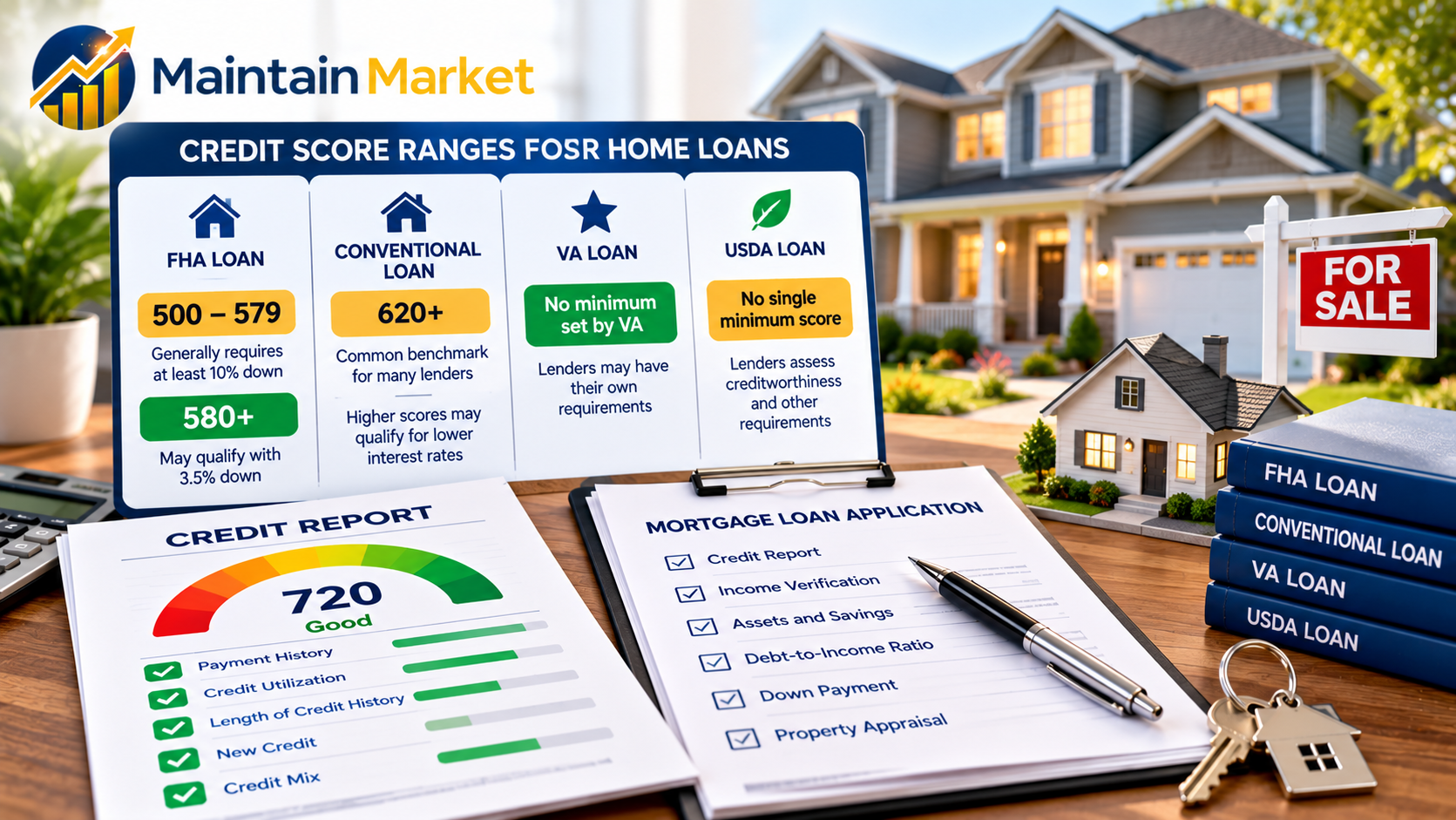
What credit score do I need to buy a house? In the United States, you may qualify for certain mortgage programs with a credit score as low as 500, while other loans and lenders may require scores of 620 or higher. The credit score you need depends on the type of mortgage, your down payment, your income, your existing debts, and the lender’s approval requirements.
For example, FHA loans can allow qualifying borrowers with scores of 580 or higher to make a down payment of 3.5%, while borrowers with scores between 500 and 579 generally need at least 10% down under FHA rules. Conventional mortgage requirements vary, and VA loans do not have a VA-mandated minimum credit score, although individual lenders may set their own standards.
A higher credit score can also help you qualify for more favorable mortgage terms. This guide explains the credit score requirements for different home loans, what lenders evaluate beyond your score, and how to prepare if your credit is not where you want it to be.
Quick Answer: What Credit Score Do You Need to Buy a House?
There is no universal minimum credit score for every mortgage. The following table provides a general starting point for U.S. homebuyers.
| Mortgage type | Credit score guidance |
|---|---|
| FHA loan | 580 or higher generally permits a 3.5% minimum down payment; 500–579 generally requires at least 10% down under FHA rules |
| Conventional mortgage | Requirements depend on the loan program, automated underwriting, lender, and other factors; 620 is a common benchmark for some conventional loans |
| VA loan | The Department of Veterans Affairs does not set a minimum score, but lenders may |
| USDA loan | No single score guarantees eligibility; lenders assess creditworthiness and apply program and underwriting requirements |
These figures are not guarantees of approval. A lender may apply additional requirements, and your overall financial profile matters.
For official guidance, review the Consumer Financial Protection Bureau’s mortgage preparation guide.
What Credit Score Do You Need for Different Types of Home Loans?
Understanding the major mortgage programs can help you identify which options may be worth exploring.
1. FHA Loans: Credit Score Requirements
FHA loans are insured by the Federal Housing Administration and are often considered by buyers who have limited savings or less-than-perfect credit.
FHA’s general credit-score and down-payment guidelines are:
- 580 or higher: A minimum down payment of 3.5% may be available.
- 500–579: A minimum down payment of 10% is generally required under FHA rules.
- Below 500: The borrower does not meet FHA’s standard minimum credit-score requirement.
Meeting these score guidelines does not automatically qualify you for an FHA mortgage. You must also meet applicable income, debt, property, and lender requirements.
Some lenders may require a higher score than FHA’s minimums.
Example: If you buy a $250,000 home and qualify for a 3.5% down payment, the down payment would be $8,750. You would still need to budget for closing costs, prepaid expenses, and other homeownership costs.
Official resource: HUD — FHA Single Family Housing Policy Handbook.
2. Conventional Loans: Credit Score Requirements
Conventional mortgages are not insured by the federal government in the same way as FHA loans. Some conventional programs allow relatively small down payments, but the eligibility requirements depend on the specific product and underwriting assessment.
A score of 620 is a commonly cited benchmark for certain conventional mortgages, particularly some manually underwritten loans. However, it is not a universal minimum for every conventional loan.
For example, Fannie Mae’s automated underwriting system can assess loan applications without a fixed minimum score requirement in some circumstances. That does not mean every borrower with a low score will qualify, because the system evaluates other risk factors and lenders may impose additional rules.
Your eligibility may depend on:
- Your credit history and the mortgage score used.
- Your down payment and loan-to-value ratio.
- Your debt-to-income ratio.
- Your income and employment history.
- The lender’s underwriting requirements.
Official resource: Fannie Mae — General Requirements for Credit Scores.
3. VA Loans: Credit Score Requirements
VA-backed home loans are available to eligible veterans, service members, and certain surviving spouses.
The Department of Veterans Affairs does not establish a universal minimum credit score for its home loan program. However, private lenders that originate VA-backed loans may have their own credit requirements.
VA eligibility also does not guarantee mortgage approval. Lenders assess credit history, income, debts, assets, and the ability to repay the loan.
If you are eligible for a VA home loan and your credit score is lower than you would like, contact multiple VA-approved lenders. Their individual requirements may differ.
Official resource: VA — Home Loan Benefits and Requirements.
4. USDA Loans: Credit Score Requirements
USDA home loans are designed to support eligible homebuyers purchasing qualifying properties in eligible rural areas. Depending on the program and circumstances, a USDA loan may offer financing with no down payment.
There is no single credit score that guarantees approval for every USDA loan. Lenders evaluate creditworthiness under applicable USDA requirements, and their underwriting practices can affect which applicants qualify.
Eligibility may depend on:
- The property’s location.
- Household income and applicable program limits.
- Your ability to repay the mortgage.
- Your credit history and other underwriting factors.
- The lender’s requirements.
If you are considering a USDA loan, ask a participating lender to evaluate your eligibility rather than relying on a credit-score number alone.
Official resource: USDA Rural Development — Single Family Housing Programs.
What Credit Score Gets You the Best Mortgage Rate?
The minimum credit score needed to qualify for a mortgage is not necessarily the score that gets you the best interest rate.
In general, stronger credit profiles can help borrowers qualify for more favorable pricing. The Consumer Financial Protection Bureau explains that borrowers with scores in the mid-to-high 700s or above generally have the most mortgage choices and often receive the lowest rates.
Its general guidance also notes:
- Mid-to-high 700s and above: Often associated with more choices and lower rates.
- 680–740: Borrowers may pay somewhat higher rates than those with stronger scores.
- 620–680: Borrowers may face higher rates and fewer options, depending on the loan.
- Below 620: Qualifying can be more difficult, although certain government-backed programs may be worth exploring.
These ranges are general guidance, not guaranteed pricing tiers. Actual offers depend on the loan program, lender, down payment, market conditions, debt-to-income ratio, and other factors.
Source: CFPB — Get Your Money Situation in Order.
Why does your credit score affect your mortgage rate?
Lenders use credit information to help assess the risk of lending money. A stronger credit profile may qualify you for better pricing, while a weaker profile may lead to a higher rate, additional requirements, or a denial.
Even a modest rate difference can affect the total interest you pay over a long mortgage term. This is why it is worth comparing offers rather than choosing a lender based only on the minimum credit score it accepts.
Which Credit Score Do Mortgage Lenders Check?
The score you see in a banking app or free credit-monitoring service may not be the same score your mortgage lender uses.
You can have multiple credit scores because different scoring models may evaluate your credit information differently. Mortgage lenders may also use different credit-reporting agencies or scoring models, depending on the loan program and applicable requirements.
For that reason, do not assume that a score shown in one app guarantees the same result during a mortgage application.
Before applying:
- Review your credit reports from Equifax, Experian, and TransUnion.
- Check for inaccurate late payments, balances, or accounts.
- Ask your mortgage lender which credit scores and reports it uses.
- Avoid unnecessary new credit applications while preparing to buy a home.
You can request your reports through AnnualCreditReport.com.
Can You Buy a House With a 580 Credit Score?
Possibly. A score of 580 may meet the general FHA credit-score threshold for a minimum down payment of 3.5%, provided you satisfy the other applicable requirements.
However, your options may be more limited than those of a borrower with stronger credit. A lender may have stricter standards, and your income, debts, payment history, down payment, and other factors can influence the outcome.
If your score is around 580:
- Ask lenders about FHA eligibility.
- Check whether a lender’s own minimum score is higher than FHA’s guideline.
- Review your credit reports for errors.
- Reduce high credit card balances where possible.
- Avoid taking on unnecessary new debt.
- Prepare documentation showing stable income and available savings.
Compare the actual mortgage offers you receive, including interest rates, mortgage insurance, fees, and closing costs.
Can You Buy a House With a 620 Credit Score?
A score of 620 may put some conventional mortgage options within reach, depending on the loan program, lender, and underwriting assessment. It may also be relevant when exploring other mortgage products.
However, 620 is not a guarantee of approval or a universal minimum across every conventional program.
If your score is around 620, ask lenders to compare the options for which you may qualify. An FHA loan may be worth considering alongside conventional financing, but the best choice depends on your down payment, monthly payment, mortgage insurance, and total borrowing costs.
Do not choose a mortgage solely because one program advertises a lower minimum credit score.
What Do Mortgage Lenders Consider Besides Your Credit Score?
Your credit score is important, but it is only one part of the mortgage approval process.
1. Debt-to-income ratio
Your debt-to-income ratio, or DTI, compares your monthly debt obligations with your gross monthly income.
For example, if you earn $6,000 per month before taxes and have $2,100 in qualifying monthly debt payments, your DTI is 35% before adding any proposed housing payment.
Lenders evaluate your existing obligations and the expected cost of the mortgage to determine whether the payment is affordable under their rules.
2. Income and employment history
Lenders generally review your income and employment or other qualifying income sources to determine whether you can afford the mortgage.
They may request pay stubs, W-2 forms, tax returns, bank statements, or other documentation depending on your circumstances.
3. Down payment and savings
Your down payment affects how much you borrow and may affect your loan options, pricing, and mortgage insurance costs.
You also need to budget for closing costs, property taxes, homeowners insurance, maintenance, and unexpected repairs.
4. Payment history
Recent missed payments, defaults, collections, or other serious negative credit events may affect your eligibility even if your current score meets a program’s stated guideline.
5. Property and loan details
The home’s price, appraised value, property type, occupancy, and loan amount may influence which programs are available to you.
The bottom line: A qualifying score does not automatically mean you can afford a home or that a lender will approve the loan.
How to Improve Your Credit Score Before Buying a House
If your score is below the range you want, improving your credit before applying may expand your options or help you qualify for better terms.
1. Check your credit reports for errors
Look for accounts that do not belong to you, incorrect balances, inaccurate late payments, or other reporting mistakes.
Dispute genuine errors with the credit bureau and the company that supplied the information.
Read our guide: How to Dispute Errors on Credit Report.
2. Pay every bill on time
Payment history is an important part of many credit-scoring models. Set reminders or automatic payments where appropriate, and contact creditors promptly if you are struggling to make a payment.
3. Reduce credit card balances
High credit utilization can negatively affect many credit scores. Paying down revolving balances may help, although the effect and timing vary by individual profile and scoring model.
Do not use all your house savings to pay off debt without considering your down payment and emergency fund needs.
4. Avoid unnecessary new credit
Opening several new credit accounts or applying for multiple loans shortly before a mortgage application may complicate your credit profile.
Avoid unnecessary applications while you are preparing to apply for a mortgage.
5. Keep older accounts in good standing
Do not close an account automatically just because you are preparing to buy a home. Closing a credit card can affect your available credit and utilization. Review your situation before making changes.
6. Build a consistent payment record
There is no guaranteed timeline for improving your credit score. Some changes may appear after creditors update reported information, while building a stronger payment history can take longer.
If you are planning to buy a home soon, discuss your credit situation with a mortgage professional before making major financial changes.
For additional advice, see our guide on how to rebuild credit.
How Long Should You Improve Your Credit Before Buying a House?
The right timeline depends on the problems in your credit profile.
- Reporting errors: A successful dispute may correct an error after the investigation process, but the timeline varies.
- High credit card balances: Changes may be reflected after updated balances are reported.
- Recent late payments: Their effects can persist, and consistent on-time payments are important going forward.
- Limited credit history: Building a stronger record may require months or longer.
- Serious negative events: Bankruptcy, foreclosure, or other major credit problems may require additional time and specific lender review.
If you hope to buy a home within the next few months, start by reviewing your reports and asking a lender to assess your situation. You may not need to delay buying if you already qualify for a suitable mortgage, but it is important to understand the costs and risks.
Should You Wait for a Higher Credit Score Before Buying a House?
Not necessarily. The decision depends on whether you qualify for an affordable mortgage today and whether waiting is likely to improve your options enough to justify the delay.
Consider applying now if:
- You meet the requirements for a suitable mortgage.
- Your income is stable enough to support the payment.
- You have sufficient savings for the down payment, closing costs, and emergencies.
- The proposed monthly payment fits your budget.
- You understand the loan’s interest rate, fees, and insurance costs.
Consider improving your credit first if:
- Your score is preventing you from qualifying.
- You are being offered mortgage terms that strain your budget.
- Your credit report contains errors that need correction.
- You have high-interest debts or insufficient savings.
- You expect meaningful improvement from paying down balances or correcting inaccurate information.
Compare written loan estimates and the total cost of borrowing. A higher score can be helpful, but it should not be the only factor in deciding when to buy.
Frequently Asked Questions
1. What credit score do I need to buy a house for the first time?
There is no separate universal credit score for all first-time homebuyers. Your options depend on the mortgage program, lender, down payment, income, and other eligibility requirements. FHA loans may be an option for eligible buyers with scores below 620.
2. Can I buy a house with a 500 credit score?
Possibly, but your options are limited. FHA guidelines generally allow scores from 500 to 579 with a minimum 10% down payment, subject to other requirements. Individual lenders may impose stricter standards, so approval is not guaranteed.
3. Is a 620 credit score good enough to buy a house?
A 620 score may qualify for certain mortgage programs, including some conventional loans, depending on the lender and underwriting assessment. Your income, debt, down payment, and credit history also matter.
4. Can I get a mortgage with a 580 credit score and no down payment?
A 580 score does not, by itself, qualify you for a zero-down-payment mortgage. FHA loans generally require at least 3.5% down at this score range. Eligible borrowers may explore other programs, such as certain VA or USDA loans, which have separate eligibility requirements.
5. What credit score gets the lowest mortgage interest rate?
Borrowers with stronger credit profiles, often in the mid-to-high 700s or above, generally have access to more choices and may qualify for lower rates. Actual pricing depends on the loan program, lender, down payment, and other factors.
6. Do mortgage lenders use FICO or VantageScore?
Mortgage lenders may use specific credit-scoring models required or permitted for the applicable loan program. The score shown by a free monitoring app may not match the score used for mortgage underwriting or pricing. Ask your lender which model it uses.
7. Does a bigger down payment make up for a low credit score?
A larger down payment can improve certain aspects of a mortgage application, but it does not automatically overcome every credit requirement. Approval depends on the loan program, lender, and full financial profile.
8. Can I buy a house after a late payment?
Possibly. A late payment does not automatically disqualify every borrower from every mortgage program. The severity, recency, overall payment history, and lender requirements all matter. Be prepared to explain the circumstances if asked.
9. Will checking my credit before buying a house lower my score?
Checking your own credit report or score is generally a soft inquiry and does not lower your score. A lender’s mortgage application process may involve a credit inquiry, so ask the lender how it will handle your application.
10. Should I pay off all my credit cards before applying for a mortgage?
Reducing credit card balances may help your credit profile and DTI, but using all your savings to pay off cards can leave you short on your down payment, closing costs, or emergency reserves. Review your overall financial position before deciding.
Why Maintain Market Is Different
Maintain Market focuses on practical, evidence-based personal finance guidance to help readers make informed decisions.
Buying a house involves more than reaching a particular credit score. We explain the differences between mortgage programs, highlight the other factors lenders consider, and encourage readers to compare loan costs instead of relying on a single advertised minimum.
Our goal is to help you understand your options, prepare your finances, and make a homebuying decision that fits your circumstances.
Official References
- Consumer Financial Protection Bureau — Does My Credit Score Affect My Ability to Get a Mortgage?
- Consumer Financial Protection Bureau — Get Your Money Situation in Order
- U.S. Department of Housing and Urban Development — FHA Handbook
- Fannie Mae — General Requirements for Credit Scores
- U.S. Department of Veterans Affairs — VA Home Loans
- USDA Rural Development — Single Family Housing Programs
- AnnualCreditReport.com — Official Credit Report Requests
Editorial Review
Intent: Informational and commercial investigation. Readers want to understand mortgage credit score requirements and determine which loan programs to explore.
Note: Credit-score figures are general guidelines and not guarantees of mortgage approval. Loan rules, scoring models, and lender requirements may change. Readers should confirm current eligibility with participating lenders and the relevant program administrator.