
If you are planning to apply for a new credit card, you may be wondering: Does applying for a credit card lower your credit score? The short answer is yes, it can. When you submit a credit card application, the issuer will typically perform a hard inquiry on your credit report, which may cause your credit score to drop slightly.
However, the impact is usually temporary. A single credit card application does not automatically damage your credit permanently. In fact, opening a new credit card and managing it responsibly may help you build a stronger credit history over time.
The important thing is to understand how credit card applications affect your credit report, how long hard inquiries remain visible, and what you can do to protect your credit score before applying.
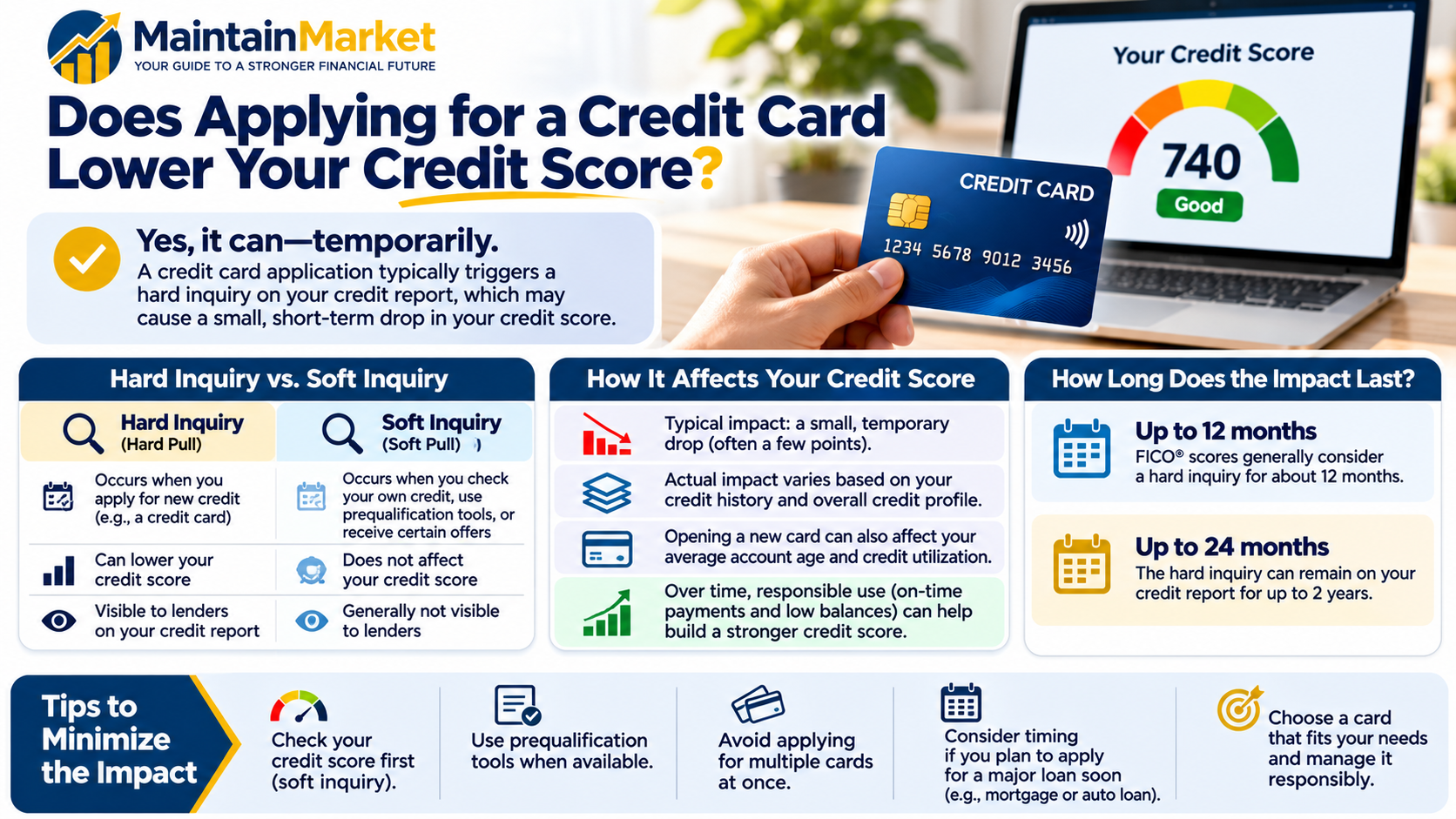
Does Applying for a Credit Card Lower Your Credit Score?
Yes, applying for a credit card can temporarily lower your credit score because the card issuer generally checks your credit history through a hard inquiry.
A hard inquiry occurs when a lender requests your credit report to evaluate your application for new credit.
For most applicants, one hard inquiry has a relatively small effect. However, the actual impact depends on your existing credit history, the scoring model being used, and other information in your credit report.
For example:
- Someone with a long, established credit history may see little change.
- Someone with a short credit history may experience a more noticeable impact.
- Someone applying for several credit cards within a short period may see a larger cumulative effect.
It is important to remember that applying for a card and opening a new account are two different events. The application can create a hard inquiry. If you are approved and open the account, the new account can also affect your credit history and utilization.
Why Does Applying for a Credit Card Affect Your Credit Score?
When you apply for a credit card, the issuer wants to understand how responsibly you have managed borrowed money in the past.
It typically checks information from one or more of the three major U.S. credit bureaus:
- Experian
- Equifax
- TransUnion
The credit inquiry helps the issuer evaluate your creditworthiness and decide whether to approve your application.
Credit scoring models consider how recently and how frequently you have applied for new credit. Frequent applications may indicate that you are seeking additional borrowing, which can be viewed as a potential risk.
There are two main types of credit inquiries: hard inquiries and soft inquiries.
Hard Inquiry vs Soft Inquiry: What’s the Difference?
Understanding the difference between hard and soft inquiries can help you avoid unnecessary concerns when checking your credit.
What is a hard inquiry?
A hard inquiry, sometimes called a hard pull, happens when a lender checks your credit report as part of a credit application.
Common examples include:
- Applying for a new credit card
- Applying for a personal loan
- Applying for an auto loan
- Applying for a mortgage
- Requesting certain credit limit increases
Hard inquiries may affect your credit score and can be visible to lenders reviewing your credit report.
A hard inquiry is generally recorded even if the credit card issuer ultimately declines your application.
What is a soft inquiry?
A soft inquiry occurs when someone checks your credit report without making a formal application for new credit.
Examples include:
- Checking your own credit score
- Reviewing your credit report
- Receiving certain prequalified credit card offers
- Existing lenders reviewing your account
- Certain background or account-management checks
Soft inquiries do not lower your credit score.
Hard inquiry vs soft inquiry comparison
| Feature | Hard Inquiry | Soft Inquiry |
|---|---|---|
| Can lower your credit score | Yes | No |
| Usually occurs when applying for credit | Yes | No |
| Visible to lenders reviewing your report | Yes | Generally no |
| Checking your own credit | No | Yes |
| Prequalification checks | Usually no | Often yes |
| Remains on credit report | Up to 2 years | May appear in your personal report |
If you are comparing credit cards, look for prequalification tools that use a soft inquiry. However, confirm the issuer’s terms because a formal application may still trigger a hard inquiry.
How Many Points Does Your Credit Score Drop When You Apply for a Credit Card?
There is no fixed number of points that every applicant loses after applying for a credit card.
According to FICO, the effect of a hard inquiry depends on your individual credit profile.
A single hard inquiry may reduce your score by only a few points, while some applicants may experience little or no noticeable change.
The impact can be more significant if:
- You have a limited credit history.
- Your credit report contains very few accounts.
- You have recently applied for several credit products.
- Your credit score is already affected by other negative information.
For example, imagine your credit score is 740 before applying for a new credit card. A hard inquiry could cause a small temporary decline.
However, there is no guarantee that your score will drop by a specific number. Your actual score may also change because of other information reported to the credit bureaus.
Important: Do not assume that every credit card application will reduce your score by exactly five or ten points. Credit scoring models evaluate the entire credit profile.
How Long Does a Credit Card Application Affect Your Credit Score?
A hard inquiry can remain on your credit report for up to two years.
However, its impact on your FICO score generally lasts for up to 12 months.
Here is the difference:
| Time period | What happens |
|---|---|
| Immediately after applying | A hard inquiry may appear on your credit report |
| First few months | The inquiry may influence your credit score |
| After 12 months | FICO scores generally stop considering the inquiry |
| After 24 months | The inquiry generally disappears from your credit report |
This means that a hard inquiry can remain visible to lenders for longer than it affects your FICO score.
You do not need to close a credit card simply because you received a hard inquiry. The inquiry is associated with the application, not an ongoing monthly penalty.
Does Opening a New Credit Card Hurt Your Credit Score?
Yes, opening a new credit card can affect your credit score in several ways.
The hard inquiry is only one part of the impact. If your application is approved and the account is opened, the new account may affect your credit history, average account age, and credit utilization.
1. It can lower your average account age
Credit scoring models consider the length of your credit history.
Opening a new account adds a recently opened account to your credit profile. This may reduce the average age of your accounts.
For example, imagine you have three credit cards that have been open for:
- 8 years
- 5 years
- 2 years
Your average account age is 5 years.
If you open another credit card, your average account age will decrease.
A shorter average account age may negatively affect your score, particularly if you have a relatively limited credit history.
2. It can increase your credit utilization
Credit utilization measures how much of your available revolving credit you are using.
The general calculation is:
Credit Utilization = Total Credit Card Balances ÷ Total Credit Limits × 100
For example:
- Total credit card balances: $2,000
- Total credit limits: $10,000
- Credit utilization: 20%
Now imagine you open a new credit card with a $5,000 limit and do not increase your spending.
Your total available credit becomes $15,000.
Your utilization becomes:
$2,000 ÷ $15,000 × 100 = 13.33%
In this simplified example, your utilization decreases because your available credit increases.
However, if you use the new card to accumulate additional debt, your utilization may increase instead.
A higher credit limit is not an invitation to spend more than you can repay.
3. It can affect your credit mix
Credit scoring models may consider the different types of credit accounts you manage.
For example, your credit report may include:
- Credit cards
- Auto loans
- Personal loans
- Student loans
- Mortgages
A credit card adds a revolving credit account to your history.
However, you should not open a credit card solely to improve your credit mix. Responsible payment behavior and manageable debt are more important.
Does Applying for Multiple Credit Cards Lower Your Credit Score?
Yes. Applying for several credit cards within a short period can have a greater negative effect than submitting one application.
Each credit card application may generate a separate hard inquiry.
Unlike certain mortgage, auto loan, and student loan rate-shopping inquiries, multiple credit card applications generally do not receive the same treatment of being grouped together as one inquiry.
For example, if you apply for four different credit cards over a short period, the credit bureaus may record four separate hard inquiries.
This can:
- Temporarily lower your credit score.
- Make you appear more dependent on new credit.
- Affect your chances of approval for future credit applications.
- Raise concerns for lenders reviewing your recent credit activity.
If you are considering multiple credit cards, avoid submitting applications simply because several promotional offers are available.
Apply only when you have a genuine need and understand the card’s fees, interest rates, and benefits.
Does Getting Denied for a Credit Card Hurt Your Credit Score?
Being denied for a credit card does not directly reduce your credit score.
However, the hard inquiry generated during the application process may still affect your score.
For example, suppose you apply for a rewards credit card and the issuer declines your application.
The denial itself is not a separate negative entry that automatically reduces your score. However, if the issuer performed a hard inquiry, that inquiry may remain on your credit report.
If your application is declined, review the reasons provided by the issuer.
Common reasons include:
- Limited credit history
- Low credit score
- High credit utilization
- Too many recent credit applications
- High existing debt
- Insufficient qualifying income
- Errors or incomplete information in your application
You can use the issuer’s explanation to identify what needs improvement before applying again.
Can Applying for a Credit Card Improve Your Credit Score?
Applying for a credit card may initially lower your score, but opening and managing the account responsibly can help build credit over time.
A credit card can contribute to a stronger credit history when you:
- Make payments on time.
- Keep balances low.
- Avoid maxing out your credit limit.
- Maintain a manageable amount of debt.
- Use the account responsibly over time.
For example, if you have limited credit history and obtain a credit card, making consistent on-time payments can help establish a positive payment record.
A new credit card can also increase your total available credit, potentially reducing your credit utilization if your balances remain unchanged.
However, these benefits are not guaranteed. The result depends on your complete credit profile and the scoring model used.
How to Apply for a Credit Card Without Hurting Your Credit Score Too Much
You cannot always avoid a hard inquiry when applying for a credit card, but you can reduce unnecessary applications and manage the impact.
Here are some practical steps.
1. Check your credit score before applying
Before submitting an application, review your credit report and understand your current credit position.
Checking your own credit score is a soft inquiry and does not lower it.
You can review your credit reports from Experian, Equifax, and TransUnion through the official AnnualCreditReport.com website.
2. Use prequalification tools
Some credit card issuers offer prequalification or preapproval tools that use a soft inquiry.
These tools can help you understand whether you may qualify before submitting a formal application.
However, prequalification does not guarantee approval. The issuer may still perform a hard inquiry when you submit the full application.
3. Avoid applying for multiple cards at once
Submitting multiple applications within a short period can create several hard inquiries.
Choose a card that matches your credit profile and financial needs rather than applying for every available offer.
4. Compare card requirements
Before applying, check:
- Recommended credit profile
- Annual fees
- APR
- Rewards structure
- Foreign transaction fees
- Balance transfer charges
- Welcome offer requirements
Choosing a suitable card can reduce the risk of unnecessary applications.
5. Avoid applying before a major loan
If you are planning to apply for a mortgage, auto loan, or another important loan soon, consider delaying a new credit card application.
A new credit inquiry and account may affect your credit profile when a lender evaluates your application.
If you are already in the mortgage application or closing process, speak with your mortgage lender before opening new credit.
6. Pay your credit card bills on time
Payment history is an important factor in credit scoring.
Once you open a credit card, make every payment by the due date.
Consider setting up automatic minimum payments as a backup, while paying the full statement balance whenever possible to avoid interest charges.
7. Keep your credit utilization low
Try to avoid using a large portion of your available credit.
For example, if your credit limit is $5,000 and your balance is $4,000, your utilization is 80%.
Reducing the balance can help lower your utilization.
There is no single utilization percentage that guarantees a particular score, but lower utilization is generally better for credit scoring.
Should You Apply for a Credit Card If You Have a Low Credit Score?
You can apply for a credit card with a low credit score, but it is important to choose the right product.
Some issuers offer secured credit cards designed for people who are building or rebuilding their credit history.
A secured credit card generally requires a refundable security deposit, which often determines your initial credit limit.
For example:
- Security deposit: $300
- Credit limit: $300
You can use the card for purchases and make payments according to the account terms.
The issuer may report your account activity to the credit bureaus, helping you establish a credit history when you manage the card responsibly.
Before applying, check whether the issuer reports to all three major credit bureaus, whether it charges an annual fee, and whether it offers a path to an unsecured card.
You can also review your credit report for errors and work on existing debt before applying.
Frequently Asked Questions
1. Does applying for a credit card lower your credit score immediately?
A formal credit card application generally triggers a hard inquiry, which may affect your credit score. The change may appear after the inquiry is reported and processed by the credit scoring system. The exact timing and impact vary.
2. How many points does a credit card application take off your score?
There is no fixed number. A single hard inquiry may reduce your score by a few points, but the effect depends on your credit history and the scoring model.
3. How long does a hard inquiry stay on your credit report?
A hard inquiry can remain on your credit report for up to two years. However, FICO scores generally consider hard inquiries only for the first 12 months.
4. Does checking my own credit score lower it?
No. Checking your own credit score is generally a soft inquiry and does not lower your credit score.
5. Does getting denied for a credit card hurt your credit score?
The denial itself does not directly lower your score. However, the hard inquiry associated with your application may affect it even if the issuer does not approve you.
6. Does opening a new credit card increase credit utilization?
Opening a new card can increase your total available credit. If your balances remain the same, your overall utilization may decrease. However, additional spending can increase your balances and utilization.
7. Can I apply for two credit cards on the same day?
You can submit multiple applications, but each may generate a separate hard inquiry. Applying for multiple cards at once can have a greater impact on your credit profile and may affect approval decisions.
8. Should I wait before applying for another credit card?
Waiting can help you avoid accumulating several hard inquiries in a short period. The appropriate timing depends on your financial situation, credit history, and upcoming borrowing needs. There is no universal waiting period that guarantees approval.
9. Do preapproved credit card offers affect my credit score?
Receiving a preapproved or prequalified offer generally does not affect your credit score when the issuer uses a soft inquiry. However, submitting a formal application may trigger a hard inquiry.
10. Can a credit card help build my credit score?
Yes. A credit card can help establish payment history and build a longer credit record when managed responsibly. Paying on time and keeping balances low are important habits.
11. Do all credit card applications create a hard inquiry?
Most formal applications involve a hard inquiry, but some issuers may offer application or preapproval processes using soft inquiries. Always check the issuer’s disclosure before submitting an application.
12. Will my credit score recover after applying for a credit card?
A score affected by a hard inquiry may recover over time. The inquiry’s influence on FICO scores generally ends after 12 months, although other factors, such as payment history and utilization, continue to affect your score.
Final Thoughts
So, does applying for a credit card lower your credit score? It can, but the impact is generally small and temporary for many applicants.
A hard inquiry may cause a short-term decline, and opening a new account can affect your average account age and credit utilization. However, responsible credit card use can help you establish a positive payment history and build your credit over time.
Before applying, check your credit report, compare card requirements, use prequalification tools where available, and avoid submitting multiple applications unnecessarily.
Most importantly, do not focus only on the short-term score impact. Choose a credit card that fits your financial situation and use it responsibly.
External authoritative sources
These sources within the article:
- CFPB – When Can a Credit Card Company Look at Your Credit Reports?
- CFPB – What Is a Credit Inquiry?
- myFICO – Do Credit Inquiries Lower Your FICO Score?
- myFICO – How Long Do Hard Inquiries Stay on Your Credit Report?
- AnnualCreditReport.com – Official Free Credit Reports
Disclaimer: This article is for educational purposes only and does not constitute financial or credit advice. Credit score changes vary by individual, credit bureau, and scoring model. Always review the terms of a credit card before applying.