
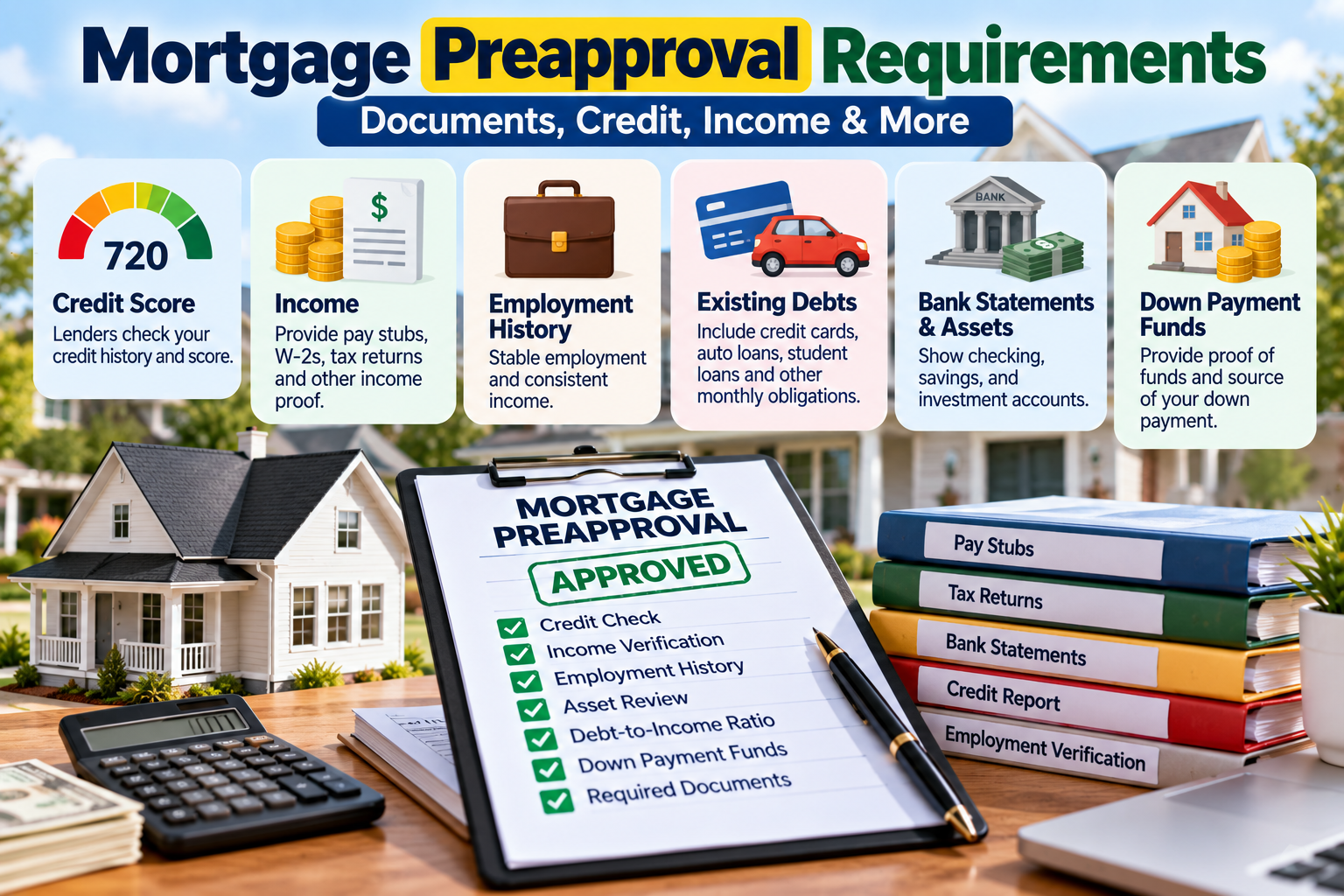
Understanding mortgage preapproval requirements can make the home-buying process much easier. Before a lender gives you a preapproval letter, it will generally review information about your income, employment, credit history, debts, assets, and available funds to estimate how much you may be able to borrow.
A preapproval can help you understand your potential price range and show sellers that you are a serious buyer. However, it is not a guaranteed mortgage approval, and the lender will still need to verify information later in the loan process.
Quick Answer: What Are the Mortgage Preapproval Requirements?
Most lenders will want information and documentation covering:
- Income
- Employment history
- Credit history
- Existing debts
- Bank and investment assets
- Down payment funds
- Identity and personal information
- Tax returns when applicable
- Additional income documentation when applicable
- Information about the property and requested loan
The exact requirements vary by lender, loan program, borrower, and financial situation.
Fannie Mae says lenders need documentation supporting information such as credit history, employment and income, assets, and other financial information used to qualify the borrower.
What Is Mortgage Preapproval?
A mortgage preapproval is a statement from a lender indicating that it is tentatively willing to lend you up to a particular amount, based on information reviewed during the preapproval process.
It can help you:
- Understand your potential borrowing range
- Set a realistic home-shopping budget
- Demonstrate financing readiness to sellers
- Identify financial issues before making an offer
- Compare lenders
But preapproval is not the same as final mortgage approval.
The CFPB explains that a preapproval letter is based on assumptions and is not a guaranteed loan offer. Additional information and verification are still required later.
1. Proof of Income
Income is one of the most important parts of a mortgage application.
Lenders need to determine whether your income is sufficient and reliable enough to support the proposed mortgage payment.
Depending on your situation, you may need:
- Recent pay stubs
- W-2 forms
- Federal tax returns
- 1099 forms
- Employment verification
- Documentation for other qualifying income
Fannie Mae’s current documentation guidance includes recent paystubs and W-2s for employment income, with additional documentation depending on the type of income being used to qualify.
Example
If you earn $90,000 per year from a regular job, your lender may ask for recent pay information and W-2 records to verify your income.
If you are self-employed, have commission income, rental income, or other income sources, additional documentation may be necessary.
2. Employment History
Lenders generally want to understand your current employment situation and whether the income being used for qualification is reliable.
Be prepared to provide information such as:
- Current employer
- Employer address
- Position
- Employment dates
- Recent pay information
- Previous employment information when required
Fannie Mae’s underwriting framework evaluates reliable and recurring income and requires lenders to verify employment income for borrowers whose income is being used to qualify.
A job change does not automatically mean you cannot get preapproved. However, your lender may need additional information to determine how your current income should be evaluated.
3. Credit History and Credit Score
Your credit history is another major part of mortgage preapproval.
A lender may review:
- Credit score
- Payment history
- Credit card balances
- Outstanding debts
- Recent credit activity
- Other information in your credit report
Fannie Mae’s current underwriting requirements use credit information in evaluating mortgage eligibility and pricing.
The exact credit requirements depend on the mortgage program and lender.
There is no single credit score that guarantees mortgage preapproval for every loan.
4. Existing Debts
Lenders need to know how much debt you already have.
Common debts include:
- Credit cards
- Auto loans
- Student loans
- Personal loans
- Existing mortgages
- Other recurring obligations
These debts matter because lenders use your financial obligations when evaluating how much additional monthly debt you can reasonably handle.
Freddie Mac notes that lenders may request information about outstanding debts, including credit cards, auto loans, and student loans, as part of the mortgage underwriting process.
5. Debt-to-Income Ratio
Your debt-to-income ratio, commonly called DTI, compares your monthly debt obligations with your gross monthly income.
A simplified formula is:
DTI = Monthly Debt Payments ÷ Gross Monthly Income × 100
Example
Suppose your gross monthly income is:
$8,000
Your monthly debt payments are:
- Car loan: $500
- Student loan: $300
- Credit card payments: $200
Total:
$1,000
Your simplified DTI would be:
$1,000 ÷ $8,000 × 100 = 12.5%
Your proposed mortgage payment would then also factor into the lender’s qualification analysis.
DTI requirements vary by loan program and lender, so don’t assume that one percentage applies to every mortgage.
6. Bank Statements and Asset Verification
Your lender may need to verify that you have enough money for the transaction.
That can include funds for:
- Down payment
- Closing costs
- Prepaid expenses
- Required reserves
- Other transaction-related costs
You may be asked for statements from:
- Checking accounts
- Savings accounts
- Investment accounts
- Retirement accounts
- Certificates of deposit
- Other eligible assets
Fannie Mae’s home-buying documentation checklist includes checking and savings accounts, CDs, bonds, retirement accounts, investment accounts, and business accounts among potential asset documentation.
7. Down Payment Funds
Your lender will want to understand where your down payment money is coming from.
Depending on the loan program, acceptable sources can include your own funds and other permitted sources such as eligible gifts or assistance.
If you recently received a large deposit, your lender may ask you to document where the money came from.
The CFPB specifically notes that borrowers should be prepared to document the source of large deposits and down-payment funds when requested.
Example
Suppose you have:
$40,000 in savings
and want to use:
$30,000 as your down payment.
Your lender may verify the account and may also evaluate whether the remaining funds are sufficient for other transaction expenses and requirements.
8. Tax Returns
Not every borrower will need the same tax documentation.
Tax returns may be particularly relevant if you have:
- Self-employment income
- Rental income
- Commission income
- Business income
- Other income that requires additional verification
Fannie Mae’s documentation guidance identifies tax returns as potential documentation for self-employment, rental, and commission income.
If you are a traditional W-2 employee, your lender may use other documentation to verify your employment income.
9. Identification and Personal Information
Your lender will also need basic information to establish your identity and complete the mortgage application.
Potential documents can include:
- Government-issued photo ID
- Social Security number
- Current address
- Previous addresses
- Employment information
- Other personal information required by the application
Fannie Mae’s home-loan document checklist includes photo identification and residential and employment history among information that may be requested.
10. Information About the Home You Want to Buy
For an early preapproval, you may not have selected a specific home yet.
You can still seek preapproval before making an offer.
Once you identify a property, the lender will need additional information about the home and transaction.
For a mortgage Loan Estimate, federal rules require six key pieces of information:
- Name
- Income
- Social Security number
- Property address
- Estimated property value
- Desired loan amount
The CFPB explains that these six pieces of information are enough to trigger the lender’s obligation to provide a Loan Estimate.
A preapproval process can involve more information and documentation than the minimum needed to receive a Loan Estimate.
Mortgage Preapproval Documents Checklist
Here’s a practical checklist to prepare before contacting lenders.
Income
- Recent pay stubs
- W-2 forms
- 1099 forms, if applicable
- Tax returns, if applicable
- Documentation of other income
Employment
- Employer name
- Employer address
- Employment history
- Current position
- Employment dates
Assets
- Checking statements
- Savings statements
- Investment statements
- Retirement account statements
- CD statements
- Other eligible asset documentation
Debts
- Credit card information
- Auto loan statements
- Student loan information
- Personal loans
- Existing mortgage information
Personal information
- Government-issued ID
- Social Security number
- Current address
- Previous addresses
Other documents
Depending on your situation:
- Divorce documents
- Gift letter
- Bankruptcy documents
- Lease or rent-payment records
- Business documents
- Rental-income documentation
Fannie Mae’s consumer checklist includes many of these documents while emphasizing that the exact documentation depends on the lender and borrower.
Mortgage Preapproval Requirements for First-Time Homebuyers
First-time buyers generally go through the same basic financial evaluation as other mortgage applicants.
You may still need to provide:
- Income documentation
- Employment information
- Credit information
- Debt information
- Bank statements
- Down-payment documentation
Being a first-time buyer can affect which assistance programs or mortgage products you may qualify for, but it does not eliminate the lender’s need to evaluate your ability to repay the loan.
Mortgage Preapproval Requirements for Self-Employed Borrowers
Self-employed borrowers may need more documentation than a traditional W-2 employee.
Depending on the situation, the lender may request:
- Personal tax returns
- Business tax returns
- Profit-and-loss statements
- Business bank statements
- Business ownership information
- 1099s
- Other documentation supporting income
Fannie Mae’s current guidance includes tax returns and profit-and-loss documentation among possible requirements for self-employed borrowers.
The exact requirements depend on how the lender calculates and verifies your qualifying income.
Mortgage Preapproval Requirements With Commission Income
Commission-based income can require additional documentation.
A lender may need to verify:
- Employment
- Income history
- Commission structure
- Tax documentation
- Continuity of income
Don’t assume that your current commission amount will automatically be treated as qualifying income.
The lender will determine what income can be used under the applicable underwriting rules.
Mortgage Preapproval With Student Loans
Student loan debt can affect your mortgage qualification because lenders consider your existing debt obligations.
You may need to provide:
- Student loan statements
- Current payment information
- Documentation of the loan status
- Other information requested by the lender
The way student-loan payments are treated can vary by loan program and underwriting rules.
Mortgage Preapproval With Credit Card Debt
Credit card balances and required payments can affect your debt-to-income calculation.
Before applying, review:
- Current balances
- Minimum payments
- Recent late payments
- Credit utilization
- New accounts
- Recent credit inquiries
Avoid making major financial changes immediately before preapproval without discussing them with your lender.
Does Mortgage Preapproval Check Your Credit?
Typically, yes.
The CFPB says lenders typically check credit before issuing a preapproval letter.
A mortgage credit inquiry can affect your credit score.
If you’re shopping for mortgages, CFPB recommends comparing multiple lenders. It also notes that getting multiple preapprovals within a short period should not have a major impact on your credit score.
How Long Does Mortgage Preapproval Take?
The timeline varies by lender and borrower.
A straightforward application with organized documentation can move faster than an application involving:
- Self-employment
- Multiple income sources
- Large recent deposits
- Complex assets
- Credit issues
- Multiple properties
- Unusual financial circumstances
The best way to speed up the process is to prepare your documents before applying and respond quickly when the lender requests additional information.
How Long Is a Mortgage Preapproval Good For?
Preapproval letters can have expiration dates.
The CFPB says preapproval letters typically expire after 30 to 60 days, although the exact period depends on the lender.
If your preapproval expires while you’re still shopping, the lender may need to update your financial and credit information.
Does Preapproval Guarantee Mortgage Approval?
No.
This is one of the most important things to understand.
A preapproval means the lender is tentatively willing to lend based on information reviewed so far.
It does not guarantee:
- Final approval
- A specific interest rate
- A specific property
- A particular loan amount
- Closing
The lender may verify additional information later, including the property, income, assets, debts, and other loan conditions.
CFPB explicitly describes a preapproval letter as not being a guaranteed loan offer.
Preapproval vs Prequalification
These terms can mean different things depending on the lender.
Generally:
| Feature | Prequalification | Preapproval |
|---|---|---|
| Financial review | Often less detailed | Generally more detailed |
| Credit review | May or may not involve a credit check | Typically involves credit review |
| Documentation | Often limited | More documentation commonly requested |
| Seller confidence | Can be less persuasive | Often more useful |
| Borrowing estimate | Approximate | Based on more detailed information |
Because lenders use these terms differently, ask exactly what the lender has reviewed before relying on the letter.
Mortgage Preapproval vs Loan Estimate
These are also different.
Mortgage preapproval
Helps determine how much a lender may be willing to lend and can help you shop for a home.
Loan Estimate
A standardized disclosure showing estimated loan terms and costs after you provide the required information and the lender receives an application.
The CFPB recommends getting Loan Estimates from multiple lenders so you can compare actual mortgage costs.
How to Improve Your Chances of Mortgage Preapproval
Before applying, consider:
Review your credit
Check your credit reports and look for errors.
Reduce unnecessary debt
Lower monthly debt obligations can improve your financial profile.
Avoid unnecessary new credit
New credit applications can change your credit profile.
Organize your income documents
Have recent paystubs and tax documents ready.
Keep down-payment funds documented
Avoid unexplained large deposits.
Maintain financial stability
Avoid major financial changes immediately before applying unless necessary.
Compare multiple lenders
Don’t assume your first lender offers the best mortgage terms.
CFPB recommends shopping around and comparing mortgage offers from multiple lenders.
What Can Cause a Mortgage Preapproval to Be Delayed?
Common reasons include:
- Missing documents
- Unexplained deposits
- Inconsistent income information
- Self-employment documentation
- Credit issues
- New debt
- Employment changes
- Incomplete tax records
- Asset-verification problems
- Delayed responses to lender requests
If a lender asks for additional documentation, respond as quickly as possible.
CFPB recommends responding promptly to lender requests and notes that delays in providing documentation can delay the mortgage process.
What Not to Do After Getting Preapproved
Getting preapproved doesn’t mean you should stop managing your finances carefully.
Avoid, unless necessary and discussed with your lender:
- Taking out a new auto loan
- Opening several credit cards
- Making large unexplained deposits
- Changing jobs without understanding the impact
- Increasing debt significantly
- Moving money without keeping records
- Making large purchases
Your financial information may be verified again during the mortgage process.
How to Get Mortgage Preapproval Step by Step
Step 1: Check your credit
Review your credit history before contacting lenders.
Step 2: Calculate your budget
Don’t assume the lender’s maximum approval amount is the amount you should spend.
Step 3: Gather documents
Prepare income, asset, debt, employment, and identity documentation.
Step 4: Compare lenders
Consider banks, credit unions, mortgage brokers, and other lenders.
Step 5: Apply for preapproval
Provide the requested financial information.
Step 6: Review the preapproval letter
Check:
- Maximum loan amount
- Loan type
- Expiration date
- Conditions
- Interest-rate assumptions, if stated
Step 7: Shop for a home
Use your preapproval as a financing guide rather than treating the maximum amount as your required spending limit.
Step 8: Compare official Loan Estimates
After you make an offer and move forward with a lender, compare the actual loan terms and costs.
Mortgage Preapproval Requirements Checklist
Before applying, make sure you can answer:
- What is my annual income?
- How stable is my income?
- What debts do I currently have?
- What is my credit score and credit history?
- How much do I have saved?
- Where did my down-payment funds come from?
- Do I have additional assets?
- Do I have self-employment or other income?
- Do I have recent large deposits?
- Do I have outstanding student loans?
- Do I have an existing mortgage?
- Do I have recent credit applications?
- Do I have all required income documents?
- Do I have identification documents?
- Have I compared multiple lenders?
Frequently Asked Questions
What are the basic mortgage preapproval requirements?
Lenders generally review your income, employment, credit history, debts, assets, and available funds. You may also need to provide documents such as pay stubs, W-2s, bank statements, tax returns, and identification, depending on your situation.
What credit score do I need for mortgage preapproval?
There isn’t one universal credit-score requirement for every mortgage. Requirements vary by loan type, lender, and borrower. A lender will also consider your broader credit history and financial profile.
How much income do I need to get preapproved for a mortgage?
There is no universal minimum income. What matters is whether your income and overall financial profile support the proposed mortgage and other debt obligations.
Do I need bank statements for mortgage preapproval?
Many lenders request bank or asset statements to verify available funds, especially for the down payment, closing costs, and required reserves. Exact documentation varies.
Do I need tax returns for mortgage preapproval?
Not every borrower will need the same tax documents. Tax returns are more commonly relevant when income comes from self-employment, rental income, commissions, or other sources requiring additional verification.
Does preapproval guarantee a mortgage?
No. A preapproval is not a guaranteed loan offer. The lender may still need to verify information and the property before final approval.
How long does mortgage preapproval last?
Preapproval letters commonly expire after about 30 to 60 days, although the exact period depends on the lender.
Can I get preapproved before finding a house?
Yes. Getting preapproved before choosing a property can help you understand your potential price range and demonstrate financing readiness when you make an offer.
Can self-employed people get mortgage preapproval?
Yes. Self-employed borrowers can obtain mortgage preapproval, but they may need additional documentation to verify their income and business finances.
Should I get multiple mortgage preapprovals?
Comparing multiple lenders can help you understand different loan options and costs. CFPB recommends shopping around and comparing mortgage offers from multiple lenders.
Final Takeaway
The mortgage preapproval requirements you’ll encounter are mainly designed to help the lender determine whether your income, credit, debts, assets, and financial circumstances support the mortgage you’re requesting.
Prepare your:
Income + employment documents + credit information + debt information + asset statements + down-payment documentation + identification.
If you’re self-employed or have additional income, debts, or complicated finances, expect to provide additional documentation.
And remember: preapproval is not final approval.
Once you’re ready to buy, compare actual Loan Estimates from multiple lenders rather than choosing a mortgage solely because one lender offered the highest preapproval amount.
Your lender may approve you for a certain amount, but you are the person who decides how much home you can comfortably afford.
Why Maintain Market Is Different
Maintain Market focuses on making mortgage decisions easier to understand without reducing them to a single approval number.
For mortgage preapproval, we explain:
- What lenders generally review
- Which documents you may need
- How income and debt affect qualification
- Why credit matters
- How assets and down-payment funds are verified
- Why preapproval is different from final approval
- How to compare lenders
- What to avoid after getting preapproved
Mortgage requirements vary by lender, loan program, borrower, and property. Always confirm the exact documentation and qualification requirements directly with your lender.
References
- CFPB — Get a Preapproval Letter
- CFPB — Shopping for a Mortgage
- CFPB — Mortgage Application & Loan Estimate
- CFPB — Documents & Lender Requests
- Fannie Mae — Documents You Need to Apply for a Mortgage
- Fannie Mae — Underwriting Requirements
- Freddie Mac — How Do I Get Pre-Approved for a Mortgage?
- Freddie Mac — Mortgage Underwriting
Editorial Review
Reviewed for U.S. mortgage preapproval terminology, documentation, credit review, income verification, assets, debt, employment, preapproval letters, and the distinction between preapproval and final mortgage approval. Mortgage requirements vary by lender, loan program, borrower, and property.
Recommended Reads
- FHA Loan Requirements — Understand FHA credit, income, down-payment, mortgage-insurance, and property requirements.
- FHA vs Conventional Loan — Compare FHA and conventional mortgages based on down payment, credit, mortgage insurance, loan limits, and overall costs.
- FHA Loan Down Payment — Learn how the FHA minimum down payment works and what additional cash you may need.