
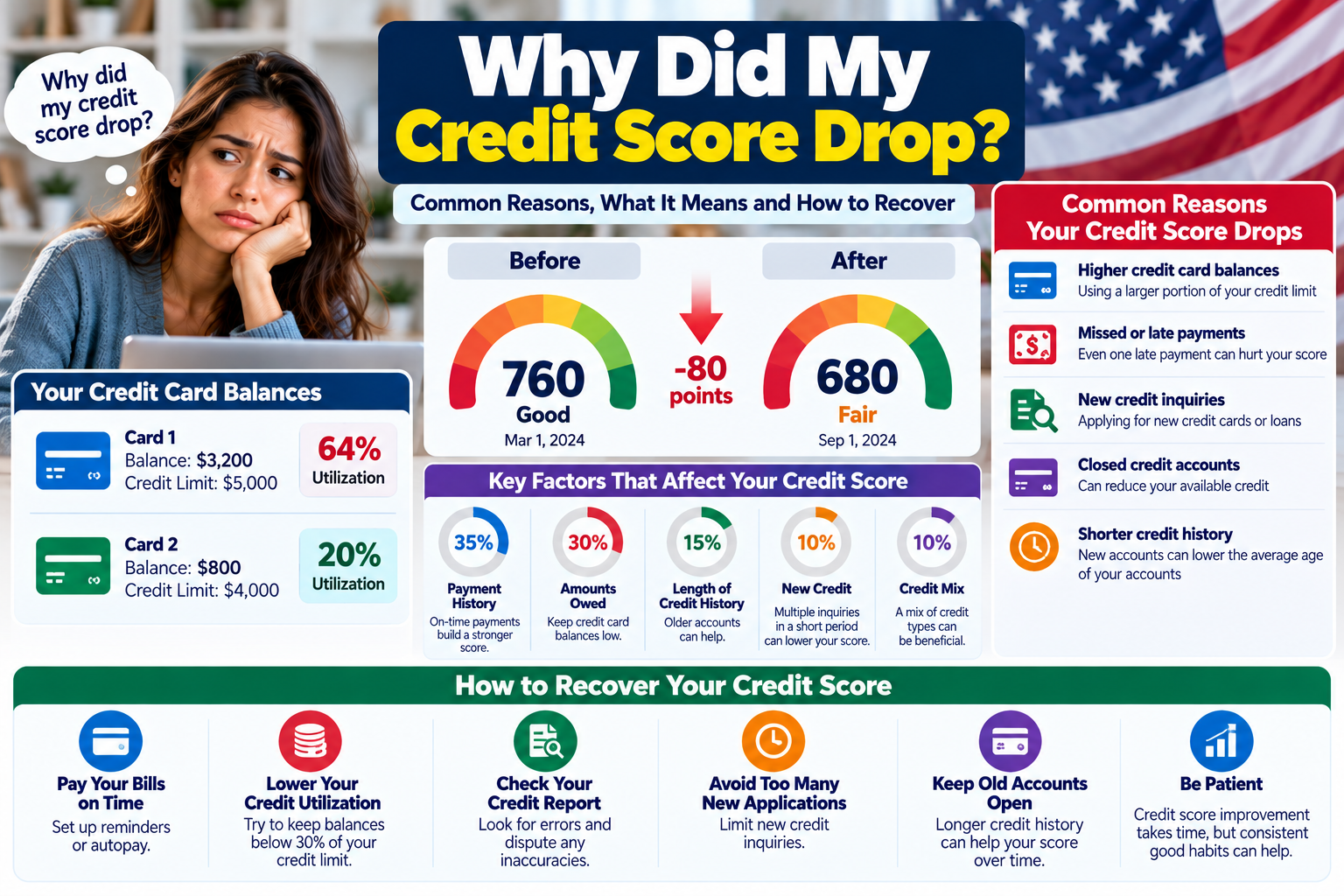
Why did my credit score drop when I have been paying my bills and trying to manage my money responsibly? It can be frustrating to see your credit score fall unexpectedly, especially when you have not missed a payment or applied for a new loan. In many cases, the reason is a recent change in your credit report, such as a higher credit card balance, a new inquiry, or an account update.
The good news is that a lower score does not automatically mean you have a serious credit problem. The first step is to identify what changed, determine whether the information is accurate, and take action based on the actual cause.
Quick Answer: Why Did My Credit Score Drop?
Your credit score may have dropped because your credit card balances increased, a payment was reported late, you applied for new credit, a lender reduced your credit limit, or information on your credit report changed. Your score can also change because different credit scoring models use different data and calculation methods.
What to do first: Check which credit score changed, review the date of the change, and compare your latest credit reports with your previous information. Look for new late payments, higher reported balances, hard inquiries, unfamiliar accounts, or closed accounts before deciding how to respond.
9 Common Reasons Your Credit Score Dropped
1. Your Credit Card Utilization Increased
One of the most common reasons for a credit score decrease is a rise in credit card utilization.
Credit utilization measures how much of your available revolving credit you are using. For example, if your total credit card limits are $10,000 and your reported balances total $4,000, your utilization is 40%.
A higher utilization ratio can negatively affect many credit scoring models, even if you pay your bills on time.
| Total credit limit | Reported balance | Utilization |
|---|---|---|
| $10,000 | $1,000 | 10% |
| $10,000 | $3,000 | 30% |
| $10,000 | $5,000 | 50% |
| $10,000 | $8,000 | 80% |
These are illustrative calculations, not guaranteed score outcomes.
How to fix it: Pay down revolving balances where possible, avoid adding unnecessary charges, and keep balances low relative to your available limits. Lower utilization can help, but the exact score change depends on your overall credit profile.
2. A Payment Was Reported Late
Payment history is an important factor in credit scoring. If a lender reports a missed payment, your score may fall, particularly if your previous history was strong.
However, a payment being a few days late does not automatically mean it has been reported as 30 days delinquent to the credit bureaus. Card issuers may charge a late fee before a payment reaches that reporting threshold, depending on the circumstances and applicable rules.
How to fix it:
- Check the account and payment due date.
- Contact the lender if you believe the payment was recorded incorrectly.
- Bring the account current as soon as you can.
- Set up automatic minimum payments or reminders to help avoid future missed payments.
If accurate late-payment information appears on your credit report, it generally cannot be removed simply because you request it. You can ask the lender about a goodwill adjustment, but approval is not guaranteed.
3. You Applied for a New Credit Card or Loan
When you apply for a credit card, personal loan, auto loan, or mortgage, the lender may conduct a hard credit inquiry.
A hard inquiry can cause a small, temporary score decrease. The impact varies based on your credit profile and the scoring model used. A new account may also affect the average age of your accounts and your overall credit mix.
Checking your own credit report or score generally counts as a soft inquiry and does not lower your FICO Score.
How to fix it: Apply for credit only when you need it, avoid unnecessary applications, and allow time for your credit history to develop. When comparing certain loans, such as mortgages or auto loans, credit scoring models may treat multiple inquiries within a defined rate-shopping period as one inquiry. The applicable window depends on the model.
4. Your Credit Card Issuer Reduced Your Credit Limit
A lender may lower your credit limit. If your balance remains unchanged, the percentage of available credit you use increases.
For example:
| Situation | Balance | Credit limit | Utilization |
|---|---|---|---|
| Before limit reduction | $2,000 | $10,000 | 20% |
| After limit reduction | $2,000 | $5,000 | 40% |
Your debt has not increased, but your utilization has doubled.
How to fix it: Check your card account for a limit-change notice. You can contact the issuer to ask whether the decision can be reconsidered, although the issuer is not required to restore the previous limit. Paying down the balance can reduce utilization.
Do not open several new cards solely to replace the lost credit limit without considering the fees, inquiries, and risks involved.
5. You Closed an Old Credit Card
Closing a credit card can affect your credit profile, particularly if it reduces your total available revolving credit.
For example, if you have two cards with a combined limit of $12,000 and close one with a $7,000 limit, your total available credit may fall to $5,000. If you still owe $2,000, your utilization could increase from approximately 17% to 40%.
Closing an account does not necessarily cause an immediate score decrease. The effect depends on your balances, other accounts, and the scoring model.
How to fix it: Before closing an account, consider its annual fee, your spending habits, your total available credit, and whether you can manage it safely. Keeping a card open is not worthwhile if the cost or risk outweighs the benefits.
6. A Credit Account Was Removed or Updated
Credit scores are calculated using the information available in your credit file at a particular time. When an account is updated, removed, or reported differently, your score may change.
Examples include:
- A paid-off installment loan being updated to show a zero balance or closed status.
- A credit card balance changing after a statement is reported.
- An old account being removed from a credit report.
- An account’s payment status or credit limit changing.
Paying off a loan is generally a positive financial step, but a score may still change afterward because the overall mix and details of your credit file have changed. That does not mean paying off debt was a mistake.
How to fix it: Check the account’s status and reported balance. Confirm that the information is accurate before taking any action.
7. You Became an Authorized User on a Card That Changed
If you are an authorized user on another person’s credit card, information about that account may affect your credit report and score, depending on the issuer’s reporting practices and the scoring model.
If the primary cardholder increases the balance, misses payments, or removes you from the account, your credit profile may change.
How to fix it: Review your credit reports to see whether the account appears and how it is reported. If the account is hurting your credit profile, contact the issuer to understand the available options. Removing yourself may not produce the same result for every scoring model or credit report.
8. Your Credit Report Contains an Error or Unfamiliar Account
Sometimes, a credit score decrease can point to inaccurate or unfamiliar information.
Check for:
- A payment incorrectly marked late.
- A balance that does not match your records.
- An account you do not recognize.
- A hard inquiry you did not authorize.
- Duplicate debts or incorrect account statuses.
- Signs that someone may have used your identity to apply for credit.
How to fix it: Obtain your credit reports from the major credit reporting companies, review the information carefully, and dispute errors with the relevant bureau and, when appropriate, the lender. If you suspect identity theft, consider placing a credit freeze with each major bureau and follow the official identity-theft reporting process.
Do not assume every unfamiliar entry is fraud. First check whether it may be an account reported under a different lender name or a legitimate inquiry.
9. You Checked a Different Credit Score or Scoring Model
Your credit score is not a single permanent number. Different providers may show different scores because they use different scoring models, credit reporting agencies, report dates, or versions of the scoring formula.
For example, a credit card app may show one score while a mortgage lender uses another. The numbers may differ even when neither is incorrect.
How to fix it: Compare like with like. Check the score provider, scoring model, credit bureau, and date associated with each score. A change between two different models does not necessarily mean your creditworthiness suddenly deteriorated.
Why Did My Credit Score Drop Even Though I Paid Everything on Time?
If you have not missed any payments, focus first on changes that can occur without a late payment.
| Possible reason | What to check | What you can do |
|---|---|---|
| Higher credit card balance | Recent statement and reported balance | Pay down balances where possible |
| Credit limit reduction | Issuer notices and account limits | Contact the issuer and review utilization |
| New hard inquiry | Credit reports and recent applications | Confirm the inquiry is legitimate |
| Closed or updated account | Account status and history | Check for accurate reporting |
| Different score model | Score provider and date | Compare the same model and bureau |
| Reporting error | Account details and payment history | Dispute incorrect information |
A useful first step is to compare your latest report with an earlier report. Focus on what actually changed instead of guessing based on the score alone.
How to Find Out Exactly Why Your Credit Score Dropped
Follow this checklist before applying for another credit card or loan.
Step 1: Confirm Which Score Changed
Write down your previous score, current score, the date of each score, and the provider showing it.
Make sure you are comparing the same score type and, where possible, the same credit bureau.
Step 2: Get Your Credit Reports
You can obtain free credit reports through the federally authorized website, AnnualCreditReport.com.
Review reports from Equifax, Experian, and TransUnion because the information each bureau holds may differ.
Remember that a credit report and a credit score are not the same thing. A report contains credit-history information, while a scoring model uses information from a credit file to calculate a score.
Step 3: Compare the Changes
Look for new information since the last time your score was checked:
- Higher balances or utilization.
- New hard inquiries or accounts.
- Late payments.
- Closed accounts or reduced credit limits.
- Changes to installment loans.
- Errors or unfamiliar activity.
If your credit score provider gives you reason codes or negative factors, use them as clues. They are not always a complete explanation of every change.
Step 4: Dispute Incorrect Information
If you find inaccurate information, file a dispute with the credit reporting company and contact the company that supplied the information when appropriate.
Keep copies of relevant statements, payment confirmations, letters, and dispute submissions. Follow the official process and review the outcome before deciding on further action.
Step 5: Make a Plan Based on the Cause
Do not take the same action for every type of score drop.
- High utilization: Focus on reducing revolving balances.
- Late payment: Bring the account current and prevent further missed payments.
- Hard inquiry: Confirm that it is legitimate and avoid unnecessary applications.
- Incorrect information: Dispute the error.
- Different scoring model: Compare equivalent scores before drawing conclusions.
How Long Does It Take for a Credit Score to Recover?
There is no universal recovery timeline. It depends on why your score fell, when the lender reports updated information, and which scoring model is used.
| Cause of the drop | What may happen next |
|---|---|
| Higher credit card utilization | The score may improve after lower balances are reported, if other factors remain similar |
| Hard inquiry | Its impact may fade over time; FICO Scores generally consider hard inquiries for up to 12 months, although inquiries can remain on reports for up to two years |
| Incorrect information | The score may change after a successful correction and a new calculation |
| Late payment | Recovery can take longer because accurate negative payment history may remain on a report for years |
| Different score model | The numbers may continue to differ because the models are not identical |
A score may improve after one issue is corrected, but that outcome is not guaranteed. Other information in your credit file can affect the result.
Illustrative Example: A Score Drops After a Credit Card Purchase
Imagine a consumer has a $5,000 credit limit and a reported balance of $500. Their utilization is 10%.
After making a $1,500 purchase, the reported balance rises to $2,000. Their utilization becomes 40%.
If the lender reports the higher balance, a credit scoring model may calculate a lower score even though the consumer has not missed a payment.
The consumer then pays down the balance before the next reporting update. Once the lower balance is reported, utilization may decrease again. The score may respond, but the exact change depends on the rest of the credit file and the scoring model.
The lesson: A score drop does not always mean you have missed a payment or made a long-term financial mistake. Check the information being reported before deciding what to do.
Mistakes to Avoid After a Credit Score Drop
Applying for Multiple Cards Immediately
Opening new accounts can create additional inquiries and may complicate your credit profile. Identify the reason for the drop before applying for more credit.
Closing Every Credit Card
Closing accounts can reduce available credit and increase utilization. Consider the account’s cost and risks before deciding whether to close it.
Paying a Company That Promises an Instant Score Increase
Be cautious of services promising guaranteed results or claiming they can remove accurate negative information. You can dispute inaccurate information yourself through official channels.
Ignoring an Unexpected Inquiry
An inquiry you do not recognize deserves investigation. Confirm whether it is legitimate and take appropriate identity-protection steps if necessary.
Assuming a Small Drop Means Financial Trouble
Scores can change for several reasons, and different models may produce different results. Review the underlying data before drawing conclusions.
Frequently Asked Questions
1. Why did my credit score drop 20 points for no reason?
A 20-point decrease may be associated with a higher reported balance, a new inquiry, an account update, or a difference in the score provider or model. It may feel unexplained because the change is not always obvious in an app notification. Compare the report dates and account information to identify what changed.
2. Why did my credit score drop when I paid off a credit card?
Paying off a credit card reduces the balance, which can help lower utilization. However, the score may be affected by other changes occurring at the same time, and the reported balance may not update immediately. Paying off debt is generally a positive financial goal, so do not carry interest-bearing debt just to try to maintain a particular score.
3. Can checking my credit score lower it?
Checking your own credit score or report generally does not lower your FICO Score because it is normally treated as a soft inquiry. Applying for credit can trigger a hard inquiry, which may affect your score. Check which type of inquiry occurred if you are concerned about an unexpected change.
4. Why did my credit score drop after getting a new credit card?
A new application may produce a hard inquiry, and opening the account can affect the average age of your accounts. If you use the card, the new balance may also change your utilization. The impact depends on your credit history and the scoring model.
5. Why did my credit score drop after paying off a loan?
Paying off an installment loan changes the information in your credit file and may affect credit mix or other characteristics considered by a scoring model. The result is not the same for everyone. Do not keep a loan open or pay unnecessary interest solely to avoid a possible score change.
6. Can a credit score drop without a late payment?
Yes. Higher credit card utilization, hard inquiries, credit limit reductions, account changes, and differences between scoring models can all contribute to a lower score. Reviewing your reports is the best way to investigate the reason.
7. How can I raise my credit score after it drops?
Start by correcting inaccurate information, making every payment on time, reducing credit card balances when possible, and avoiding unnecessary applications. The right steps depend on what caused the decrease, and no specific point increase or recovery date can be guaranteed.
8. Should I dispute a credit score drop?
You generally dispute inaccurate information on a credit report rather than the score number itself. If the information is correct, a dispute is unlikely to remove it simply because the score decreased. Review the report, identify any errors, and submit supporting documentation through the appropriate process.
Why Maintain Market Is Different
At Maintain Market, we focus on helping readers understand the reason behind a financial change and the practical steps they can take next.
Instead of treating every credit score decrease as a crisis, this guide separates utilization changes, payment issues, credit inquiries, account updates, and reporting errors. That approach helps readers investigate the cause before making decisions that could add unnecessary debt or new credit applications.
Credit scoring models differ, and no single action guarantees a particular score. Use your credit reports and official resources to make an informed decision.
References
- Consumer Financial Protection Bureau — Understand Your Credit Score
- myFICO — Not-So-Obvious Causes of a Dropping FICO Score
- myFICO — How Credit Limit Decreases Can Affect Your Score
- myFICO — Do Credit Inquiries Lower Your FICO Score?
- AnnualCreditReport.com — Official Free Credit Reports
- Federal Trade Commission — Identity Theft
Editorial Review
This article is for general educational purposes for U.S. consumers. Credit scoring models, credit reporting practices, and the impact of individual actions can vary. Check your own credit reports and consult the relevant credit bureau or lender for account-specific concerns.