
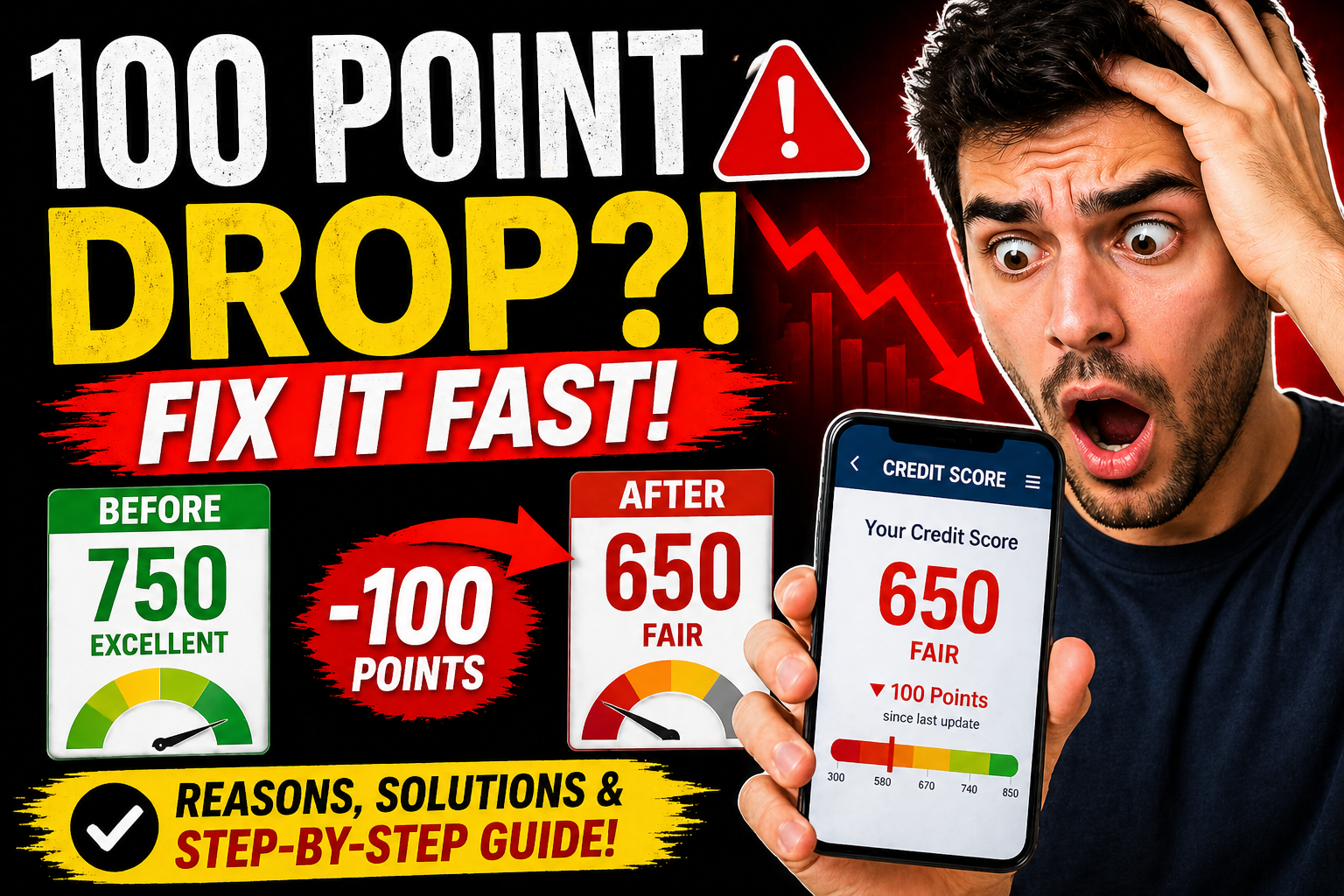
Lost 100 points on your credit score? Learn the real reasons and step-by-step strategies to recover your credit fast and avoid loan rejection. In this article, let’s talk about how to recover 100 point credit score drop.
Introduction
You wake up, check your credit score… and it’s down by 100 points.
No warning. No explanation. Just damage.
Suddenly:
- Your loan gets rejected
- Your credit card limit drops
- Your interest rates go up
And the worst part? You don’t even know what went wrong.
I’ve seen this happen to people who were doing “everything right.”
Here’s the truth — a 100-point drop is serious, but it’s NOT permanent.
And if you act smartly, you can recover faster than most people think.
Quick Answer Box
To recover a 100-point credit score drop:
- Identify the exact cause (late payment, utilization, hard inquiry, account closure)
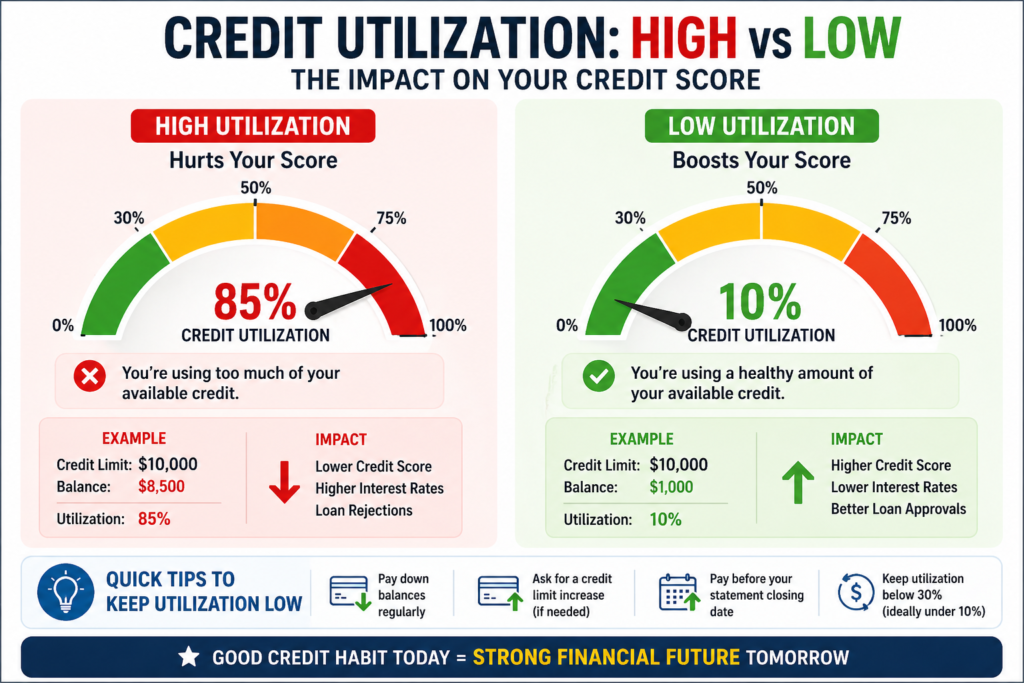
- Reduce credit utilization below 30% (ideally 10%)
- Dispute errors on your credit report immediately
- Make all payments on time (no exceptions)
- Add positive credit (secured card or credit builder account)
- Avoid new hard inquiries for 60–90 days
Recovery time:
- Minor issue: 30–45 days
- Major issue: 3–6 months
Why This Problem Happens (Real Reasons)
Let’s be honest — credit score doesn’t drop randomly.
There’s ALWAYS a trigger.
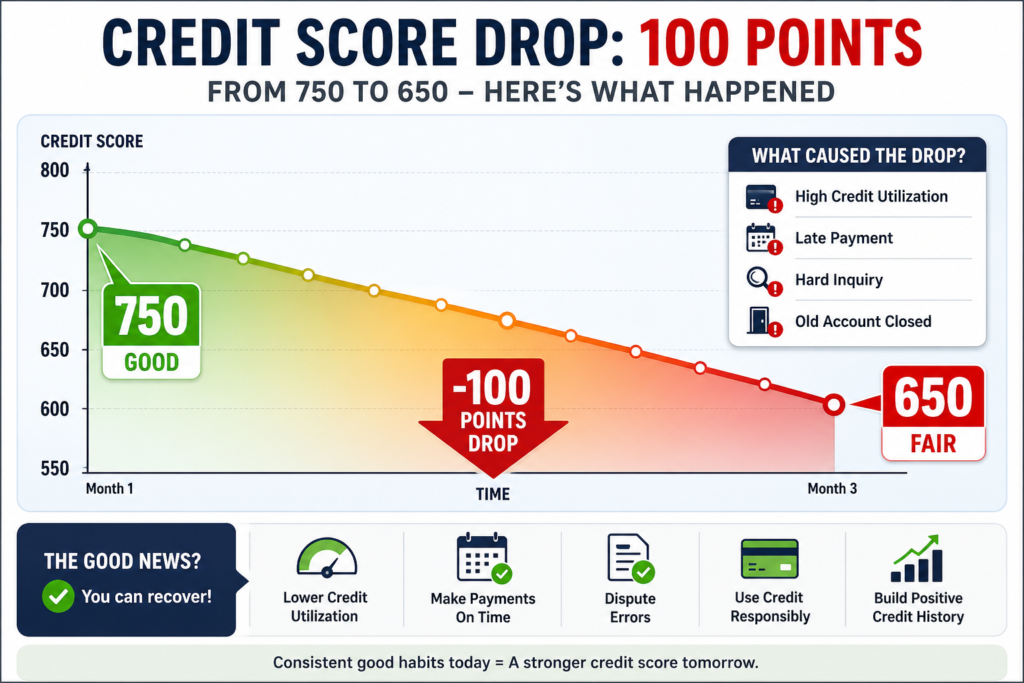
1. Late Payment (Biggest Killer)
Even a single 30-day late payment can drop your score by 80–110 points.
Banks don’t care about your history. They care about recent behavior.
2. Credit Utilization Spike
If your credit card usage suddenly goes from:
- 20% → 80%
Your score can crash instantly.
This is one of the most common hidden reasons.
3. Hard Inquiries
Applying for multiple loans or credit cards in a short time = red flag.
Lenders see you as desperate for credit.
4. Account Closure
Closing an old credit card reduces:
- Your total credit limit
- Your credit history length
Both hurt your score.
5. Errors on Credit Report
This is more common than you think.
Wrong late payment. Duplicate account. Fraud.
And boom — your score drops.
Step-by-Step Solution (Real-World Fix)
Now let’s fix it properly.
Step 1: Check Your Credit Report (Immediately)
Use platforms like:
- Experian
- Equifax
- TransUnion
Look for:
- Late payments
- Incorrect balances
- Unknown accounts
Step 2: Fix Credit Utilization FAST
This is your quickest win.
If your card is maxed out:
- Pay it down below 30%
- Ideally below 10%
This alone can recover 20–40 points in weeks.
Step 3: Dispute Errors (If Any)
If you find something wrong:
- File dispute online
- Provide proof
- Follow up aggressively
Banks don’t fix things unless you push.
Step 4: Make Payments Perfectly On Time
No delay. Not even 1 day.
Set:
- Auto-pay
- Reminders
Your score rebuild depends on consistency.
Step 5: Add Positive Credit
If your profile got weak:
- Use a secured credit card
- Use credit builder apps
This adds fresh positive data.
Step 6: Stop Applying for Credit Temporarily
Give your profile time to stabilize.
Avoid:
- Loan applications
- Credit card applications
At least for 60–90 days.

ADVANCED RECOVERY STRATEGIES (MOST PEOPLE DON’T KNOW THIS)
1. The “Credit Limit Boost Hack” (Fast Score Jump)
If your score dropped due to high utilization, here’s a smart move:
Call your credit card issuer and ask for a credit limit increase WITHOUT a hard inquiry.
Why this works:
- Same balance
- Higher limit
- Lower utilization instantly
Example:
- Before: $4,000 balance / $5,000 limit = 80% utilization
- After: $4,000 / $10,000 = 40% utilization
Score impact: +20 to +50 points possible
2. Become an Authorized User (Fastest Hidden Trick)
If someone you trust has:
- Old credit card
- Perfect payment history
- Low utilization
Ask to be added as an authorized user.
What happens:
- Their positive history reflects on your report
This can boost your score within 30–45 days
3. The “Statement Date Strategy”
Most people don’t know this:
Your credit utilization is reported before your due date, not after.
So even if you pay on time, high usage can still hurt you.
Fix:
- Pay your card BEFORE statement date
- Keep reported balance low
This is a game-changing tactic
4. Remove Small Negative Accounts (Negotiation Method)
If you have:
- Collections
- Small unpaid accounts
Call the creditor and ask for:
- “Pay for delete”
Meaning:
- You pay
- They remove it from report
Not guaranteed, but works in many cases.
5. Use Multiple Small Payments (Score Optimization Trick)
Instead of paying once a month:
- Pay weekly or bi-weekly
This keeps your balance consistently low → improves score stability
CREDIT SCORE RECOVERY TIMELINE (REALISTIC)
| Action Taken | Timeline | Expected Impact |
|---|---|---|
| Reduce utilization | 7–30 days | Fast boost |
| Dispute errors | 30–60 days | High boost |
| On-time payments | 2–4 months | Strong recovery |
| Add secured card | 2–3 months | Moderate boost |
| Remove negatives | 1–3 months | Huge impact |
WHAT IF YOUR SCORE IS NOT IMPROVING?
This is where most people get stuck.
Possible Reasons:
1. You Fixed One Problem, Not All
Example:
- Reduced utilization
BUT - Still have late payment
Result: No major improvement
2. Credit Profile Too Thin
If you have:
- Only 1 account
- No history
Your score won’t grow fast
Fix:
- Add 1–2 more accounts (smartly)
3. Negative Mark Still Active
Late payments stay for up to 7 years.
But impact reduces over time.
4. You’re Applying Too Often
Too many applications = score stagnation
LENDER PSYCHOLOGY BREAKDOWN (VERY IMPORTANT)
Banks classify you into 3 types:
1. Stable Borrower
- Low usage
- Consistent payments
→ Best rates, easy approvals
2. Risky Borrower
- High usage
- Recent drop
→ Higher interest rates
3. Desperate Borrower
- Multiple applications
- Missed payments
→ Immediate rejection
Your goal:
Move back to Stable Borrower category
EXTRA MISTAKES THAT DESTROY RECOVERY
- Paying only minimum dues
- Ignoring old accounts
- Using BNPL excessively
- Taking payday loans
- Closing oldest credit card
MAINTAINMARKET TESTED STRATEGY (PRACTICAL FRAMEWORK)
If your score dropped 100 points, follow this exact system:
Phase 1 (First 7 Days)
- Identify issue
- Pay down balances
- Stop all applications
Phase 2 (Next 30 Days)
- Fix utilization
- Dispute errors
- Start auto-pay
Phase 3 (Next 90 Days)
- Build positive credit
- Maintain low usage
- Avoid risky behavior
Phase 4 (Long-Term)
- Keep utilization under 30%
- Maintain 100% payment history
- Use credit strategically
Insider Insights (How Lenders Actually Think)
Here’s what most people don’t understand:
Banks don’t just look at your score.
They look at your behavior pattern.
If they see:
- Sudden high usage
- Multiple inquiries
- Payment inconsistency
They assume:
“This person is becoming risky.”
Even if your score looks decent.
That’s why fixing behavior matters more than just numbers.
Real-Life Case Study (USA)
John (Texas)
- Credit Score: 742 → 638 (lost 104 points)
- Reason: Missed 1 payment + high credit usage
What he did:
- Paid down credit cards from 78% → 18%
- Set auto-pay
- Disputed one incorrect late payment
Results:
- 45 days: +38 points
- 90 days: +72 points
- 5 months: back to 720+
Lesson: Recovery is possible if you act fast.
Comparison Table (Best Recovery Methods)
| Strategy | Speed | Impact | Difficulty |
|---|---|---|---|
| Reduce utilization | Fast | High | Easy |
| Fix errors | Medium | High | Medium |
| On-time payments | Slow | Very High | Easy |
| Add secured credit | Medium | Medium | Easy |
| Avoid inquiries | Medium | Medium | Easy |
Mistakes People Make
- Ignoring the drop
- Applying for more loans
- Closing credit cards
- Paying minimum balance only
- Not checking credit report
These mistakes make recovery slower.
MaintainMarket Expert Advice
If your score dropped 100 points, don’t panic — but don’t ignore it either.
Focus on 3 things only:
- Utilization
- Payment behavior
- Credit report accuracy
Forget everything else.
That’s how real recovery happens.
Why MaintainMarket is Different
Most websites give textbook advice.
We focus on:
- Real financial behavior
- Lender psychology
- Practical recovery steps
No theory. Just what works in real life.
Action Plan (Do This Now)
Today:
- Check your credit report
- Identify the cause
Next 7 days:
- Reduce credit usage
- Fix any errors
Next 30 days:
- Maintain perfect payments
- Avoid new credit
Next 90 days:
- Add positive credit if needed
Conclusion
A 100-point drop feels like a financial disaster.
But it’s actually a signal.
It’s telling you something changed — and you need to fix it fast.
If you follow the right steps, you won’t just recover…
You’ll come back stronger.
FAQs – How to Recover 100 Point Credit Score Drop
Q1. Can a credit score drop 100 points in one day?
Yes, a credit score can drop 100 points or more after a serious negative event, such as a reported late payment, depending on your credit profile. A sudden increase in credit utilization or inaccurate reporting can also cause a significant decline.
Q2. How long does it take to recover 100 points?
Recovering 100 credit score points can take several months or longer, depending on what caused the decline. Paying down high credit card balances may lead to faster improvement, while recovering from late payments or defaults can take considerably longer.
Q3. Can I fix my credit score in 30 days?
You may be able to improve your credit score within 30 days, particularly by reducing high credit card balances or correcting reporting errors. However, recovering 100 points or repairing serious negative information generally takes longer and depends on your individual credit history.
Q4. Does paying off debt increase score immediately?
Paying off credit card debt may improve your score once the lender reports the updated balance to the credit bureaus. However, the increase isn’t guaranteed or immediate, and the impact depends on your credit utilization, account history and other scoring factors.
Q5. Should I close unused credit cards?
Not necessarily. Closing an unused credit card can reduce your available credit and increase your overall utilization, potentially lowering your score. If the card has no annual fee, keeping it open may help maintain your available credit, provided you manage it responsibly.
Q6. Can errors cause big drops?
Yes, inaccurate information, such as incorrectly reported late payments or balances, can cause significant credit score declines. If you identify an error, you generally have the right to dispute it with the credit bureau and the company that provided the information.
Q7. How many points does a late payment drop?
A late payment can cause a substantial credit score decline, but there is no fixed number of points for everyone. Depending on your credit history and scoring model, the impact can range from relatively small to more than 100 points, particularly for someone with an otherwise strong credit profile.
Q8. Is credit repair company worth it?
A credit repair company may help you manage disputes, but it cannot legally guarantee a specific score increase or remove accurate negative information. You can generally dispute inaccurate information yourself for free, so compare the company’s services, fees and claims before paying for assistance.
People searched for: 15 Best Side Hustles From Home USA (Earn $1000+/Month)
Also read: 10 Safest Investment with High Returns in USA 2026 – Low Risk Options Ranked by Stability
5 thoughts on “How to Recover 100 Point Credit Score Drop Fast – Hacks Banks Won’t Tell You”