
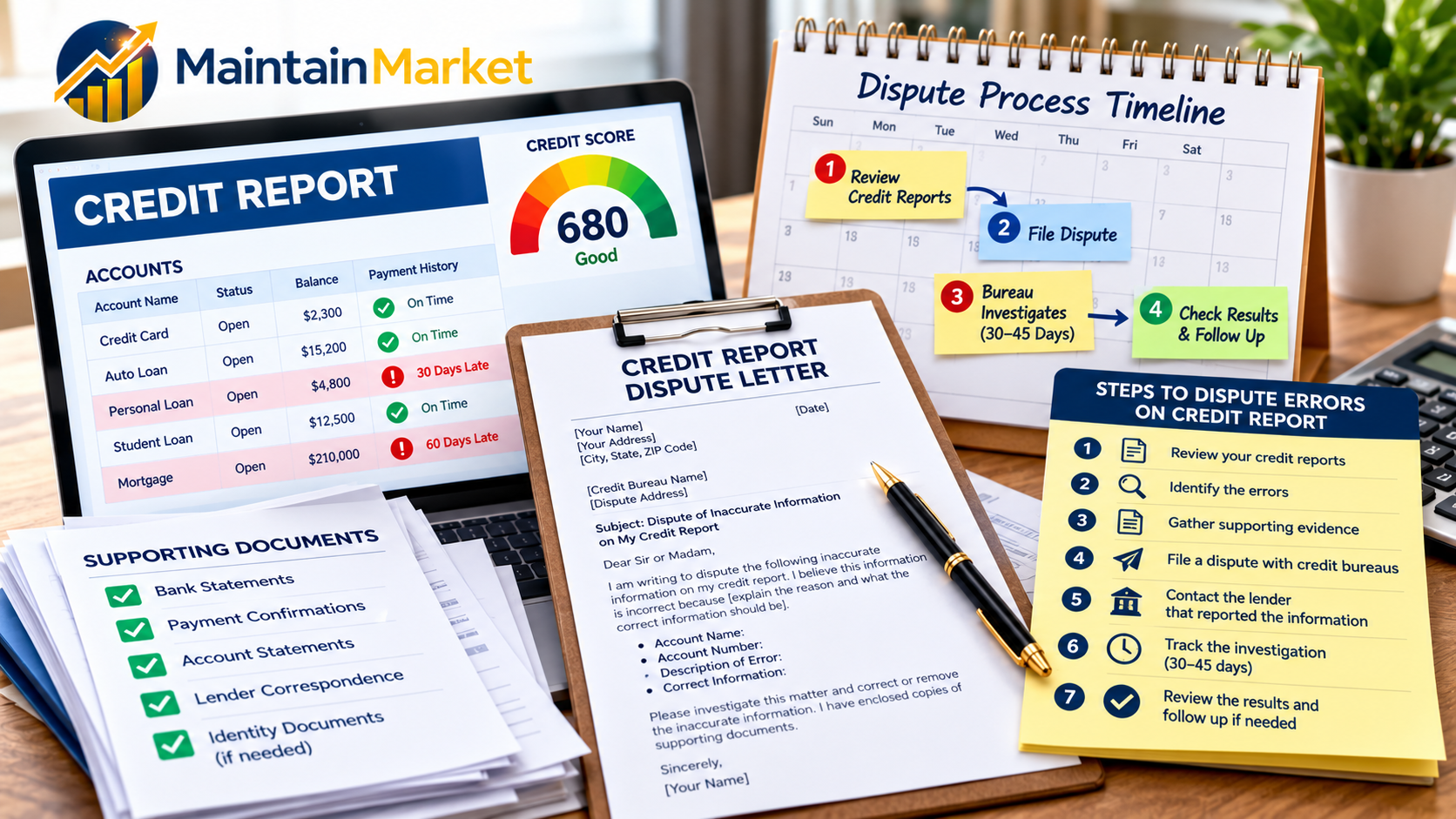
If you want to learn how to dispute errors on credit report, start by reviewing your credit reports, identifying the inaccurate information, and gathering documents that support your claim. You can dispute errors directly with the credit bureau reporting them and the company that supplied the information. Under U.S. federal law, these disputes are generally free, and the companies must investigate qualifying disputes and correct information that is inaccurate or cannot be verified.
An error on your credit report could involve a payment incorrectly marked late, an account you never opened, an incorrect balance, or a debt that appears more than once. Correcting these mistakes can help ensure that lenders and other authorized users see accurate information when reviewing your credit history.
This guide explains how to identify credit report errors, file a dispute, write a dispute letter, understand the investigation timeline, and take further action if the problem remains unresolved.
Quick Answer: How Do You Dispute Errors on a Credit Report?
To dispute errors on a credit report, follow these steps:
- Get and review your credit reports from Equifax, Experian, and TransUnion.
- Identify each inaccurate or incomplete item.
- Collect evidence, such as bank statements, account statements, or payment confirmations.
- File a dispute with every credit bureau reporting the error.
- Contact the lender or company that supplied the incorrect information.
- Track the investigation and review the results.
- Escalate the issue if the error remains unresolved.
Credit bureaus generally have 30 days to investigate a dispute, although certain circumstances allow up to 45 days. The exact timeline depends on how and when the dispute is submitted.
1. Get Copies of Your Credit Reports
Before filing a dispute, check your reports to understand exactly what information is being reported.
You can request your credit reports from all three nationwide credit bureaus through AnnualCreditReport.com, the federally authorized website.
Review these reports carefully:
- Equifax: Check your account details, balances, payment history, and personal information.
- Experian: Look for inaccurate account statuses, payment records, and unfamiliar accounts.
- TransUnion: Check for incorrect debts, duplicate entries, and other reporting problems.
The information may differ between bureaus because some lenders do not report to all three.
Requesting your own credit reports does not hurt your credit score. Review each report separately and note which bureau is reporting each error.
2. Identify the Type of Credit Report Error
Before filing a dispute, determine what is wrong and what the correct information should be.
The Consumer Financial Protection Bureau identifies several common categories of credit report errors.
Incorrect personal information
Examples include:
- A misspelled name or incorrect address.
- Another person’s account appearing on your report.
- Information belonging to someone with a similar name.
- Accounts opened using your identity without permission.
Incorrect account information
Examples include:
- A credit card account you never opened.
- A loan incorrectly listed as active or unpaid.
- A closed account shown as open.
- An incorrect account balance or credit limit.
- A debt that appears more than once.
Incorrect payment history
Examples include:
- A payment marked late even though you paid on time.
- A payment incorrectly shown as missed.
- A late-payment status that does not match the lender’s records.
- An inaccurate date of last payment or first delinquency.
Outdated or incomplete information
You may also find information that is incomplete or reported beyond the applicable legal reporting period. The rules depend on the type of information, so verify the specific item before challenging it.
Important: Dispute information because it is inaccurate, incomplete, outdated under applicable rules, or does not belong to you. Negative information that is accurate and legally reportable generally cannot be removed simply because it harms your credit score.
3. Gather Evidence to Support Your Dispute
A clear dispute supported by relevant evidence is easier to investigate than a vague request.
Collect documents that directly support your claim. Depending on the error, these may include:
- Bank statements showing payment dates.
- Credit card or loan statements.
- Payment receipts and confirmation emails.
- Letters from your lender confirming an account status.
- Records showing that an account was closed or paid off.
- Identity-theft documentation, when applicable.
- A copy of the credit report with the disputed item highlighted.
Keep the original documents and submit copies unless the recipient specifically requires something else.
Example: Incorrect late payment
Suppose your credit report says you missed a credit card payment in April, but your bank statement shows that the payment was completed before the due date.
You could submit a dispute explaining the discrepancy, attach the relevant bank statement, and request correction of the April payment status.
Be specific about the account, month, reported status, and correction you are requesting. Avoid sending unrelated personal documents.
4. File a Dispute With the Credit Bureaus
Once you have identified the error and gathered evidence, file a dispute with each credit bureau reporting the inaccurate information.
You can generally submit a dispute online, by mail, or through the bureau’s other available dispute channels.
Use these official resources:
What should your dispute include?
Include the following information where applicable:
- Your full name and contact information.
- The credit report confirmation number, if available.
- The account name and account number or last four digits.
- A clear explanation of the information you believe is inaccurate.
- The correct information, if known.
- Copies of supporting documents.
- A specific request to correct or remove the inaccurate information.
If you mail the dispute, consider using certified mail with a return receipt so you can document delivery. Keep copies of your letter, evidence, and any confirmation numbers.
The credit bureau generally forwards relevant information to the company that supplied the data and investigates the dispute.
5. Dispute the Error With the Company That Reported It
Do not rely only on the credit bureau dispute process. You should generally also contact the company that supplied the inaccurate information, such as a bank, credit card issuer, auto lender, or debt collector.
This company is often called the data furnisher.
Contact the company using the dispute address listed on your credit report or the address it designates for credit reporting disputes. Follow its instructions and retain records of your communication.
Explain:
- Which account or entry you are disputing.
- Why the information is inaccurate or incomplete.
- What the correct information should be.
- Which documents support your claim.
- What correction you are requesting.
If the company determines that the information it reported was wrong, it must take the required steps to correct the information with the credit reporting companies to which it supplied the inaccurate data.
Why contact both?
The credit bureau maintains your credit report, while the data furnisher supplies information about your account. Contacting both can help address the error at both stages of the reporting process.
For additional guidance, read the CFPB’s instructions for disputing credit report errors.
6. Use This Credit Report Dispute Letter Template
If you prefer to dispute an error by mail, you can adapt this letter. Replace the bracketed information with your own details and describe only errors you can reasonably support.
Subject: Dispute of Inaccurate Information on My Credit Report
[Date]
[Your Full Name]
[Your Mailing Address]
[City, State, ZIP Code]
[Credit Bureau or Company’s Name]
[Dispute Mailing Address]
Dear Dispute Department,
I am writing to dispute information appearing on my credit report that I believe is inaccurate or incomplete.
Account name: [Name of lender or company]
Account number: [Account number or last four digits]
Credit report reference number: [If available]
The information I am disputing is: [Describe the specific entry, payment status, balance, account ownership, or other error].
I believe this information is inaccurate because [explain the facts clearly and state what the correct information should be].
I request that you investigate this matter and correct or remove the disputed information as appropriate. I have enclosed copies of documents supporting my claim, including [list relevant documents].
Please provide the investigation results in writing and send me an updated credit report if the information is corrected.
Thank you for your attention to this matter.
Sincerely,
[Your Full Name]
Enclosures: [List supporting documents]
Tips for sending your dispute letter
- Highlight the disputed entry on a copy of your report.
- Include copies, not irreplaceable original documents.
- Be factual and specific rather than emotional or vague.
- Keep a complete copy of the letter and every enclosure.
- Save proof of delivery if you send the letter by mail.
You can also use the FTC’s sample dispute letter as a reference.
7. Track the Investigation and Review the Results
After submitting your dispute, save the confirmation number and note the date it was received.
Under the Fair Credit Reporting Act, credit reporting companies generally must investigate disputes within 30 days. Some cases may take up to 45 days, including certain disputes involving additional information or reports obtained under specific circumstances.
After completing an investigation, the credit bureau generally must notify you of the results within five business days. If your report is corrected, review the updated report to confirm the change.
What happens if the error is confirmed?
If the investigation determines that the information is inaccurate or cannot be verified, the credit reporting company must correct or remove it as required by law.
The data furnisher may also have obligations to correct the information with other credit bureaus to which it supplied the inaccurate data.
What if the bureau says the information is accurate?
Read the explanation and check whether the investigation addressed the specific error you raised. If you have additional relevant evidence, you can submit it and ask for further review.
If you still disagree, you may be able to add a brief statement to your credit file explaining the dispute. You can also consider filing a complaint with the CFPB when eligible.
Official timeline guidance: How long does it take to repair an error on a credit report?.
What If the Credit Bureau Does Not Fix the Error?
If your dispute is rejected or the error remains on your report, do not immediately assume that you have no further options.
Consider these steps:
- Review the investigation results. Identify whether the bureau addressed the exact information you challenged.
- Submit additional evidence. Provide relevant documents that may not have been included in the first dispute.
- Contact the data furnisher again. Ask it to review the records supporting the information it reported.
- Request a consumer statement if appropriate. You may have the right to add a brief statement explaining your disagreement to your credit file.
- Submit a CFPB complaint when eligible. For complaints about inaccurate or incomplete information at a credit reporting agency, the CFPB requires you to dispute the information directly with that agency first. Generally, the dispute must no longer be pending or more than 45 days must have elapsed since you filed it.
You can find the official process at the CFPB credit reporting complaint page.
For complex cases involving identity theft, substantial financial harm, or repeated failures to comply with the law, consider seeking advice from a qualified consumer-law attorney.
How to Dispute Errors Caused by Identity Theft
If an account or debt appears on your credit report because someone used your personal information without permission, take additional precautions.
- Visit IdentityTheft.gov to report the suspected identity theft and receive a recovery plan.
- Contact the company associated with the unfamiliar account.
- Dispute the fraudulent information with every credit bureau reporting it.
- Follow the applicable identity-theft blocking or removal procedures.
- Keep copies of identity-theft reports, correspondence, and case numbers.
Do not assume that every unfamiliar entry is fraud. First determine whether it might be a legitimate account, an authorized-user account, or a reporting error.
If the information is connected to identity theft, clearly identify it as such and follow the official process rather than submitting a generic dispute alone.
Can Disputing a Credit Report Error Improve Your Credit Score?
It can, but the result is not guaranteed.
If an inaccurate negative item is corrected or removed, your credit score may improve. The effect depends on the information changed, your broader credit history, and the scoring model used.
For example, correcting a falsely reported late payment may help your credit profile. Correcting an address typo, however, may not change your score at all.
Disputing an error does not automatically raise your score, and the investigation process itself does not guarantee a particular outcome.
After the correction, continue paying bills on time, manage credit card balances carefully, and monitor your reports for new errors.
Common Mistakes to Avoid When Disputing Credit Report Errors
Disputing everything without an explanation
A vague dispute may not give the bureau enough information to investigate. Identify each specific error and explain why it is wrong.
Sending no supporting evidence
Evidence is not required in every possible dispute, but relevant documentation can help clarify your claim. Include the records that directly support the correction you are requesting.
Contacting only one credit bureau
If the same error appears on multiple reports, dispute it with each bureau reporting it.
Assuming every negative item is an error
Accurate negative information generally can remain on your credit report for the applicable reporting period. A dispute is meant to address inaccuracies or incompleteness, not simply remove unfavorable information.
Paying a company that promises guaranteed removal
Be cautious of credit repair services that guarantee a score increase or promise to erase accurate negative information. You have the right to dispute inaccurate information yourself, generally for free.
Frequently Asked Questions
1. How to dispute errors on credit report for free?
You can dispute errors directly with Equifax, Experian, and TransUnion using their official online, mail, or other available channels. You can also contact the company that supplied the incorrect information. You generally do not need to pay a credit repair company to file a dispute.
2. How long does a credit report dispute take?
Credit bureaus generally have 30 days to investigate a dispute. Certain circumstances allow up to 45 days. The bureau generally must notify you of the investigation results within five business days after completing the investigation.
3. Can I dispute an error with all three credit bureaus?
Yes. If an error appears on reports from Equifax, Experian, and TransUnion, dispute it with each bureau. Each bureau maintains its own file, so correcting one report does not necessarily mean the others have been corrected.
4. What evidence should I submit with a credit report dispute?
Depending on the error, useful evidence may include bank statements, payment confirmations, account statements, lender correspondence, or records showing that an account was closed or paid. Submit copies and keep the originals.
5. What happens if a credit bureau cannot verify an account?
If the information cannot be verified through the investigation, the bureau must correct or remove it as required by law. The precise result depends on the disputed information and applicable legal requirements.
6. Can I dispute a late payment that is accurate?
You should not falsely claim that accurate information is incorrect. If a late payment is legitimate, you can ask the lender for a goodwill adjustment, but approval is voluntary and not guaranteed.
7. Will disputing a credit report error hurt my credit score?
Filing a dispute does not, by itself, automatically lower your credit score. The effect of any correction depends on what information changes and how the scoring model evaluates your credit history.
8. Can I dispute a debt that does not belong to me?
Yes. Explain that the account is not yours, provide relevant supporting evidence, and dispute it with the credit bureaus and the company reporting it. If identity theft may be involved, use IdentityTheft.gov.
9. What if the credit bureau rejects my dispute?
Review the results, gather any additional evidence, and contact the company that supplied the information. Depending on the circumstances, you may request a consumer statement or submit a CFPB complaint after meeting the applicable requirements.
10. Can a credit repair company remove errors from my report?
A company may assist with the dispute process, but it cannot guarantee removal of accurate, verifiable information. You can dispute inaccurate information yourself without paying a credit repair company.
Why Maintain Market Is Different
Maintain Market focuses on practical, evidence-based personal finance guidance. When dealing with credit report errors, we distinguish between information that is inaccurate and negative information that is legally reportable.
Our goal is to help readers understand their rights, gather relevant evidence, follow the correct dispute process, and avoid paying for services that promise unrealistic results.
Official References
- Consumer Financial Protection Bureau — How to Dispute an Error on Your Credit Report
- Consumer Financial Protection Bureau — Common Credit Report Errors
- Consumer Financial Protection Bureau — Dispute Investigation Timeline
- Federal Trade Commission — Disputing Errors on Your Credit Reports
- Federal Trade Commission — Sample Credit Bureau Dispute Letter
- AnnualCreditReport.com — Official Credit Report Requests
- IdentityTheft.gov — Identity Theft Recovery
Editorial Review
Editorial focus: Practical dispute instructions, evidence collection, official resources, investigation timelines, and next steps if an error remains unresolved.
Note: The dispute process does not guarantee removal of every negative item or a credit-score increase. Accurate information can generally remain on a credit report for the applicable reporting period.
Recommended Reads: