
If you’re comparing a debt consolidation loan vs personal loan, there’s an important detail to understand: a debt consolidation loan is usually a type of personal loan used to combine multiple existing debts into one payment. The main difference is how the loan is intended to be used, rather than the basic loan structure.
Both options may offer a fixed interest rate, a predictable monthly payment, and a defined repayment period. However, lenders can differ in their interest rates, fees, eligibility requirements, and how they distribute the funds.
Before choosing either option, compare the total repayment cost—not just the monthly payment.
Quick Answer: Debt Consolidation Loan vs. Personal Loan
A debt consolidation loan is generally a personal loan specifically used to pay off multiple existing debts, such as credit card balances or other loans.
A regular personal loan can be used for different purposes, including home improvements, unexpected expenses, or debt repayment, depending on the lender’s rules.
The key takeaway: You may be able to use an ordinary personal loan to consolidate debt. What matters most is the APR, fees, repayment term, and total amount you will pay.
What Is a Debt Consolidation Loan?
A debt consolidation loan combines multiple outstanding debts into one new loan. Instead of managing several payments and due dates, you repay a single lender according to the new loan agreement.
For example, imagine you have:
- Credit Card A: $3,000
- Credit Card B: $2,500
- Personal Loan: $2,000
Your total outstanding debt is $7,500.
You might qualify for a $7,500 debt consolidation loan and use the proceeds to pay off these balances. You would then make one monthly payment on the new loan.
How Does a Debt Consolidation Loan Work?
The process generally involves:
- Reviewing your outstanding debts and their interest rates.
- Checking your credit profile and estimating how much you need to borrow.
- Comparing loan offers from banks, credit unions, and online lenders.
- Applying for a loan that covers the eligible debts.
- Using the funds to pay off the existing balances, either yourself or through direct creditor payments if the lender offers that service.
- Making regular payments until the new loan is repaid.
Benefits of a Debt Consolidation Loan
- Simplified payments: Replace multiple eligible debt payments with one.
- Potential interest savings: A lower APR may reduce borrowing costs.
- Predictable repayment: Fixed-rate loans generally have consistent scheduled payments.
- Clear payoff timeline: You know the agreed repayment period.
Disadvantages of a Debt Consolidation Loan
- Origination fees: Some lenders charge fees that reduce your savings.
- Longer repayment periods: A lower monthly payment may mean paying more interest overall.
- Credit requirements: Approval and pricing depend on the lender’s underwriting criteria.
- Risk of additional debt: Paying off credit cards does not prevent you from using them again.
What Is a Personal Loan?
A personal loan is money borrowed from a bank, credit union, or online lender that you repay over an agreed period, usually through scheduled monthly payments.
Many personal loans are unsecured, meaning you do not have to pledge an asset such as your home or car. However, secured personal loans also exist.
Depending on the lender’s restrictions, you may use a personal loan for:
- Medical or emergency expenses
- Home repairs and improvements
- Major purchases
- Moving expenses
- Debt repayment or consolidation
Personal loans commonly have fixed interest rates and repayment schedules, although terms vary by lender.
How Does a Personal Loan Work?
- Choose a lender and review its loan terms.
- Check whether you can prequalify.
- Submit your application and financial information.
- The lender reviews your creditworthiness, income, existing debt, and other factors.
- If approved, review the final APR, fees, and repayment schedule.
- Receive the funds and repay the loan according to the agreement.
If you intend to use a personal loan for debt consolidation, check whether the lender permits that purpose and whether it pays creditors directly.
Benefits of a Personal Loan
- Flexible use: Funds can cover several eligible expenses.
- Fixed repayment schedule: Many personal loans provide predictable monthly payments.
- Potentially competitive rates: Qualified borrowers may receive rates below those on existing high-interest debt.
- Multiple lender choices: Banks, credit unions, and online lenders offer different loan structures.
Disadvantages of a Personal Loan
- Interest costs: Borrowing increases the total amount you must repay.
- Origination fees: Some lenders deduct a fee from the loan proceeds.
- Credit impact: Applying may result in a hard inquiry, depending on the lender’s process.
- Repayment obligation: You must make payments even if your financial situation changes.
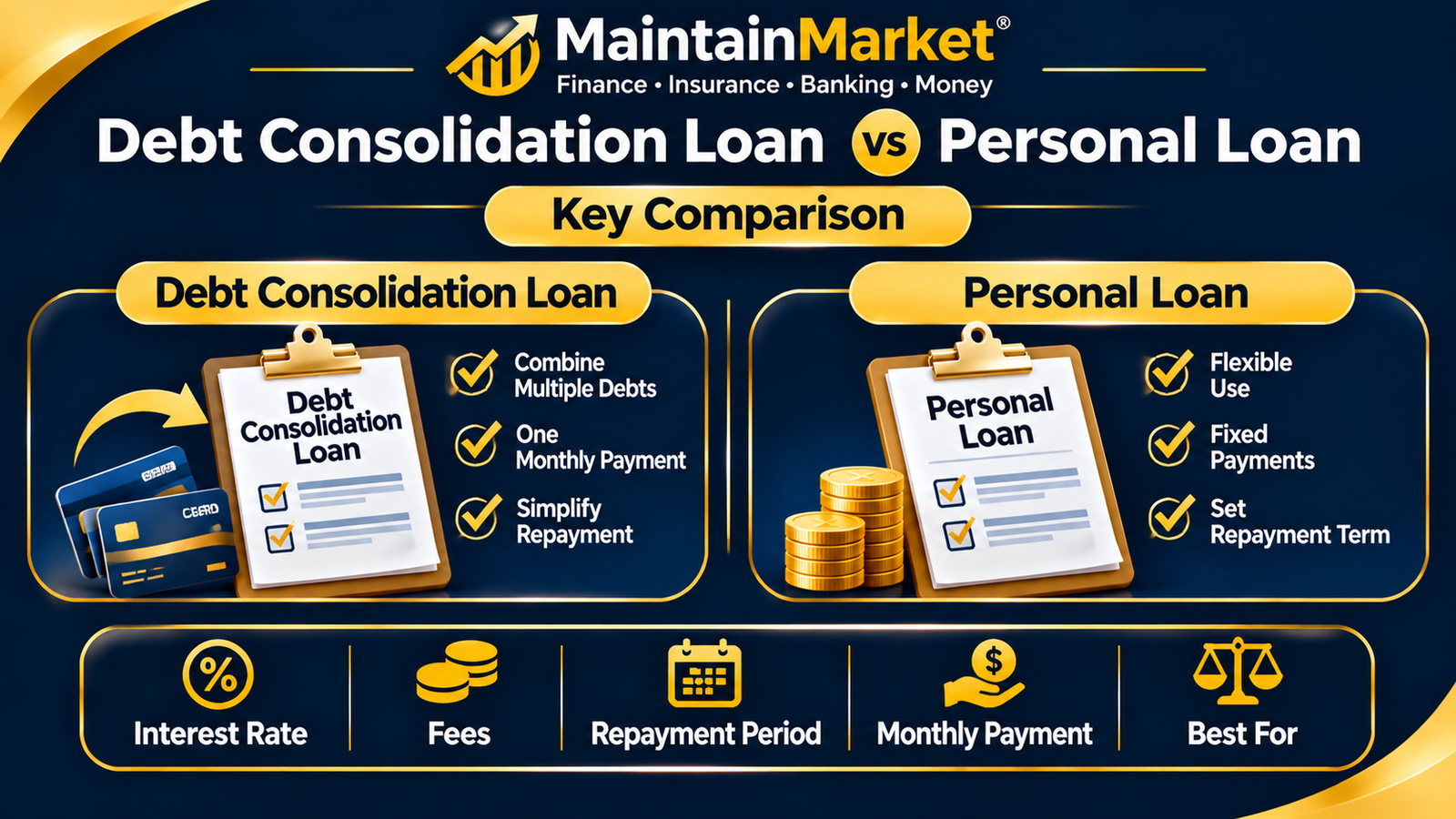
Debt Consolidation Loan vs. Personal Loan: Key Differences
The two options often overlap. A debt consolidation loan is generally a personal loan with a debt-repayment purpose.
| Comparison | Debt Consolidation Loan | Personal Loan |
|---|---|---|
| Main purpose | Combine existing debts | Various eligible expenses |
| Loan structure | Usually installment loan | Usually installment loan |
| Interest rate | Fixed or variable, depending on product | Fixed or variable, depending on product |
| Monthly payments | Usually one payment | Usually one payment |
| Repayment period | Set by lender | Set by lender |
| Fund usage | Intended for paying existing debts | Depends on lender restrictions |
| Direct creditor payment | May be available | Depends on lender |
| Fees | May include origination fees | May include origination fees |
| Collateral | Often unsecured, but not always | Secured or unsecured |
Important: The name of the loan does not guarantee a lower interest rate or better terms. Compare the actual loan agreement.
Which Loan Has a Lower Interest Rate?
Neither loan type automatically offers a lower interest rate.
Your APR may depend on:
- Credit score and credit history
- Income and employment information
- Debt-to-income ratio
- Loan amount
- Repayment period
- Lender underwriting policies
For example, one lender might offer a competitive rate on a debt consolidation product, while another might offer a better rate through its standard personal loan.
Compare the APR rather than relying on the product name or advertised starting rate.
Example: Comparing Two Loan Offers
Suppose you need to borrow $10,000 to repay existing high-interest debt.
You receive two hypothetical offers:
| Details | Offer A | Offer B |
|---|---|---|
| Loan amount | $10,000 | $10,000 |
| APR | 12% | 15% |
| Repayment term | 36 months | 36 months |
| Monthly payment | About $332 | About $347 |
| Total repayment | About $11,957 | About $12,479 |
In this example, Offer A costs approximately $522 less over the repayment period.
These are illustrative figures, not actual lender quotes. They assume fixed APRs, monthly payments, and no additional fees.
The important lesson is that the loan with the lower overall borrowing cost is generally more attractive, provided you can comfortably afford the payments.
When Should You Choose a Debt Consolidation Loan?
A debt consolidation loan may be worth considering if:
- You have multiple high-interest credit card balances.
- You are struggling to manage different payment dates.
- You qualify for a lower APR than your existing debts.
- You want a structured repayment schedule.
- The total cost, including fees, is lower than your current repayment strategy.
Before accepting an offer, calculate whether the interest savings outweigh any origination fees and other charges.
When Should You Choose a Regular Personal Loan?
A regular personal loan may be more suitable if:
- You need funds for an eligible expense beyond debt repayment.
- You want flexibility in how you use the proceeds.
- You have found a competitive offer from a lender.
- You want to consolidate debt but the lender does not market a separate consolidation product.
You can also use an eligible personal loan to consolidate debt. Just confirm the lender’s permitted uses before applying.
What Should You Check Before Applying?
Before signing a loan agreement, compare these six factors:
1. Annual Percentage Rate (APR)
APR helps you compare the annual borrowing cost, including certain fees. Look beyond the advertised interest rate.
2. Origination Fees
Some lenders charge an upfront origination fee. Find out whether it is deducted from your loan proceeds or added to the amount you owe.
3. Monthly Payment
Make sure the payment fits your budget without affecting essential expenses.
4. Total Repayment Amount
A longer loan term may reduce monthly payments but increase the total interest you pay.
5. Prepayment Penalties
Check whether the lender charges a fee for paying off the loan early.
6. Direct Creditor Payments
If you’re consolidating debt, check whether the lender pays your creditors directly or deposits the funds into your bank account.
Does Debt Consolidation Affect Your Credit Score?
Debt consolidation can affect your credit score in different ways.
When you apply for a loan, a hard credit inquiry may temporarily affect your score. Opening a new loan can also change your credit profile.
However, paying down revolving credit card balances may reduce your credit utilization. Consistent on-time payments on the new loan can also support a healthier credit history over time.
Results are not guaranteed. Missing payments, taking on additional debt, or continuing to carry high balances may create further financial problems.
Common Mistakes to Avoid
Before choosing a loan, avoid these mistakes:
- Choosing the lowest monthly payment: A longer repayment term can increase total interest.
- Ignoring fees: Origination and other charges can reduce potential savings.
- Applying without comparing offers: Different lenders may provide significantly different terms.
- Continuing to accumulate debt: Paying off credit cards with a new loan does not solve overspending.
- Ignoring loan restrictions: Some lenders limit which debts or expenses qualify.
- Trusting guaranteed approval claims: Legitimate lenders evaluate applications and cannot guarantee approval without reviewing eligibility.
Be cautious of companies promising guaranteed debt elimination or demanding suspicious upfront payments. Review the Federal Trade Commission’s guidance on avoiding debt relief scams.
Frequently Asked Questions
Is a debt consolidation loan the same as a personal loan?
Usually, a debt consolidation loan is a type of personal loan used to combine multiple existing debts into one payment. Some lenders market it as a separate product, but the underlying loan structure can be very similar.
Can I use a personal loan to consolidate credit card debt?
Yes. Many lenders allow eligible personal loan proceeds to pay off credit card balances. Check the lender’s terms and whether it offers direct creditor payments.
Is a debt consolidation loan better than a personal loan?
Neither is automatically better. A debt consolidation loan is generally a personal loan used for a specific purpose. Compare APR, fees, repayment period, and total cost before choosing.
Does a debt consolidation loan require collateral?
Many debt consolidation loans are unsecured, but secured options also exist. Always check whether the lender requires collateral and what could happen if you fail to repay.
Will a personal loan lower my credit card interest?
It may, if you qualify for a personal loan with a lower APR than your existing credit card rates. Include fees and the full repayment period when calculating potential savings.
Can I consolidate multiple types of debt?
Some lenders allow borrowers to consolidate eligible credit cards, personal loans, and other debts. However, eligibility and restrictions vary. Confirm which balances qualify before applying.
Can I get a debt consolidation loan with bad credit?
Possibly, but approval is not guaranteed. Borrowers with weaker credit profiles may face higher APRs, lower loan amounts, or stricter terms. Compare offers carefully and avoid loans that make your financial situation worse.
Should I close my credit cards after consolidating debt?
Not necessarily. Closing accounts may affect your available credit and credit utilization. Consider your spending habits, account fees, and credit profile before deciding.
Final Verdict: Which Loan Should You Choose?
For many borrowers, a debt consolidation loan and a personal loan are essentially the same type of borrowing arrangement. The difference is primarily the intended use of the funds.
If your goal is to combine multiple debts, compare personal loans specifically designed for debt consolidation with other eligible personal loan offers.
Choose the option that provides an affordable monthly payment, a competitive APR, reasonable fees, and the lowest practical total repayment cost.
Remember: Consolidating debt only changes how you repay what you owe. Building a sustainable budget and avoiding additional unnecessary borrowing are equally important.
Disclaimer: This article is for educational purposes only and does not constitute financial, legal, or tax advice. Loan availability, eligibility, interest rates, and fees vary by lender and borrower.
Sources and Further Reading
- Consumer Financial Protection Bureau – What to Know About Consolidating Credit Card Debt
- Federal Trade Commission – How to Get Out of Debt
- Federal Trade Commission – How to Avoid Debt Relief Scams
- Consumer Financial Protection Bureau