
If you’re struggling with high-interest credit card debt, understanding debt consolidation vs. balance transfer can help you choose a more manageable repayment strategy. Both options can simplify debt payments and potentially reduce interest costs, but they work differently.
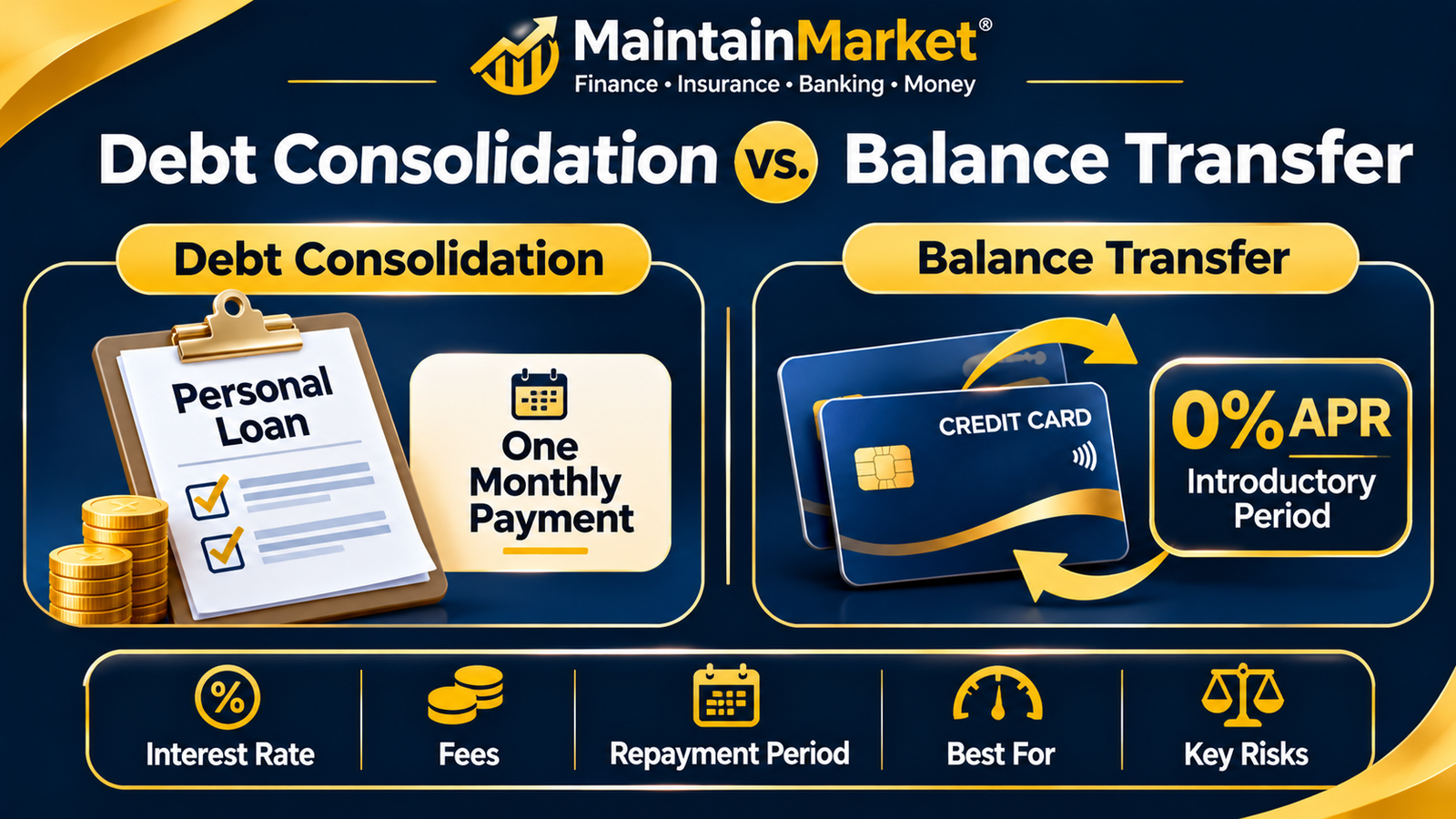
A debt consolidation loan combines multiple debts into one installment loan, usually with a fixed repayment schedule. A balance transfer moves eligible credit card debt to another credit card, often with a temporary low or 0% introductory APR.
The short answer: A balance transfer may be a better choice if you qualify for a favorable promotional offer and can repay the transferred balance before the introductory period ends. A debt consolidation loan may be more suitable if you need a longer repayment period, have multiple types of unsecured debt, or prefer predictable monthly payments.
Neither option eliminates debt. Your decision should depend on the interest rate, fees, repayment period, credit profile, and how much you can realistically afford to pay each month.
Quick Answer: Debt Consolidation vs. Balance Transfer
| Comparison | Debt consolidation loan | Balance transfer credit card |
|---|---|---|
| How it works | Combines debts into one installment loan | Moves eligible balances to another credit card |
| Interest rate | Usually fixed for a fixed-rate personal loan | May offer temporary 0% or low introductory APR |
| Fees | May include an origination fee | May include a balance transfer fee |
| Monthly payments | Usually fixed | Depends on the balance, APR and card terms |
| Repayment period | Set loan term | Promotional period followed by the regular APR |
| Best suited for | Larger or multiple types of eligible debts | Credit card debt that can be repaid during the promotional period |
| Credit requirements | Vary by lender | Favorable promotional offers may require stronger credit |
| Main risk | Paying more over a longer loan term | Remaining balance may accrue interest after the promotion ends |
Important: A lower monthly payment does not necessarily mean a cheaper debt solution. Compare the total amount you will pay, including interest and fees.
1. What Is Debt Consolidation?
Debt consolidation means combining multiple outstanding debts into a single repayment arrangement.
One common method is taking out a personal loan and using the money to pay off existing debts, such as credit card balances.
Instead of managing several credit card payments with different due dates and interest rates, you make one payment toward the new loan.
How Does a Debt Consolidation Loan Work?
The process generally involves:
- Reviewing your outstanding debts and balances.
- Comparing personal loan offers from banks, credit unions and other lenders.
- Checking the APR, loan term, origination fees and other charges.
- Applying for a loan that meets your needs.
- Using the loan proceeds to pay eligible existing debts.
- Repaying the new loan through scheduled monthly installments.
Some lenders may offer direct payments to creditors. Others deposit the loan proceeds into your bank account, leaving you responsible for paying your existing creditors.
Always confirm that the old accounts have been paid and understand when your new loan payments begin.
Example of Debt Consolidation
Imagine you have three credit card balances:
| Credit card | Outstanding balance |
|---|---|
| Card A | $3,000 |
| Card B | $2,500 |
| Card C | $2,500 |
| Total debt | $8,000 |
You apply for a personal loan and receive an offer that allows you to consolidate the $8,000 into one installment loan.
Instead of managing three separate card payments, you now make one loan payment each month.
However, whether this saves money depends on the loan’s APR, origination fee, repayment term and the interest you would otherwise pay on your existing cards.
Advantages of Debt Consolidation Loans
- One scheduled monthly payment instead of several.
- A fixed interest rate may make repayment costs more predictable.
- A defined repayment term provides a target payoff date.
- May accommodate multiple types of eligible unsecured debt.
- Could reduce interest costs if the loan APR and fees are lower than the existing debt costs.
Disadvantages of Debt Consolidation Loans
- Some lenders charge origination fees.
- Approval and interest rates depend on your financial profile.
- A longer repayment term may increase total interest costs.
- A lower monthly payment can create a false sense of savings.
- Paying off credit cards may leave available credit that you could use again, creating additional debt.
Remember: A debt consolidation loan only helps if the repayment terms are manageable and you avoid rebuilding the balances you just paid off.
2. What Is a Balance Transfer?
A balance transfer involves moving an eligible credit card balance from one card to another.
Some credit cards offer a promotional APR, including 0% APR for a limited period, on qualifying balance transfers.
This can help reduce interest costs while you repay existing credit card debt.
How Does a Balance Transfer Work?
A typical balance transfer process looks like this:
- Compare credit cards that offer introductory balance transfer APRs.
- Check the promotional period and transfer fee.
- Apply for a suitable card.
- If approved, request a transfer of eligible balances.
- Continue making payments on your existing accounts until the transfer is completed.
- Repay the transferred balance according to the new card’s terms.
Do not assume the transfer happens immediately. Continue making required payments to your existing creditors until you confirm that the balances have been transferred and credited correctly.
Example of a Balance Transfer
Suppose you have $8,000 in credit card debt and qualify for a balance transfer offer with:
- Promotional APR: 0%
- Promotional period: 15 months
- Balance transfer fee: 3%
Your transfer fee would be:
$8,000 × 3% = $240
Your new balance would be:
$8,000 + $240 = $8,240
To repay the entire balance within 15 months, you would need to pay approximately:
$8,240 ÷ 15 = $549.33 per month
<text color=”secondary” size=”xs”>This is an illustrative calculation assuming the fee is added to the balance, the transfer qualifies for the promotional APR, and no additional purchases, fees or missed payments occur.</text>
If you can afford the required payments, a balance transfer could help you avoid interest on the transferred balance during the promotional period.
However, any remaining balance after the promotion ends may be subject to the regular APR.
Advantages of Balance Transfer Cards
- May offer a temporary 0% introductory APR.
- Can reduce interest costs during the promotional period.
- May simplify multiple credit card payments into one.
- Can help you focus more of your payment on the principal during the promotional period.
- May help manage credit card debt without taking out a personal loan.
Disadvantages of Balance Transfer Cards
- A balance transfer fee may apply.
- Promotional APRs are temporary.
- Approval is not guaranteed.
- Your approved credit limit may be insufficient to transfer all your debt.
- The regular APR may be considerably higher after the promotion.
- New purchases may have different interest terms.
- Missing payments can create additional costs or affect promotional terms, depending on the agreement.
Before applying, read the card agreement carefully. Check whether the introductory APR applies to balance transfers, purchases, or both.
3. Debt Consolidation vs. Balance Transfer: What Are the Biggest Differences?
Both options can help manage debt, but their repayment structures and costs are different.
Difference 1: Interest Rates
A balance transfer card may offer a temporary 0% introductory APR on qualifying transferred balances.
A debt consolidation personal loan generally charges interest throughout the repayment term, although its rate may be lower than the rates on your existing credit cards.
A 0% promotional offer can be attractive, but only if you can repay the balance before the offer expires.
Difference 2: Fees
Both options can involve upfront costs.
Balance transfer costs may include:
- A percentage-based balance transfer fee.
- A minimum transfer fee, where applicable.
- Interest after the promotional period ends.
Debt consolidation loan costs may include:
- Origination fees.
- Late payment fees.
- Other charges disclosed in the loan agreement.
Compare the total cost rather than focusing only on the advertised interest rate.
Difference 3: Repayment Period
A personal loan generally has a defined repayment term, such as a set number of monthly installments.
A balance transfer card has a promotional APR period, after which the regular APR generally applies to the remaining balance.
This difference matters if you need more time to repay your debt.
Difference 4: Types of Debt You Can Combine
A debt consolidation loan may be used for different eligible unsecured debts, depending on the lender and loan terms.
A balance transfer card is primarily designed for moving eligible credit card balances. Some issuers permit other types of transfers, but restrictions vary.
Check the issuer’s terms before assuming a particular debt can be transferred.
Difference 5: Monthly Payments
Personal loans generally have fixed scheduled payments.
Credit card minimum payments vary according to the outstanding balance and the card agreement.
With a balance transfer, paying only the minimum may leave a substantial amount unpaid when the promotional period ends.
Difference 6: Credit Requirements
Both options involve credit and financial eligibility assessments.
Some promotional balance transfer cards require good or excellent credit, although issuer requirements differ.
Personal loan lenders also assess credit history, income, existing debt and ability to repay. Some may offer prequalification tools that use a soft inquiry.
Neither option guarantees approval or a particular interest rate.
4. Which Is Better: Debt Consolidation or Balance Transfer?
The right option depends on your debt amount, credit profile, repayment capacity and available offers.
| Your situation | Option to consider |
|---|---|
| You can repay eligible card debt during a 0% promotional period | Balance transfer |
| You need a fixed monthly payment | Debt consolidation loan |
| You have several types of unsecured debt | Debt consolidation loan |
| You qualify for a favorable 0% balance transfer offer | Balance transfer |
| Your debt will take longer to repay than the promotional period allows | Debt consolidation loan |
| You want a defined loan payoff date | Debt consolidation loan |
| You cannot qualify for a suitable balance transfer card | Compare personal loan offers and other repayment options |
When Should You Choose a Balance Transfer?
A balance transfer may make sense if:
- Most of your debt is on credit cards.
- You qualify for a competitive introductory APR.
- The balance transfer fee is lower than the interest you expect to save.
- Your approved transfer limit is sufficient.
- You can repay the transferred balance within the promotional period.
- You can avoid adding new credit card debt.
When Should You Choose a Debt Consolidation Loan?
A debt consolidation loan may be worth considering if:
- You have multiple types of unsecured debt.
- You need more time than a promotional balance transfer period provides.
- You qualify for a loan with a lower total borrowing cost.
- You prefer predictable monthly installments.
- You want a clear repayment schedule.
- You can manage the new loan payment without taking on additional debt.
Neither option is suitable for everyone. If you are struggling to make even the minimum payments, consider speaking with a reputable nonprofit credit counselor before taking on another financial product.
5. How Much Can You Save With Debt Consolidation or a Balance Transfer?
Your potential savings depend on the interest rate, balance transfer fee, loan origination fee, repayment period and how quickly you repay the debt.
Let’s look at an illustrative comparison.
Suppose you have $8,000 in credit card debt.
Option A: Balance Transfer
Assume:
- Transferred balance: $8,000
- Promotional APR: 0%
- Promotional period: 15 months
- Transfer fee: 3%
| Item | Amount |
|---|---|
| Original balance | $8,000 |
| Transfer fee | $240 |
| New balance | $8,240 |
| Approximate monthly payment to clear in 15 months | $549.33 |
| Interest during qualifying 0% period | $0 |
This example assumes the balance is transferred successfully and repaid within the promotional period.
Option B: Debt Consolidation Loan
Now suppose a lender offers an illustrative personal loan with:
- Loan amount: $8,000
- Fixed APR: 12%
- Repayment term: 36 months
- No origination fee
The estimated monthly payment would be approximately $266.
The total of 36 monthly payments would be approximately $9,565, including about $1,565 in interest.
<text color=”secondary” size=”xs”>This is a hypothetical amortizing-loan calculation, not a current lender quote. Actual APRs, fees, payment dates and loan terms vary.</text>
What Does This Comparison Tell You?
| Factor | Balance transfer | Personal loan |
|---|---|---|
| Starting debt | $8,000 | $8,000 |
| Illustrative fee | $240 | $0 |
| Interest rate | 0% during promotion | 12% fixed |
| Repayment period | 15 months | 36 months |
| Approximate monthly payment | $549 | $266 |
| Approximate total repayment | $8,240 | $9,565 |
In this example, the balance transfer costs less because the balance is cleared during the promotional period.
However, the monthly payment is much higher.
If you cannot afford approximately $549 per month, the balance transfer may not be practical. The loan offers a lower scheduled payment but costs more overall in this illustration.
The lesson: Choose the option you can realistically repay, and compare total costs rather than just monthly payments.
6. What Happens If You Cannot Pay Off a Balance Transfer Before the Promotional Period Ends?
This is one of the most important things to understand before applying.
When the introductory APR expires, the remaining balance is generally subject to the card’s regular APR.
For example:
- Original transferred balance and fee: $8,240
- Amount repaid during the promotional period: $6,000
- Remaining balance: $2,240
The remaining $2,240 may begin accruing interest at the applicable regular APR.
This can make the balance transfer less attractive if you have not planned your repayment schedule.
Before applying:
- Check the exact promotional end date.
- Review the regular APR after the promotion.
- Calculate the monthly payment required to clear the balance.
- Avoid unnecessary new purchases.
- Set up payment reminders or automatic payments.
Do not assume every 0% APR offer has the same conditions. Read the card’s promotional terms.
7. Does Debt Consolidation or a Balance Transfer Hurt Your Credit Score?
Both options can affect your credit profile, but the impact depends on how you use them and the details of your accounts.
Credit Score Effects of a Debt Consolidation Loan
Applying for a personal loan may result in a hard inquiry.
If approved, the new loan can affect your credit profile in several ways:
- Your credit mix may change.
- Your total debt may remain similar initially.
- Paying off revolving card balances may reduce reported credit utilization.
- Opening a new account may affect the average age of accounts and other scoring factors.
- Making on-time loan payments may contribute to positive payment history.
Credit Score Effects of a Balance Transfer
Applying for a new balance transfer card may result in a hard inquiry.
The new account can also affect your credit utilization.
For example, transferring a large balance to a card with a low credit limit could leave that card with high utilization.
If you move a $5,000 balance to a new card with a $6,000 limit, the card’s utilization would be approximately 83.3%, assuming the transfer fee does not increase the balance.
The overall impact depends on your total credit limits, reported balances, credit history and scoring model.
Important: Neither strategy guarantees an increase in your credit score.
8. Common Mistakes to Avoid
Mistake 1: Choosing the Lowest Monthly Payment
A lower monthly payment may result from a longer repayment term.
Always compare the total amount you will pay, including interest and fees.
Mistake 2: Ignoring Balance Transfer Fees
A 0% introductory APR does not necessarily mean a free balance transfer.
Calculate the transfer fee before deciding.
Mistake 3: Continuing to Use Paid-Off Credit Cards
If you consolidate credit card debt but continue spending on the old cards, you may end up with both a loan and new card balances.
Mistake 4: Missing Payments
Late payments can create additional fees and damage your credit history. Understand the payment requirements of the new account.
Mistake 5: Ignoring the Regular APR
A balance transfer offer may look attractive initially, but the regular APR matters if you still have debt when the promotional period ends.
Mistake 6: Choosing a Loan Without Comparing Origination Fees
A loan with a lower advertised APR may still be expensive if it includes a substantial origination fee.
Mistake 7: Consolidating Without Addressing Spending Habits
If your expenses consistently exceed your income, moving debt from one account to another will not solve the underlying problem.
Build a realistic budget and identify why the debt accumulated.
9. Alternatives to Debt Consolidation and Balance Transfers
If neither option fits your financial situation, consider these alternatives.
Debt Management Plan
A nonprofit credit counseling agency may help you create a debt management plan.
Depending on your circumstances and the creditors involved, the plan may help organize payments and potentially negotiate concessions.
Understand any fees and account restrictions before enrolling.
Debt Snowball Method
The debt snowball method focuses on paying off the smallest debt first while maintaining required payments on other debts.
After clearing the smallest balance, you redirect that payment toward the next debt.
This approach can provide a sense of progress, although it may not minimize interest costs.
Debt Avalanche Method
The debt avalanche method prioritizes the debt with the highest interest rate.
You make required payments on other debts and direct additional available money toward the highest-rate balance.
This approach can reduce total interest costs compared with prioritizing balances solely by size, assuming other terms remain comparable.
Contact Your Creditors
You can contact your existing creditors and ask whether they offer hardship programs, lower interest rates, or alternative payment arrangements.
Get any agreed changes in writing and understand how they may affect your account.
Nonprofit Credit Counseling
If your debt has become difficult to manage, a reputable nonprofit credit counseling organization may help you review your budget and repayment options.
You can learn more through the National Foundation for Credit Counseling.
10. A Practical Checklist Before Choosing
Before taking out a consolidation loan or applying for a balance transfer card, answer these questions:
- How much total debt do I owe?
- What APR am I currently paying on each balance?
- Can I qualify for a balance transfer offer?
- What is the transfer fee?
- How long is the introductory APR period?
- What regular APR applies afterward?
- What APR and origination fee does the personal loan offer?
- What is the total repayment amount under each option?
- Can I comfortably afford the monthly payment?
- Am I likely to avoid accumulating new debt?
- Have I compared alternatives such as a debt management plan?
If you cannot answer these questions, take time to compare the offers before committing.
Frequently Asked Questions
1. Is debt consolidation better than a balance transfer?
Neither is automatically better. A balance transfer may cost less if you qualify for a favorable promotional APR and repay the balance before the offer expires. A debt consolidation loan may suit borrowers who need a longer repayment period or want fixed monthly payments.
2. Is a balance transfer the same as debt consolidation?
Not exactly. A balance transfer moves eligible credit card debt to another credit card. Debt consolidation combines multiple debts into one repayment arrangement, commonly through a personal loan. Both can simplify debt repayment.
3. Does a balance transfer save money?
It can save money if the interest avoided is greater than the transfer fee and other applicable costs. Your savings also depend on how quickly you repay the balance and the regular APR after the promotional period.
4. What credit score do I need for a balance transfer card?
There is no universal credit score requirement. Promotional balance transfer cards may require good or excellent credit, but eligibility differs by issuer and card. Income, existing debt, payment history and other application information may also matter.
5. Can I transfer multiple credit card balances to one card?
Some balance transfer cards allow eligible balances from multiple credit cards to be transferred, subject to the available credit limit and issuer restrictions. Check whether the card accepts transfers from your existing issuers.
6. Does debt consolidation hurt your credit score?
Applying for a personal loan may result in a hard inquiry, and opening a new account can affect your credit profile. Paying off credit card balances may reduce revolving utilization. The overall effect depends on your circumstances and the scoring model.
7. What happens if I cannot pay off my balance transfer before the 0% APR ends?
The remaining balance generally becomes subject to the regular APR under the card agreement. Interest may then accumulate on the unpaid amount. Check the promotional terms and plan payments before transferring the debt.
8. Can I get a debt consolidation loan with bad credit?
Some lenders consider applicants with less-than-perfect credit, but approval and interest rates vary. You may receive a higher APR, lower loan amount, or less favorable terms. Compare the total cost before accepting an offer.
9. Is a debt consolidation loan cheaper than credit card interest?
It may be cheaper if the loan’s APR and fees are lower than the costs of your existing credit card balances. Compare the total repayment amount and loan term rather than looking only at the advertised rate.
10. Can I use a balance transfer to pay off a personal loan?
Some issuers permit certain non-card balance transfers, while others restrict transfers to eligible credit card balances. Check the card’s terms before applying.
11. Should I close my credit cards after consolidating debt?
Not necessarily. Closing an account can reduce available credit and potentially increase your overall credit utilization. However, keeping a card open is not always appropriate if it has high fees or encourages additional spending. Consider your circumstances before deciding.
12. Can debt consolidation eliminate my debt?
No. Debt consolidation changes how you repay your debt; it does not erase the amount owed. You remain responsible for repaying the new loan or transferred balance.
Final Verdict: Debt Consolidation vs. Balance Transfer
Choosing between debt consolidation and a balance transfer comes down to how much you owe, how quickly you can repay it, and which offer has the lowest realistic total cost.
A balance transfer may be worth considering if you have eligible credit card debt, qualify for a favorable introductory APR, and can clear the balance during the promotional period.
A debt consolidation loan may be a better fit if you need a longer repayment schedule, have multiple types of unsecured debt, or want a predictable monthly payment.
Before choosing either option, compare interest rates, fees, repayment periods, and total costs. Most importantly, address the spending or budgeting issues that contributed to the debt in the first place.
The best debt repayment strategy is not simply the one with the lowest advertised rate. It is the one you can afford to complete without accumulating more debt.
Disclaimer: This article is for general educational purposes for U.S. consumers and is not individualized financial advice. Loan eligibility, APRs, origination fees, balance transfer fees, promotional periods, and repayment terms vary by lender, card issuer, and applicant. Review all agreements and disclosures before making a financial decision.
References
- Consumer Financial Protection Bureau – What Do I Need to Know About Consolidating My Credit Card Debt?
- Consumer Financial Protection Bureau – Credit Card Consumer Resources
- Consumer Financial Protection Bureau – Consumer Credit Card Market Report
- Federal Trade Commission – Credit and Loans
- National Foundation for Credit Counseling
Editorial Review: Reviewed for U.S. consumer relevance, debt consolidation terminology, balance transfer mechanics, promotional APR considerations, fees, and responsible repayment guidance.