

Waiting for your 2026 tax refund? Discover the real reasons your IRS refund is delayed and proven steps to get your money faster. In this article, let’s talk about why your tax refund is delayed.
You filed your taxes.
You checked the status.
And now… nothing.
Days turn into weeks. Weeks turn into frustration.
Meanwhile, you’re thinking:
“Did I do something wrong?”
“Is my refund stuck forever?”
“Why is everyone else getting theirs faster?”
Here’s the truth most people don’t realize:
Tax refund delays are rarely random. There’s always a reason — and once you understand it, you can actually fix or speed things up.
Let’s break it down properly.





Quick Answer
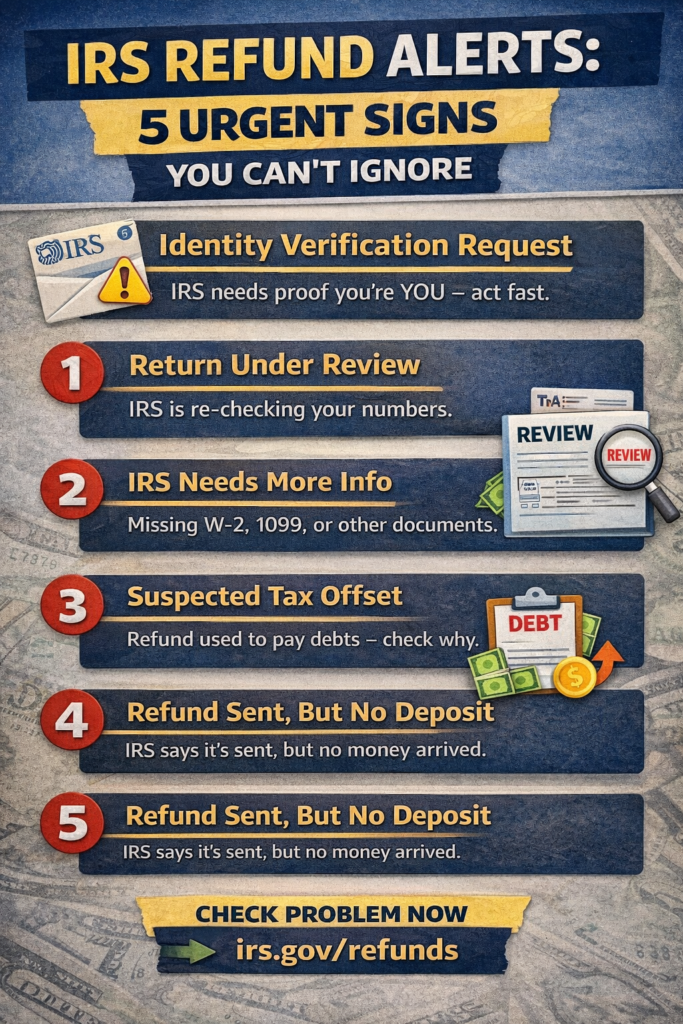
If your tax refund is delayed in 2026, it’s usually due to:
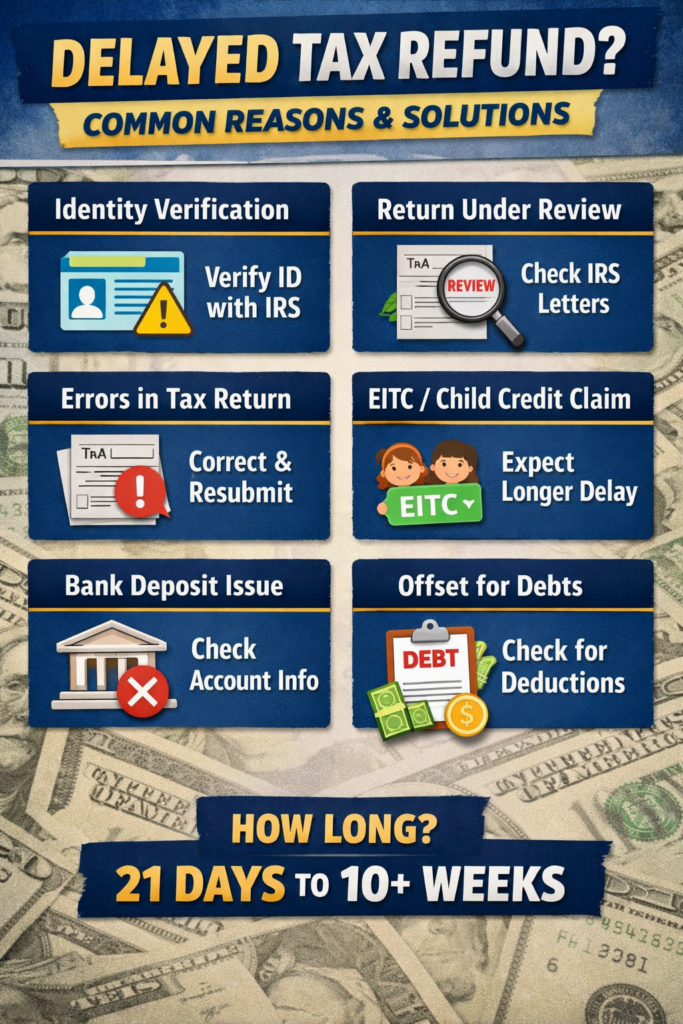
- IRS verification checks (identity or income mismatch)
- Errors in your tax return
- Claiming credits like EITC or Child Tax Credit
- Bank or direct deposit issues
- Manual review by IRS
Most refunds take 21 days, but delays can extend to 6–10 weeks or more depending on the issue.
Why This Problem Happens (Real Reasons, Not Textbook)
Let’s get real — IRS doesn’t delay refunds for no reason.
1. IRS Is Double-Checking Your Data
In 2026, fraud detection is stricter than ever.
If something looks even slightly off:
- Income mismatch
- Different employer data
- Sudden income jump
Your return gets flagged.
2. You Claimed Refund Credits
If you claimed:
- Earned Income Tax Credit (EITC)
- Child Tax Credit
Your refund is automatically delayed due to federal law.
Even if everything is correct.
3. Small Mistakes = Big Delays
One wrong number can trigger:
- Manual review
- Reprocessing
- Recalculation
And yes — this alone can delay your refund by weeks.
4. Identity Verification Triggered
This is the most annoying one.
IRS might send you a letter asking:
“Verify your identity.”
Until you respond:
Your refund is frozen.
5. Your Return Is Under Manual Review
This is where things slow down badly.
No timeline.
No updates.
Just waiting.
Step-by-Step: How to Fix It (Real Solutions)
Now let’s stop guessing and fix this.
Step 1: Check Your Refund Status Properly
Use IRS “Where’s My Refund” tool.
Look for:
- “Still Processing” → Normal delay
- “Being Reviewed” → Problem detected
- “Approved” but not received → Payment issue
Step 2: Verify If You Got Any IRS Letter
Check your mail carefully.
Common letters:
- Identity verification request
- Additional info request
Ignoring this = infinite delay
Step 3: Double-Check Your Tax Return
Look for:
- Wrong SSN
- Incorrect bank details
- Missing forms (W-2, 1099)
Step 4: Contact IRS (If Needed)
If it’s been:
- More than 21 days (e-filed)
- More than 6 weeks (paper filed)
Call IRS.
Yes, it’s painful — but sometimes necessary.
Step 5: Track Bank Issues
If status shows “Sent” but no money:
- Check with your bank
- Confirm account details
Insider Insight: How IRS Actually Thinks
Here’s something most blogs won’t tell you:
IRS has one priority — risk reduction, not speed.
If your profile looks:
- Low-risk → fast refund
- Medium-risk → delay
- High-risk → investigation
Triggers include:
- First-time filer
- Large refund amount
- Multiple credits claimed
- Self-employment income
Points to Keep in Your Mind:-
1. IRS System Backlog (Not Your Fault)
Sometimes the issue isn’t you — it’s the IRS.
In peak season (Feb–April):
- Millions of returns hit the system
- Processing slows down automatically
Reality:
Even perfect returns can get delayed due to volume.
2. Amended Return (Form 1040-X)
If you corrected your return:
- IRS processes it separately
- No standard timeline
Expected delay:
8–16 weeks (sometimes more)
3. Refund Offset (Hidden Debt Deduction)
This is something most people don’t expect.
IRS can reduce your refund for:
- Student loan defaults
- Child support
- State taxes
You won’t get full money — and it may delay processing.
4. Bank Rejected Your Deposit
If your bank details were:
- Incorrect
- Closed account
- Mismatched name
Your refund gets:
→ Rejected
→ Sent back to IRS
→ Reprocessed
This adds 2–4 weeks delay
5. Filing Too Early (Before IRS Systems Sync)
If you filed extremely early:
- IRS may not have your employer data yet
- Your return gets flagged
Result: Review + delay
6. Multiple Income Sources (Gig Economy Issue)
If you have:
- Freelance income
- Side hustle
- Multiple 1099s
IRS cross-checks everything.
More data = more chances of mismatch.
7. First-Time Filing in the US
If you’re a new filer:
- No history = higher scrutiny
- Identity verification more likely
This is very common for:
- Students
- Immigrants
- New earners
8. Large Refund Amount Trigger
If your refund is unusually high:
IRS thinks:
“Why is this person getting so much back?”
This triggers:
- Additional review
- Delay
9. Tax Software Glitches or Submission Errors
Even platforms like:
- TurboTax
- H&R Block
Can sometimes:
- Submit incomplete data
- Miss attachments
You won’t know — IRS will catch it.
10. Use IRS Transcript Tool
Check your tax transcript.
Why?
It shows:
- What IRS received
- What’s missing
- Where the mismatch is
This gives you real clarity instead of guessing.
11. Request a Refund Trace
If your refund shows “sent” but you didn’t receive it:
Ask IRS for a refund trace.
This helps track:
- Where the money went
- Whether it was returned
12. File Form 3911 (Hidden Power Move)
Most people don’t know this.
Form 3911 helps when:
- Refund is lost
- Payment failed
- No update for weeks
This can actually push your case forward.
13. Contact Taxpayer Advocate Service (Secret Weapon)
If your delay is extreme:
Use Taxpayer Advocate Service (TAS)
They:
- Work inside IRS
- Help resolve stuck cases
This is especially useful for:
- Financial hardship situations
14. Why Some People Always Get Refunds Faster
It’s not luck.
People who get fast refunds usually:
- File early but not too early
- Use e-file
- Avoid tax credits errors
- Have consistent income
IRS trusts predictable profiles.
15. Why Waiting Without Action Makes It Worse
Most people do this mistake:
They wait… and wait… and wait…
Meanwhile:
- IRS is waiting for YOU to respond
- Your case is stuck silently
Sometimes delay = your inaction
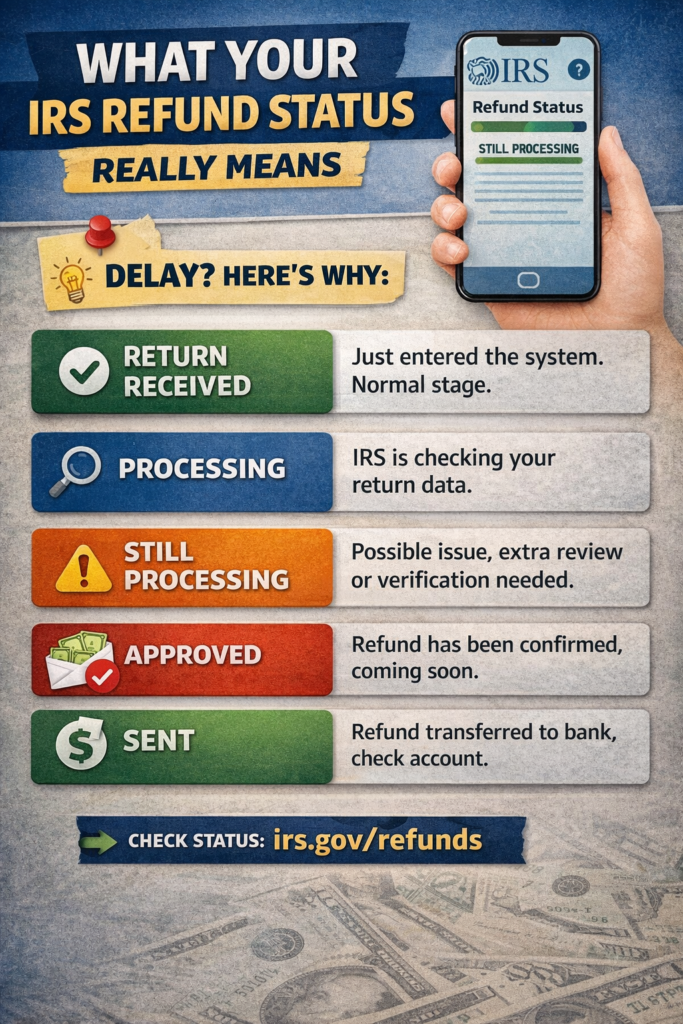
What Your Refund Status REALLY Means
Break this clearly in your article:
- “Return Received” → Just entered system
- “Processing” → Under review
- “Still Processing” → Possible issue
- “Approved” → Money coming
- “Sent” → Check bank
This improves:
- Time on page
- User clarity
- Featured snippet chances
Tools That Can Help You Avoid This Problem Next Year
You can recommend:
- Tax filing software
- Audit protection tools
- Credit monitoring tools
Position it like:
“Most delays happen due to small mistakes — the right tool can prevent this completely.”
Real Case Study (USA)
Case: John (Texas)
- Filed: February 5
- Expected refund: $3,200
- Status: “Still Processing”
Problem:
Income mismatch between W-2 and IRS database.
Action:
Submitted corrected info via IRS request.
Result:
Refund received after 8 weeks
Lesson:
Even small mismatches can freeze your refund.
Comparison Table: Delay Causes vs Solutions
| Problem | What It Means | What You Should Do | Time Impact |
|---|---|---|---|
| Still Processing | Normal backlog | Wait | 21–30 days |
| Under Review | Suspicious data | Check IRS letter | 4–8 weeks |
| Identity Verification | Fraud check | Verify immediately | 2–6 weeks |
| Bank Issue | Payment failed | Contact bank | 1–2 weeks |
| Errors in Return | Mistakes found | Amend return | 4–10 weeks |
Mistakes People Make
- Filing in a hurry without checking details
- Ignoring IRS letters
- Calling IRS too early
- Entering wrong bank details
- Claiming credits without eligibility
MaintainMarket Expert Advice
If your refund is delayed, don’t panic — but don’t stay passive either.
Do this:
- Track your refund every 2–3 days
- Keep documents ready
- Respond to IRS immediately
The faster you act, the faster you get paid.
Why MaintainMarket Is Different
Most websites give you generic IRS timelines.
We don’t.
We break down:
- Real reasons behind delays
- What IRS actually checks
- Exact steps that work in real situations
This is not theory — it’s practical finance.
Action Plan (Do This Now)
- Check your refund status
- Look for IRS notices
- Verify your tax return details
- Wait minimum 21 days before panic
- Contact IRS if needed
- Track your bank
Conclusion
Your refund isn’t “lost.”
It’s either:
- Being processed
- Being checked
- Or waiting on you
Once you understand the reason, the situation becomes controllable.
And that’s the difference between stress and clarity.
FAQs about Why Your Tax Refund Is Delayed
Q1. How long does IRS take in 2026?
The IRS says most refunds are issued in fewer than 21 days when taxpayers file electronically, although some returns take longer because of errors, additional review or other issues. Paper-filed returns generally take 6 weeks or more. Filing electronically and choosing direct deposit remains the fastest option.
Q2. Why is my refund still processing after 3 weeks?
A refund can remain pending after three weeks for several reasons, including errors or missing information, identity verification, additional IRS review, or certain tax-credit claims. The IRS recommends using Where’s My Refund? to check your personalized status rather than assuming that a three-week delay means something is wrong.
Q3. Can I speed up my refund?
You generally cannot ask the IRS to speed up a refund that is already being processed. However, filing electronically, choosing direct deposit and submitting a complete and accurate return can help avoid unnecessary delays. If the IRS requests additional information or identity verification, responding promptly can help move the process forward.
Q4. What if IRS says refund sent but I didn’t get it?
First, check your bank account or financial institution and confirm the account information you provided. If the IRS shows that your refund was issued but you still haven’t received it, you may be able to request a refund trace. The IRS provides different trace procedures depending on your filing situation and the type of refund.
Q5. Does claiming tax credits delay refund?
Some tax credits can delay your refund. In particular, the IRS is legally required to hold refunds that include the Earned Income Tax Credit (EITC) or Additional Child Tax Credit (ACTC) until at least mid-February. This applies to the entire refund, not just the portion associated with the credit. For eligible early filers in 2026, the IRS said most EITC/ACTC refunds were expected by March 2 when the return was filed electronically, direct deposit was selected and there were no other issues.
Q6. Should I call IRS?
Usually, you should check Where’s My Refund? first. The IRS says representatives generally cannot provide additional refund-status information until enough processing time has passed or the online tool directs you to contact the IRS. For most e-filed returns, that means waiting at least 21 days; paper returns generally require more time.
Q7. What is IRS identity verification?
IRS identity verification is a security process used to confirm that the person filing the tax return is actually the taxpayer and help prevent identity theft and refund fraud. If the IRS needs you to verify your identity or provide additional information, it will generally send instructions explaining what you need to do. Completing the verification process may be necessary before the IRS can continue processing your refund.
Q8. Can wrong bank details delay refund?
Yes. Incorrect or missing bank-account information can prevent a direct deposit from reaching you on time. The IRS specifically identifies missing bank-account information as one possible reason for a refund delay. If a refund has already been issued and there is a problem receiving it, check your refund status and follow the IRS instructions for resolving the issue.
People also searched for: Best Financial Tools in the USA That Actually Save You Money and Help You Earn More (2026 Guide)
Also Read: Loan Denied After Pre-Approval? Real Reasons & Fix – Solutions To Know (USA 2026)
Read: Not Enough Retirement Savings at 40? Real Plan to Catch Up Fast in the USA
3 thoughts on “5 Reasons Why Your Tax Refund Is Delayed in 2026 (IRS) — And How to Get It Faster”