
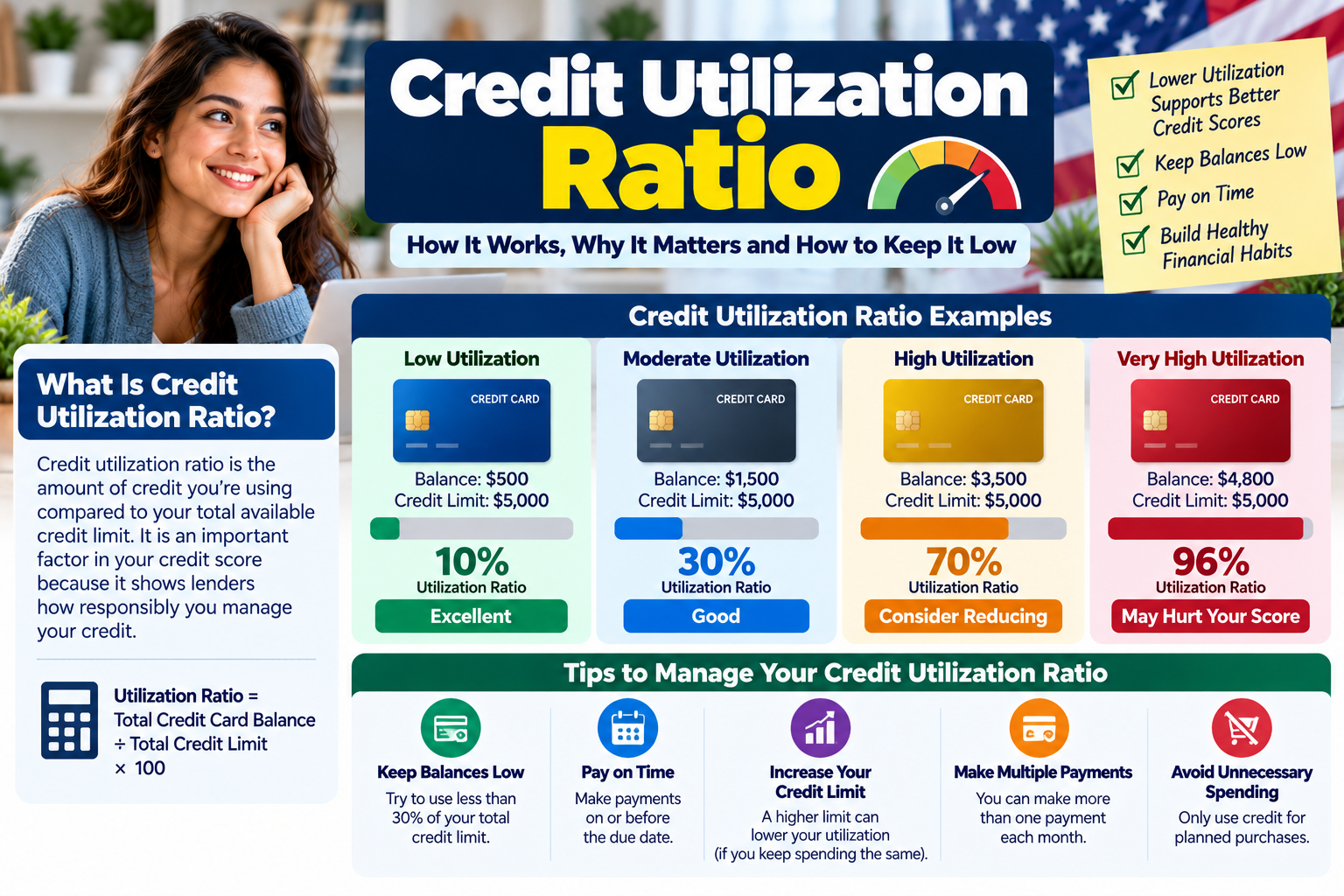
Your credit utilization ratio is an important factor that can influence your credit score in the United States. It measures how much of your available revolving credit you are using. If your credit cards are close to their limits, your score may be affected even when you make payments on time.
The good news is that credit utilization is often easier to change than factors such as the length of your credit history. By understanding the calculation, managing your reported balances, and avoiding unnecessary debt, you can take practical steps toward healthier credit.
Quick Answer: What Is a Credit Utilization Ratio?
A credit utilization ratio is the percentage of your available revolving credit that you are using. It is commonly calculated by comparing your credit card balances with their credit limits.
For example, if your credit card has a $5,000 limit and a $1,000 reported balance, your credit utilization ratio is 20%.
A lower ratio is generally better for credit scores. Keeping utilization below 30% is a common guideline, while a ratio below 10% may be beneficial for some scoring profiles. However, neither percentage guarantees a particular credit score.
Quick formula:
Credit utilization ratio = (Credit card balance ÷ Credit limit) × 100
How to Calculate Your Credit Utilization Ratio
You can calculate utilization for an individual credit card or across multiple credit cards.
1. Calculate utilization for one credit card
Suppose your card has:
- Credit limit: $4,000
- Reported balance: $800
Calculation:
$800 ÷ $4,000 × 100 = 20%
Your credit utilization ratio is 20%.
2. Calculate your overall credit utilization
When calculating overall credit card utilization, add the reported balances across the relevant cards and divide them by the combined credit limits.
Consider this example:
| Credit card | Credit limit | Reported balance |
|---|---|---|
| Card A | $5,000 | $1,000 |
| Card B | $3,000 | $600 |
| Card C | $2,000 | $400 |
| Total | $10,000 | $2,000 |
Your overall utilization is:
$2,000 ÷ $10,000 × 100 = 20%
Although each card has a different limit, your combined credit utilization ratio is 20%.
Remember that credit scoring models can consider both overall utilization and utilization on individual accounts. A high balance on one card may matter even if your overall ratio is relatively low.
What Is a Good Credit Utilization Ratio?
There is no single utilization percentage that guarantees an excellent credit score. However, keeping your balances low relative to your available limits is a sensible goal.
| Credit utilization | General interpretation |
|---|---|
| 0% | No reported revolving balance; this is not inherently bad |
| 1%–9% | Low utilization that may be favorable for many scoring profiles |
| 10%–29% | Below the commonly cited 30% guideline |
| 30%–49% | Higher utilization that may put pressure on credit scores |
| 50%–74% | High utilization relative to available credit |
| 75%–99% | Very high utilization and close to the credit limit |
| 100% or more | At or above the available limit, potentially due to fees or other account activity |
These are practical ranges, not official score bands. Different scoring models and credit profiles can respond differently.
Is 30% credit utilization good?
Staying below 30% is a useful general guideline, but it should not be treated as a guaranteed safe threshold. Lower utilization may be more favorable, depending on the scoring model and the rest of your credit profile.
For example, someone with a $10,000 total credit limit would generally want to keep the reported balance below $3,000 to stay under 30%. A balance below $1,000 would put utilization under 10%.
You do not need to carry debt or pay interest to build good credit.
How Does Credit Utilization Affect Your Credit Score?
Credit utilization is part of the information credit scoring models use to assess how you manage revolving debt.
For example, FICO includes amounts owed as a major scoring category, and the amount of available revolving credit you use is one component of that category. High utilization can indicate that you are relying heavily on available credit.
Your utilization ratio can affect your credit score in several ways.
Overall credit utilization
Scoring models may evaluate the combined balances and credit limits across relevant revolving accounts. A high total balance relative to your total available credit can hurt your score.
Individual credit card utilization
Your utilization on each card can also matter. One card near its limit may be a concern even if your other cards have little or no balance.
Reported balances
Your credit report may show a balance that differs from what you currently owe. Card issuers generally report account information periodically, often around the billing cycle.
That means you could pay your statement in full and still have a balance reported if the issuer reported the account before your payment was reflected.
Changes over time
Many commonly used credit scoring models place substantial emphasis on recently reported utilization. As a result, lowering balances may improve your score after updated information reaches the credit bureaus. The size and timing of any change are not guaranteed.
Other scoring models may consider utilization trends over time.
9 Smart Ways to Improve Your Credit Utilization Ratio
1. Pay Down Your Credit Card Balances
Reducing your outstanding balances is one of the most direct ways to lower your utilization ratio.
Suppose your total credit limit is $8,000 and your reported balances total $3,200. Your utilization is 40%.
If you reduce the balances to $1,600, your utilization falls to 20%.
If you are carrying debt, focus on a repayment plan you can sustain. Continue making at least the required minimum payments on every account.
2. Make Payments Before the Statement Closing Date When Appropriate
Your payment due date and statement closing date are different.
The due date is when the issuer requires your payment to avoid being late. The statement closing date is when the billing cycle ends.
Because issuers commonly report balances around the billing cycle, paying down a balance before the statement closes may reduce the amount reported to the credit bureaus.
However, reporting schedules vary. Check your issuer’s policies, and never miss the payment due date while trying to optimize utilization.
3. Keep Your Credit Card Balances Low
Try not to use a large portion of your available limit for routine spending.
For example, if your credit limit is $2,000, a $1,400 balance represents 70% utilization. Reducing the reported balance to $200 would bring utilization to 10%.
A low balance is generally easier to manage, but you should not spend unnecessarily just to demonstrate credit activity.
4. Avoid Maxing Out One Credit Card
Even when your overall utilization is low, a single card with a very high utilization ratio may affect your credit score.
For example, suppose you have two cards with a combined limit of $10,000 and a total balance of $1,500. Your overall utilization is 15%.
If most of that $1,500 is concentrated on a card with a $1,000 limit, that card is at or above its limit even though your overall utilization looks reasonable.
If possible, reduce the balance on the heavily used card rather than focusing exclusively on your combined percentage.
5. Consider a Credit Limit Increase Carefully
A higher credit limit can reduce utilization if your balance stays the same.
For example:
| Situation | Balance | Credit limit | Utilization |
|---|---|---|---|
| Before an increase | $1,500 | $5,000 | 30% |
| After an increase | $1,500 | $7,500 | 20% |
However, a credit limit increase is not guaranteed. The issuer may review your income, account history, and credit profile. Some requests may involve a hard inquiry.
Do not request a higher limit if it is likely to encourage additional spending you cannot afford.
6. Avoid Closing Credit Cards Without Considering the Impact
Closing a card can reduce your total available credit, potentially increasing your overall utilization if your balances remain unchanged.
For example, if you owe $2,000 across cards with a combined $10,000 limit, your utilization is 20%. If you close a card with a $5,000 limit and the remaining limits total $5,000, your utilization could rise to 40%.
There may still be good reasons to close an account, such as an unaffordable annual fee or difficulty controlling spending. Consider the full trade-off rather than keeping every account open automatically.
7. Limit New Spending While Paying Off Debt
If you keep adding new purchases while trying to reduce your balances, your utilization may stay high.
Create a realistic budget and prioritize essential expenses. If possible, use money already available in your budget for purchases instead of relying on revolving credit.
Avoid treating a lower utilization ratio as permission to spend more.
8. Be Careful Before Opening Another Credit Card
A new card may increase your available credit limit, which could reduce your overall utilization. However, opening an account can also lead to a hard inquiry and affect other parts of your credit profile.
Do not open a new card solely to lower your utilization without considering fees, eligibility, spending habits, and long-term costs.
9. Monitor Your Credit Reports
Review your credit reports to understand which balances and limits are being reported.
Look for:
- Incorrect credit limits.
- Balances that have not updated as expected.
- Accounts you do not recognize.
- Duplicate or inaccurate account information.
- Payments incorrectly reported as late.
You can obtain free credit reports through the federally authorized website, AnnualCreditReport.com. If you find an error, follow the relevant credit bureau’s dispute process and contact the lender where appropriate.
How Much Should You Pay to Reach a Target Utilization?
You can estimate the balance needed to reach a particular utilization percentage.
Formula:
Target balance = Total credit limit × Target utilization percentage
Suppose your combined credit limit is $12,000 and your current reported balance is $4,200.
| Target utilization | Target balance | Approximate reduction needed |
|---|---|---|
| 30% | $3,600 | $600 |
| 20% | $2,400 | $1,800 |
| 10% | $1,200 | $3,000 |
| 5% | $600 | $3,600 |
These calculations assume the credit limit remains unchanged and exclude new purchases, interest, and fees.
You do not have to reach the lowest possible percentage immediately. Choose a repayment target that fits your budget and protects your ability to make other essential payments.
Credit Utilization Ratio vs. Debt-to-Income Ratio
These terms are often confused, but they measure different things.
| Feature | Credit utilization ratio | Debt-to-income ratio |
|---|---|---|
| What it measures | Revolving balances relative to credit limits | Monthly debt payments relative to gross monthly income |
| Common use | Credit scoring and credit risk assessment | Often used in mortgage and lending decisions |
| Main calculation | Relevant revolving balances ÷ relevant credit limits | Monthly debt payments ÷ gross monthly income |
| How to lower it | Reduce revolving balances or increase available limits where appropriate | Reduce monthly debt obligations or increase income |
For example, someone can have low credit utilization but a high debt-to-income ratio because of large mortgage or auto loan payments. Conversely, someone may have a low debt-to-income ratio but high credit utilization.
Both can matter when you apply for credit, but they should not be used interchangeably.
Common Credit Utilization Mistakes to Avoid
Assuming 30% is a guaranteed cutoff
Thirty percent is a guideline, not a universal threshold that guarantees a good score. Lower utilization may be more favorable.
Paying interest to build credit
You do not need to carry a balance or pay interest to build a credit history. Paying your statement balance in full by the due date can help you avoid interest on eligible purchases when your account has a grace period.
Ignoring individual card balances
Your overall utilization can look low while one card is nearly maxed out. Monitor both individual and overall ratios.
Confusing the statement balance with the current balance
Your credit report may show the last balance the issuer reported, rather than your account balance today. Check reporting dates before assuming that the information is incorrect.
Applying for unnecessary credit
Opening new cards may increase available credit, but applications can have downsides. Focus first on reducing balances and managing existing accounts responsibly.
Expecting an exact score increase
There is no reliable universal formula that predicts how many points your score will increase after lowering utilization. The result depends on the scoring model and your complete credit profile.
Frequently Asked Questions About Credit Utilization Ratio
1. What is the ideal credit utilization ratio?
There is no single ideal percentage for everyone. Lower utilization is generally favorable, and keeping it below 30% is a common guideline. A ratio below 10% may be beneficial for some credit profiles, but it does not guarantee a specific score.
2. Is 0% credit utilization bad?
No. A 0% reported utilization ratio is not inherently bad, and you do not need to carry a balance to build good credit. Depending on the scoring model and the rest of your credit profile, a small reported balance may sometimes score differently from zero utilization. Never pay interest simply to create a balance.
3. How quickly can credit utilization improve my score?
Some scoring models respond to updated utilization information relatively quickly, often after the credit bureaus receive new account data. The timing depends on when your issuer reports the balance and when your score is calculated. Any score change is individual and cannot be guaranteed.
4. Does credit utilization include all my loans?
No. Credit utilization generally concerns revolving credit accounts, such as credit cards and certain lines of credit. Mortgages, auto loans, and most personal installment loans are not calculated using the same balance-to-credit-limit formula. However, installment debt can affect your credit score in other ways.
5. Should I pay my credit card before the statement closes?
Paying before the statement closes may reduce the balance reported to the credit bureaus, depending on your issuer’s reporting practices. But you should always pay at least the required amount by the due date. If possible, paying the statement balance in full by the due date can also help you avoid interest on eligible purchases.
6. Can a credit limit increase lower my utilization ratio?
Yes, if your balance stays the same and the issuer increases your limit. For example, a $1,000 balance on a $5,000 limit is 20% utilization. If the limit rises to $10,000, the same balance represents 10%. The increase is not guaranteed, and you should avoid spending more just because your limit has increased.
7. Does credit utilization reset every month?
Reported balances and utilization can change as issuers update account information. Many widely used scoring models place substantial weight on the most recently reported utilization, but newer models may consider trends over time. Your credit report may not update immediately after a payment.
8. Can high credit utilization hurt my chances of getting a loan?
It can. High utilization may negatively affect credit scores, and lenders may consider those scores when reviewing applications. Approval also depends on other factors, including income, payment history, existing debt, and the lender’s criteria.
9. Can I improve credit utilization without paying off all my debt?
You can reduce utilization by paying down some balances or, in some circumstances, increasing available credit. However, a credit limit increase is not guaranteed, and opening new accounts may have other consequences. Paying down high-interest debt remains useful because it can reduce interest costs as well as utilization.
Why Maintain Market Is Different
Maintain Market focuses on practical financial explanations that help readers understand the numbers behind credit decisions.
Rather than suggesting that one utilization percentage guarantees a particular score, we explain how to calculate the ratio, compare individual cards with overall utilization, understand reporting timing, and choose realistic repayment targets.
Credit scoring models differ, and the same action can affect people differently. Our goal is to help readers make informed decisions using transparent calculations and reliable sources.
References
- CFPB — How to Get and Keep a Good Credit Score
- CFPB — Does Paying Off My Credit Card Every Month Improve My Credit Score?
- CFPB — Understand Your Credit Score
- FICO — Amounts Owed and Credit Utilization
- Experian — How to Calculate Credit Card Utilization
- AnnualCreditReport.com — Official Free Credit Reports
Editorial Review
This article is intended for general educational purposes for consumers in the United States. Credit scoring models can differ, and no utilization percentage guarantees a specific score or loan approval. Readers should review their credit reports and consult their lenders or relevant credit bureaus when account information appears incorrect.